- General Videos
- Music
- Economics
- Health
- Travel & Events
- History
- Psychology
- Spirituality
- Movies
- News & Politics
- Kmtyw Combat Sciences
- Ɔbenfo Ọbádélé Kambon Videos
- Ɔbenfoɔ Kamau Kambon: Black Liberation Philosophy
- Science, Tech, Engineering and Math
- Permaculture
- Self-Sustainability
- Living Off Grid
- Yoruba Language Learning
- Education
- Mmɔfra Adesua
- Nana Kamau Kambon Playlist
- Livestream
- Komplementarity Kouples and Revolutionary Singles
- Abibitumi Film Series
- Decade of Our Repatriation
- Kwento xpr
- Live
Permaculture


Instead of neat rows of monoculture, forest gardens combine fruit and nut trees, shrubs, herbs, vines and perennial vegetables together in one seemingly wild setting. This type of agroforestry mimics natural ecosystems and uses the space available in a sustainable way. UK-based Martin Crawford is one of the pioneers of forest gardening. Starting out with a flat field in 1994, his land has been transformed into a woodland and serves as an educational resource for others interested in forest gardening. This short film by Thomas Regnault focuses on Crawford's forest garden, which is abundant, diverse, edible, and might be one answer to the future of food systems.
➡ Subscribe: http://bit.ly/NatGeoSubscribe
➡ Get More Short Film Showcase: http://bit.ly/ShortFilmShowcase
#NationalGeographic #ForestGarden #ShortFilmShowcase
About Short Film Showcase:
The Short Film Showcase spotlights exceptional short videos created by filmmakers from around the web and selected by National Geographic editors. We look for work that affirms National Geographic's belief in the power of science, exploration, and storytelling to change the world. The filmmakers created the content presented, and the opinions expressed are their own, not those of National Geographic Partners.
See more from National Geographic's Short Film Showcase at http://documentary.com
Get More National Geographic:
Official Site: http://bit.ly/NatGeoOfficialSite
Facebook: http://bit.ly/FBNatGeo
Twitter: http://bit.ly/NatGeoTwitter
Instagram: http://bit.ly/NatGeoInsta
Follow Thomas Regnault
https://www.thomasregnault.com
https://www.instagram.com/dewtownmayor/
About National Geographic:
National Geographic is the world's premium destination for science, exploration, and adventure. Through their world-class scientists, photographers, journalists, and filmmakers, Nat Geo gets you closer to the stories that matter and past the edge of what's possible.
A Forest Garden With 500 Edible Plants Could Lead to a Sustainable Future | Short Film Showcase
https://youtu.be/Q_m_0UPOzuI
National Geographic
https://www.youtube.com/natgeo


[English below]
Songhaï est avant tout motivé par le bonheur ! Le désir de bonheur est l'impulsion pour un développement socio-économique durable. Il n'y a pas de bonheur dans l'insuffisance alimentaire, l'actuel exode rural africain et la fuite des cerveaux, une économie dépendante des importations, la dégradation de l'environnement, la perte d'espoir pour l'avenir chez les jeunes, l'agriculture de subsistance et la dévaluation de l'opportunité qui vient avec une croissance démographique excessive.
Le père Godfrey Nzamujo, est un prêtre dominicain, titulaire d'un doctorat en électronique, microbiologie et sciences du développement. Le père Nzamujo s'est associé à un groupe d'Africains et d'amis de l'Afrique qui partagent la vision de rendre à l'Afrique sa dignité, trop longtemps bafouée.
En 1982-1983, les médias ont fourni de nombreuses images de la famine africaine et de la grave sécheresse qui ont frappé l'Éthiopie en particulier. Ces images ont dépeint l'Afrique comme un continent ravagé par des guerres sanglantes, la famine, les crises et la pauvreté - un continent où l'espoir n'était pas permis. Le père Nzamujo, qui était alors professeur d'université aux États-Unis, a débarqué en Afrique avec la ferme conviction de changer les choses. "Au début, personne n'y croyait, ni mon ordre religieux, ni ma famille et mes amis. Mais j'étais convaincu que demain serait différent, parce que Dieu allait nous aider et que l'injustice pouvait être repoussée. ("Songhai When Africa stands up", p.28).
Quatre ans après sa création, Songhai a commencé à former de jeunes entrepreneurs agricoles. La formation de longue durée a commencé à Porto-Novo en 1989. Le Centre a étendu sa mission à tout le Bénin et à la sous-région occidentale de l'Afrique.
http://songhai.org/
_______________________________________________________________
[English]
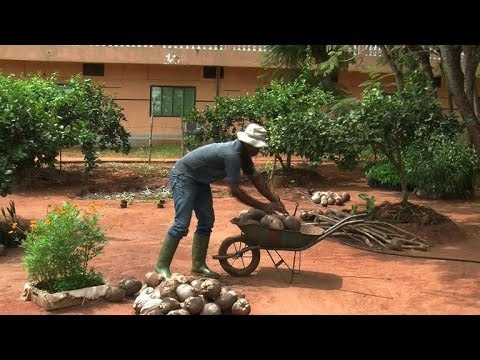
Songhai is motivated primarily by happiness! The desire for happiness is the impetus for sustainable socio-economic development. There is no happiness in food insufficiency, the current African rural exodus and brain drain, an import-dependent economy, environmental degradation, loss of hope for the future among young people, subsistence agriculture, and devaluation of the opportunity that comes with excessive population growth.
Father Godfrey Nzamujo, is a Dominican priest with doctorate degrees in electronics, microbiology, and development science. Father Nzamujo joined forces with a group of Africans and friends of Africa who shared the vision of giving back to Africa its dignity, which has been scorned for far too long.
During 1982-1983, the media provided abundant images of African famine and severe drought, which struck Ethiopia in particular. These images portrayed Africa as a continent ravaged by bloody wars, famine, crisis, and poverty -- a continent where hope was not permitted. Father Nzamujo, who was then a university professor in the United States, landed in Africa with the firm conviction to change things. "At first, nobody believed it, neither my religious order, nor my family and friends. But I was convinced that tomorrow would be different, because God was going to help us and that injustice could be pushed away. (“Songhai When Africa stands up”, p.28).
Four years after its creation, Songhai began to train young agricultural entrepreneurs. Long duration training began in Porto-Novo in 1989. The Centre expanded its mission throughout Benin and western sub-region of Africa.
http://songhai.org/


A Creative Force For Good Has Arrived.
Producing & Publishing
The Videos Are Both
Educational & Beneficial.
To Find Out More & Other Subjects!! Go To:
http://videoscene.weebly.com
We Thank You! For Looking In.