- General Videos
- Music
- Economics
- Health
- Travel & Events
- History
- Psychology
- Spirituality
- Movies
- News & Politics
- Kmtyw Combat Sciences
- Ɔbenfo Ọbádélé Kambon Videos
- Ɔbenfoɔ Kamau Kambon: Black Liberation Philosophy
- Science, Tech, Engineering and Math
- Permaculture
- Self-Sustainability
- Living Off Grid
- Yoruba Language Learning
- Education
- Mmɔfra Adesua
- Nana Kamau Kambon Playlist
- Livestream
- Komplementarity Kouples and Revolutionary Singles
- Abibitumi Film Series
- Decade of Our Repatriation
- Kwento xpr
- Live
General Videos


![Somalia: The Forgotten Story | Al Jazeera World [2016]](https://i.ytimg.com/vi/-io_RfLBpgc/hqdefault.jpg)

Somalia's modern history is a tale of independence, prosperity and democracy in the 1960s, military dictatorship in the 1970s and 1980s - followed by a desperate decline into civil war and chaos almost ever since.
The effect of the war has been to scatter the Somali people in their millions to refugee camps and neighbouring countries - and in their hundreds of thousands to the UK, Canada and the United States.
Somalia gained independence from Britain and Italy in 1960. It held free and fair elections and was ruled democratically from 1960 to 1969.
Once labelled the "Switzerland of Africa", Somalia enjoyed almost a decade of democracy. The first elected president of Somalia, uniting the former British and Italian territories, was Adam Abdullah Osman who reigned for seven years. He was succeeded, freely and peacefully, by Abdirashid Ali Sharmarke.
Sharmarke, however, was assassinated by one of his own bodyguards in 1969.
Speaker of the Somali Parliament Mukhtar Mohamed Hussein took over, but his brief, six-day tenure was cut short by a military coup led by General Siad Barre, ending Somalia's period of democratic government.
Whatever its faults - and there were many - Barre's 22-year rule effectively created modern Somalia, building one of Africa's strongest armies and massively improving the literacy of the population.
Yet Barre, who gained the support of the US and the Soviet Union, the superpowers of the day, also dissolved parliament, suspended the constitution, banned political parties, arrested politicians and curbed press freedom.
"From then, there was a downward trend. In everything. A disintegration. And every time things were going down, the military regime was becoming more brutal and more dictatorial," says Jama Mohamed Ghalib, a former Somali government minister.
But when Barre launched the Ogaden war in 1977 to take the Somali majority region from Ethiopia, it provoked serious international opposition, including that of the Soviet Union which had once supported Barre but now sided with Ethiopia. The Somali army was forced to withdraw.
But the other long-lasting outcome was civil war, with myriad competing factions and frequent intervention by foreign powers and neighbouring countries.
In 2006, the Islamic Courts Union split into several factions, one of which was Al Shabab. The radical group still controls large parts of the south of the country today.
- Subscribe to our channel: http://aje.io/AJSubscribe
- Follow us on Twitter: https://twitter.com/AJEnglish
- Find us on Facebook: https://www.facebook.com/aljazeera
- Check our website: http://www.aljazeera.com/
#AlJazeera #SomalianHistory #AlJazeeraWorld


It's being called a game changer - and the start of a new era. Germany has promised to begin returning the artefacts known as the Benin Bronzes to Nigeria next year, making it the first country to do so.
Germany has a collection of just over 1,000 Benin Bronzes. They're on display in museums in Cologne, Dresden, Hamburg, Leipzig, and Stuttgart. The sculptures and metal plaques are from the ancient Kingdom of Benin - which is today known as Edo State in southern Nigeria. The Bronzes were looted by British soldiers in 1897 and sold to museums in North America and Europe. The largest collection of the Bronzes is held by the British Museum.
Nigeria has been trying to get the bronzes back for decades. Without success. But momentum has been building over the last few years... with calls growing ever louder for artefacts seized during the colonial era to be returned to their places of origin. Germany's culture minister explained why Berlin had decided to act now. She said:
''We are confronting our historic and moral responsibility. We want to contribute to a common understanding and reconciliation with the descendants of the people who were robbed of their cultural treasures during the times of colonialism.''
It's not just the Benin Bronzes from Nigeria that are wanted by their rightful owners. There is also a claim from Cameroon from where a special artefact known as the Tangay was stolen from a local King. More than a century later it is still in Germany. But not everyone in Cameroon is of the view that it should be brought back to the country.
In Douala, Cameroon Prince Kum'a Ndumbe III has been advocating for the return of the Tangue, a sculpture stolen from his grandfather in 1884. Prince Ndumbe has made a copy of the Tangue and put it on show in Cameroon.
The original artifact - looted by the Germans during colonial times - is on display at a museum in Munich.
But not everyone agrees that the Tangue should be immediately returned. Princess Marilyn Douala Bell is an artist and founder of an art center in Douala. Even though her great-grandfather was executed in 1914 for resisting German rule, Marilyn thinks Cameroon is not ready to receive the artefact.
Others in Douala also claim to be the rightful owners of the Tangue. At least one more descendant of a Douala King has made a claim on the artifact. For Marilyn this is a source of concern. She wants the tangue to be returned but fears the conditions are currently not right.
Subscribe: https://www.youtube.com/user/d....eutschewelleenglish?
For more news go to: http://www.dw.com/en/
Follow DW on social media:
►Facebook: https://www.facebook.com/deutschewellenews/
►Twitter: https://twitter.com/dwnews
►Instagram: https://www.instagram.com/dwnews
Für Videos in deutscher Sprache besuchen Sie: https://www.youtube.com/dwdeutsch
#BeninBronzes #Nigeria #LootedArtefacts
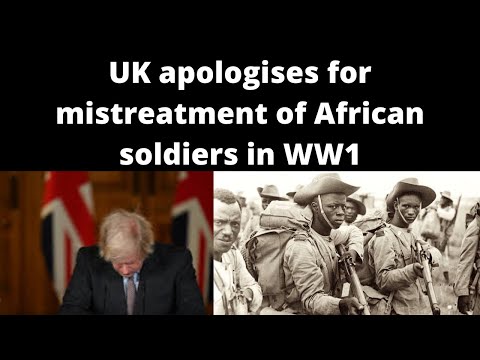


In a conversation with Dr. Felicia Mabuza Suttle, Winnie Madikizela-Mandela talks about the challenges her and other women like Albertina Sisulu faced for freedom in South Africa.
Check out Conversations With Felicia at Http://theafricachannel.com
![Go Ape - The Fascinating World of Primates | Free Documentary Nature [2020]](https://i.ytimg.com/vi/V3auPw3Ee3M/hqdefault.jpg)
Go Ape - The Fascinating World of Primates | Wildlife Documentary
Everyone loves a cheeky monkey. Primates are fun and fascinating to watch. But there is a greaterdraw – perhaps because they bring out the inner primate in us. Through Africa, South America and Asia, our wild cousins are far more diverse than you might think. Ever adaptable masters of survival, we enjoy watching their lives, but in doing so, we might learn a little bit about ourselves…Our journey begins in the heart of Africa, where a troop of Eastern Lowland gorillas welcome a new arrival. Everyone in the clan rush to greet the baby, revealing their very human instincts to work together to nurture and protect their family.While gorillas lead through gentle nurturing, they share their forest with a much more aggressivecousin, the chimpanzee. Chimps rule with an iron fist, literally beating their opponents intosubmission. Chimpanzee have another close relative, the bonobo, which looks almost exactly thesame but exhibits very different behavior. Any disruption in a chimpanzee family will lead toviolence, but bonobo’s defuse tension and avoid conflict through sex. Any age or gender can matewith any other, making these the king of the swingers.
▬▬▬▬▬▬▬▬▬
Subscribe Free Documentary - Nature Channel for free: http://bit.ly/2mFDC3QFacebook: https://bit.ly/2QfRxbG
Twitter: https://bit.ly/2QlwRiI
▬▬▬▬▬▬▬▬▬
#FreeDocumentaryNature #Documentary #Apes
▬▬▬▬▬▬▬▬▬
Free Documentary is dedicated to bring high-class documentaries to you on youtube for free. With the latest camera equipment used by well-known filmmakers working for famous production studios. You will see fascinating shots from the deep seas and up in the air, capturing great stories and pictures from everything our beautiful and interesting planet has to offer. Enjoy stories about nature, wildlife, culture, people, history and more to come.
![Namib: Surviving the Sand Sea Documentary [2019]](https://i.ytimg.com/vi/DqbOgx_FCbw/hqdefault.jpg)
![Mali in Crisis: The Fight Between the Dogon and Fulani | Talk to Al Jazeera In The Field [2019]](https://i.ytimg.com/vi/1YCFf_Erdvc/hqdefault.jpg)
Deep in central Mali, what was supposed to be harvest season for villagers has become a season of starvation, death and destruction.Mali's health ministry says so far hundreds of people have died from what it describes as a man-made famine, as farmers and herders fight over land.It is an ancestral conflict that takes place at the height of the dry season between the Dogon, who are traditional farmers and hunters, and the Fulani, the semi-nomadic herders of the Sahel.
The Dogon accuse the Fulani of overstepping on their farmland to feed their animals, while the Fulani accuse the Dogon of killing and stealing their cattle. And now they are killing each other.In one of the worst attacks, 160 Fulani villagers were killed in Ogossagou in March. Mamadou Togo, the chief representative of Mali's Dogon people, tells Al Jazeera the attack was not perpetrated by Dogon hunters. He says the Dogon have not attacked any Fulani villages, despite there being tensions between the two communities.However, he admits that "when other people come and attack the Dogon, they retaliate"."We cannot sit and watch people come and kill us and go back without anything. We said no, this is intolerable," he says. "When you come to kill me and I'm not dead, for instance, if I can I will kill you."
The two sides both accuse the other of being the aggressor.Mahmoud Dicko, a Fulani and a powerful leader of the High Islamic Council, blames the mutual mistrust on outside interference."I am convinced that there are other invisible, obscure forces that are planning to destabilise the entire subregion. And to succeed in this destabilisation, it is necessary to create a war between the different ethnic groups," he says.The violence is not limited to Mali, either. In neighbouring Sahelian countries, Fulanis have been in conflict with other tribes as well. Fuelling this conflict are armed groups - including al-Qaeda and Islamic State affiliates - who are stepping in and taking sides.
Some have been fighting in the war in Libya."This crisis in the centre of Mali started from the occupation of northern Mali by terrorist groups [in 2012]," says Tiebile Drame, the Malian minister of foreign affairs. "The Malian crisis is directly linked to the situation in Libya, to the collapse of Libya in 2011."Since 2013, the United Nations peacekeeping mission MINUSMA has been operating in Mali. There are currently 14,000 UN troops - among them British, Canadian and German soldiers - as well as 4,000 French combat troops and regional G5 Sahel forces in the country.Despite this, the violence is spreading, and spiralling out of control.Insurgent and rebel groups also directly target security forces, launching suicide attacks and car bombings.
MINUSMA is now the deadliest UN peacekeeping mission, with more UN troops dying in Mali than anywhere else, or at any time before. This also adds to the feeling shared by many Malians that the security forces are not a source of protection but a source of danger.Nevertheless, the $1bn a year MINUSMA mission has been renewed for another year, while Mali's government is calling for the creation of a coalition force like the ones seen in Iraq and Afghanistan to intervene in Mali.But the Dogon and Fulani leaders we spoke to are both sceptical about outside actors.
Dogon leader Togo believes France profits from the instability in the country, saying Mali's former colonial master "wants to recolonise again this country because of the wealth underground".Meanwhile, Fulani leader Dicko says the UN mission and international community are failing Mali, spending billions of dollars "for their own comfort"."I say to leave us alone, to leave the Sahelians between us," he says. "We are brothers, we have lived together for millennia. We have a mechanism to settle things between us. If we are left alone, we ourselves will find a solution to this problem."To examine who profits from Mali's state of instability, and how the violence can be brought to an end, Talk to Al Jazeera In The Field meets Dogon and Fulani leaders to try to understand this complex conflict.
Subscribe to our channel: http://aje.io/AJ
Check our website: https://www.aljazeera.com/