- General Videos
- Music
- Economics
- Health
- Travel & Events
- History
- Psychology
- Spirituality
- Movies
- News & Politics
- Kmtyw Combat Sciences
- Ɔbenfo Ọbádélé Kambon Videos
- Ɔbenfoɔ Kamau Kambon: Black Liberation Philosophy
- Science, Tech, Engineering and Math
- Permaculture
- Self-Sustainability
- Living Off Grid
- Yoruba Language Learning
- Education
- Mmɔfra Adesua
- Nana Kamau Kambon Playlist
- Livestream
- Komplementarity Kouples and Revolutionary Singles
- Abibitumi Film Series
- Decade of Our Repatriation
- Kwento xpr
- Live
Top videos

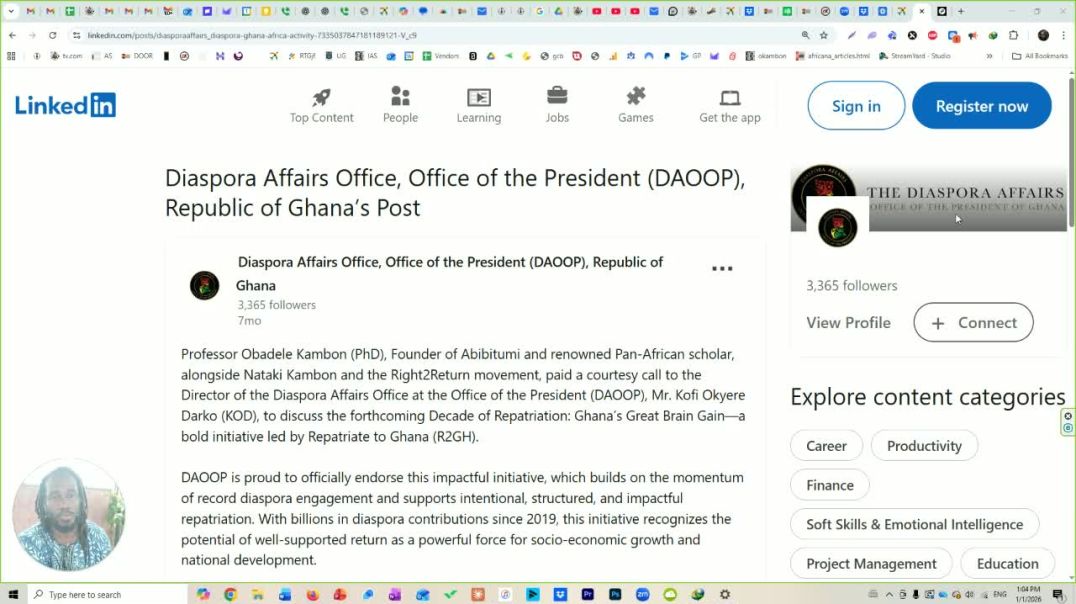

Check the original post here: https://www.linkedin.com/posts..../diasporaaffairs_dia
Greetings Abibitumfoɔ,
I’m inviting you to join the new Decade of Our Repatriation (DOOR) group on Abibitumi. This will be our space to share updates, key resources, announcements, and coordinated steps for those actively moving toward repatriation and those supporting the work.
Join here! https://www.abibitumi.com/grou....ps/decade-of-our-rep
ABIBITUMI! ABIBIFAHODIE!
Ɔbenfo Ọbádélé Bakari Kambon


https://teespring.com/africa2theworld
Donate & Support Me On Go Fund Me:https://www.gofundme.com/f/b74....hu-africa-to-the-wor & Support the Channel on Patreon:https://www.patreon.com/wode_mayaDonate and Support me on Paypal:https://www.paypal.me/aiyawodemaya



https://www.decadeofourrepatriation.comIn this recorded emergency Zoom meeting, organizational leaders across Ghana and the historic diaspora come together to give clear, up-to-date guidance on the Ghana diaspora citizenship process following the January 30 policy announcement, the February 2 suspension, and the February 11 restart.You’ll hear directly from leaders connected to DOOR (Decade of Our Repatriation), RepatriateToGhana, the Rastafari Council of Ghana, the Ghana Caribbean Association, AAA Ghana, Real Repatriation Consultant, Ministry of the Future, and other community partners—sharing what applicants can do right now to move forward, and how we continue advocating for a fair and workable process for our people.What you’ll learn in this videoKey guidance discussed includes:The 3 core pillars being used in vetting (as shared by officials in direct conversations with leadership):Cumulative time in Ghana (1 year or more)Strong ties to Ghana (examples discussed: land/home, business, NGO/community impact, Ghanaian language ability, etc.)Background checks (Ghana + home country)Why vetting before payment matters (to avoid risking fees before qualification)How applicants are being asked to demonstrate time in GhanaPractical notes on police clearance and typical turnaround expectationsWhy community and organization membership matters for support, accurate info-flow, and safetyUpdates on upcoming citizenship timelines/ceremony expectations (as discussed in the meeting)Note: Processes can change quickly. This discussion reflects what was shared and discussed during this live meeting and should not be treated as legal advice.Helpful linksRepatriateToGhana: https://repatriatetoghana.comDOOR (Decade of Our Repatriation): https://decadeofourrepatriation.comAbibitumi: https://abibitumi.comAbibitumi Conference: https://conference.abibitumi.comSankɔfa Journey: https://www.sankofajourney.comChapters0:00 – Greetings from Ghana + why this matters now3:30 – What the old process looked like5:45 – Timeline recap: Jan 30 announcement → Feb 2 pause → Feb 11 restart9:22 – Vetting pillar #1: 1 year cumulative time in Ghana (not necessarily continuous)12:00 – Vetting pillar #2: Strong ties to Ghana (what counts)14:20 – Vetting pillar #3: Background checks (Ghana + home country)15:40 – Fee discussion: 25,000 GHS + clarification on paying after vetting21:10 – Live Q&A: proof of time in Ghana, background checks, FBI/local checks, documents31:47 – Fairness concerns + why legal clarity matters for background checks41:38 – Real applicant walkthrough: what vetting looked like in practice54:22 – Why joining an organization matters (community, safety, support, info access)1:00:08 – Language as “strong ties” + learning options1:07:22 – How to get updates + next meeting plans1:10:24 – Recap: the 3 key pillars again1:16:11 – Dual citizenship considerations (as discussed)1:51:15 – Organization introductions + collaboration moving forward2:09:39 – DOOR overview: vetted resources + on-the-ground support2:14:22 – Closing remarks + next stepsIf this helped you✅ Like the video✅ Subscribe for updates✅ Share with someone preparing for Ghana✅ Comment where you’re tuning in from (and your repatriation timeline)#ghanacitizenship #repatriation #door #repatriatetoghana #diaspora #blackpower #abibitumi #abibifahodiehttps://www.decadeofourrepatriation.com


Note: Per text on video, i disagree with the usage of "Broken English" as that reduces our Black Languages and takes away our agency. It has a eurasian colonialist and racist origin. It's their perspective on how they look down on our languages, and we need to stop using their concepts as that has us self-discriminate. That aside, this is a great song covering the injected oppression of destroying one's melanin through skin lightening cancer creams.
original video info:
Yellow Fever (1976) Fela Kuti
From the LP Yellow Fever (CD release 1997)
http://fela.net/discography/
This video is part of a series of songs being posted on Fela's official YouTube channel (http://www.youtube.com/fela) each featuring, alongside the music, an informative commentary by Afrobeat Historian, Chris May.
The entire catalogue, released on Kntting Factory Records, is available on the Fela website (http://fela.net/), along with documentaries and recorded concerts, CDs and vinyl, tee shirts, posters and many other items.

"2AM in Venezuela" (OFFICIAL VIDEO): https://youtu.be/GtvkwgbVKF8
BLACK WINTER (Full Album): https://youtube.com/playlist?list=PLJSMFuicKjJ46p1K9TlqZPRGFSd0M5z9U&si=4WG_YXCGJinM6XEN
Join the Patreon for exclusive videos that you won't find on Youtube: https://www.patreon.com/NTD1814
S U P P O R T
Cash App - $NelsonAmadeus
PayPal- GlobalHitsWorld@gmail.com
EMAIL - KingNeferkare@gmail.com
Twitter @NTDessalines
Instagram @NelsonAmadeus
TURN ON POST NOTIFICATIONS.