- General Videos
- Music
- Economics
- Health
- Travel & Events
- History
- Psychology
- Spirituality
- Movies
- News & Politics
- Kmtyw Combat Sciences
- Ɔbenfo Ọbádélé Kambon Videos
- Ɔbenfoɔ Kamau Kambon: Black Liberation Philosophy
- Science, Tech, Engineering and Math
- Permaculture
- Self-Sustainability
- Living Off Grid
- Yoruba Language Learning
- Education
- Mmɔfra Adesua
- Nana Kamau Kambon Playlist
- Livestream
- Komplementarity Kouples and Revolutionary Singles
- Abibitumi Film Series
- Decade of Our Repatriation
- Kwento xpr
- Live
Top videos


Hydroponics is the pioneer initiator and leader of hydroponic farming systems in East Africa.
It enables farmers to achieve predictable and highly nutritious yields for vegetables and produce their own animal feed at limited cost of input.
With hydroponics the farmer is unaffected by seasons and adverse weather conditions.
www.farmers.co.ke is the site for authoritative multimedia agricultural and agribusiness content.
Visit us today for farming news, agribusiness tips, practical expert advice and industry updates.
For farming, tips send the word FARMERS to 22071 (no charges)
JOIN FB GROUP: https://www.facebook.com/groups/FarmK...
Follow us on Twitter: https://www.instagram.com/farmkenya254/
Follow us on Twitter: https://twitter.com/FarmKenya254
WATCH KTN FARMERS TV ON BAMBA, PANG, GOTV, STARTIMES AND ALL FREE TO AIR SET-TOP BOXES
#Hydroponics #FarmersTV
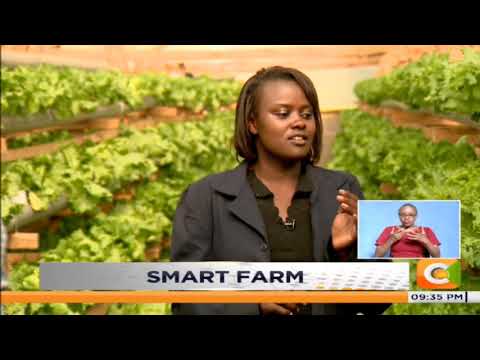
Would you ditch the beauty industry for vegetable farming? Well that is exactly what one lady in Kiambu County did and has never looked back. Hope Wanjiru is one of the young farmers growing crops under the hydroponics system and together with her group, they have managed to secure contracts with large firms supplying them with lettuce and tomatoes every season. Denis Otieno has more on this week’s smart farm.
Citizen TV is Kenya's leading television station commanding an audience reach of over 60% and in its over 12 years of existence as a pioneer brand for the Royal Media Services (RMS), it has set footprints across the country leaving no region uncovered.
This is your ideal channel for the latest and breaking news, top stories, politics, business, sports, lifestyle and entertainment from Kenya and around the world.
Follow us:
http://citizentv.co.ke
https://twitter.com/citizentvkenya
https://www.facebook.com/Citizentvkenya
https://plus.google.com/+CitizenTVKenya
https://instagram.com/citizentvkenya

![The Science of Spying [1965]](https://i.ytimg.com/vi/O41eYMenhlU/hqdefault.jpg)
This film presents an account of Central Intelligence Agency (CIA) activities that had previously been covert, including actions in Iran, Vietnam, Laos, the Congo, Cuba, and Guatemala. The film includes interviews with CIA director Allen Dulles and Dick Bissel.
From archive.org/US National Archives.
####
As described in the book,
Into the Fray: How NBC's Washington Documentary Unit Reinvented the News By Tom Mascaro
https://www.amazon.com/Into-Fr....ay-Washington-Docume
The Science of Spying, marked the arrival of Bob Rogers as a field reporter-producer. The program aired May 4, 1965, and tracked the roots of U.S. covert operations back to the 1950s, providing a stark account of clandestine initiatives in a time before public disclosures, congressional investigations, and Hollywood movies made the 1970s a difficult time to be an American spy. The "Pentagon Papers," the Pike and Church Committees, and thrillers such as Three Days of the Condor eventually revealed the CIA's complicity in assassination plots and interna-tional meddling, which Yates and Rogers had already seen up close. NBC management stood firm when The Science of Spying attracted criti-cism. Ad reps from Batten, Barton, Durstine & Osborn (BBD&O) screened it and advised their client B. F. Goodrich Company to withdraw.31 BBD&O issued a statement saying the program violated the Goodrich advertising policy "in that it treats a controversial public issue in a way which may do harm to the government of the United States?" NBC countered that the documentary "fell within the broad outlines of the program policy origi-nally submitted to and accepted by the B. F. Goodrich agency, BBD&O."33 The CIA watched the program and tracked subsequent reactions in the national press. Viewers wrote to President Johnson complaining NBC News had given America's enemies negative propaganda.34 Yates may have antici-pated some adverse reactions to the program, but he never expected to be frightened by what he discovered. "
#####
Reelblack's mission is to educate, elevate, entertain, enlighten, and empower through Black film. If there is content shared on this platform that you feel infringes on your intellectual property, please email me at Reelblack@mail.com and info@reelblack.com with details and it will be promptly removed.


A study by Thompson Sanders & Alexander concluded that black patients feel more accepted, understood, and perceive the provider to be more culturally sensitive when treated by black therapists. Even though that was an American study, increasingly evidence is showing this to be the case in Brazil as well.
Please Visit our Website to get more information: https://blackbraziltoday.com/
🔔Explore the true narrative of Brazil – Subscribe to Black Brazil Today for insightful discussions on race, culture, and media.🔍
=============================
✅ About Black Brazil Today.
Welcome to Black Brazil Today, a channel that explores black Brazilians' vibrant and diverse experiences✊. Get into our in-depth race, culture, and media discussions, highlighting Brazilian society's significant strides and challenges.
Join us as we dissect racial dynamics, celebrate black Brazilian culture, and amplify voices often unheard. From music and movies to social movements, we bring you the real stories shaping black Brazil's narrative. Subscribe to be part of a community committed to truth, representation, and change. 🎥🌍💬
🔔 Let's Explore the untold stories – Subscribe to Black Brazil Today for the latest on black Brazilians in news, music, and entertainment. 🎵📰
=================================
#blackpsychology #blackpsychologist #blacktherapist #raceinbrazil #blackinbrazil #racisminbrazil #blackbrazilians #afrobrazilians
⚠DISCLAIMER: We do not accept any liability for any loss or damage incurred from you acting or not acting as a result of watching any of our publications. You acknowledge that you use the information we provide at your own risk. Do your research.
Copyright Notice: This video and our YouTube channel contain dialogue, music, and images that are the property of Black Brazil Today. You are authorized to share the video link and channel and embed this video in your website or others as long as a link back to our YouTube channel is provided.
© Black Brazil Today


Let’s reclaim our food sovereignty and transform the industrial food system! African organisations, including the African Centre for Biodiversity, participating in the Autonomous people's response to the UN Food Systems Summit (UNFSS), coordinated this event, as part of the three days of global mobilisation, which took place during the UNFSS pre-summit, from 25 to 28 July 2021.
We Africans reject the UNFSS, as a continuation of the neocolonial development and agrarian extractivist agenda on our continent. The UNFSS paints African food systems as deficient, and in need of more Western saviour technology, productivity and competitive enhancement. Yet this will only serve to further weaken systems already eroded by decades of state neglect and economic subordination.
Strengthening African food systems, and food producers needs to be grounded in human rights, biodiversity and broader socio-ecological wellbeing. This event brings together small-scale food producers, agricultural workers and vulnerable consumers, to launch the African common position and collectively voice our priorities and solutions for the continent’s food systems and ecologies. Together, we can begin to outline a people’s pan-African vision for food system transformation, from the ground up.
Featured:
Moderators: Mariam Mayet, African Centre for Biodiversity (ACB) and
Mateus Santos, La Via Campesina (LVC)
Presentation of the common position:
Introduction to the vision: Mateus Santos
The vision we defend: Mariam Mayet
What we denounce: Elizabeth Mpofu, Zimbabwe Small Holder Organic Farmers' Forum (ZIMSOFF)/ LVC
What we call for (FR): Dieudonné Pakodtogo, Réseau des Organisations Paysannes et de Producteurs de l'Afrique de l'Ouest (ROPPA)
Voices from the Ground:
Youth and women: Nzira Deus, World March of Women
Fisherfolk: Christiana Saiti Louwa, World Forum of Fisher Peoples
Small-scale family farmers / Peasants: David Otieno, Kenyan Peasant League
Urban food insecure: Samuel Ikua, Habitat International Coalition (HIC)
Indigenous people: Ali Aii Shatu, Indigenous Peoples of Africa Co-ordinating Committee
Agricultural workers (FR): Mohamed Hakech, Fédération Nationale Du Secteur Agricole (FNSA/MAROC)
Closing performance: “Tell the children”, a poem by South African Poet Khadija Tracey Heeger
You can read the declaration (and please sign your organisations on to endorse it) here: https://docs.google.com/docume....nt/d/e/2PACX-1vTVDdM
To find out more about this event, click here: https://www.acbio.org.za/africa-responds-unfss
Follow the social media conversation: #FoodSystems4People
For more information on the counter mobilisation, please click here: https://www.foodsystems4people.org/