- General Videos
- Music
- Economics
- Health
- Travel & Events
- History
- Psychology
- Spirituality
- Movies
- News & Politics
- Kmtyw Combat Sciences
- Ɔbenfo Ọbádélé Kambon Videos
- Ɔbenfoɔ Kamau Kambon: Black Liberation Philosophy
- Science, Tech, Engineering and Math
- Permaculture
- Self-Sustainability
- Living Off Grid
- Yoruba Language Learning
- Education
- Mmɔfra Adesua
- Nana Kamau Kambon Playlist
- Livestream
- Komplementarity Kouples and Revolutionary Singles
- Abibitumi Film Series
- Decade of Our Repatriation
- Kwento xpr
- Live
Top videos


Lucie Green takes us on a journey from the centre of the sun to planet earth in a run-down of the latest solar physics research.
Watch the Q&A here: https://www.youtube.com/watch?v=0JkxTILe2Nk
Lucie's book "15 Million Degrees: A Journey to the Centre of the Sun" is available to buy now - https://geni.us/2oB8V
110 times wider than Earth; 15 million degrees at its core; an atmosphere so huge that Earth is actually within it: come and meet the star of our solar system.
Light takes eight minutes to reach Earth from the surface of the Sun. But its journey within the Sun takes hundreds of thousands of years. What is going on in there? What are light and heat? How does the Sun produce them and how on earth did scientists discover this? Since the Royal Institution was founded in 1799 our knowledge of the Sun has changed dramatically and much of the work was carried out at the Ri.
Join Lucie Green for an enlightening talk, taking you from inside the Sun to its surface and to Earth, to discover how the Sun works, how a solar storm can threaten the modern technology that society relies on and more of the latest research in solar physics.
Lucie Green is a Professor of Physics based at the Mullard Space Science Laboratory, UCL’s Department of Space and Climate Physics. She studies activity in the atmosphere of our nearest star, the Sun. In particular, she looks at immense magnetic fields in the Sun’s atmosphere which sporadically erupt into the Solar System.
Lucie is very active in public engagement with science, regularly giving public talks and appearing on TV shows like Sky at Night.
Subscribe for regular science videos: http://bit.ly/RiSubscRibe
The Ri is on Twitter: http://twitter.com/ri_science
and Facebook: http://www.facebook.com/royalinstitution
and Tumblr: http://ri-science.tumblr.com/
Our editorial policy: http://www.rigb.org/home/editorial-policy
Subscribe for the latest science videos: http://bit.ly/RiNewsletter
Product links on this page may be affiliate links which means it won't cost you any extra but we may earn a small commission if you decide to purchase through the link.
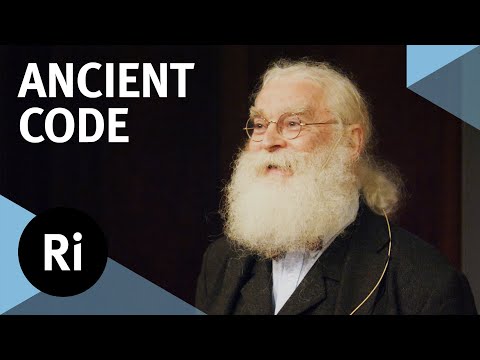
Writing is generally agreed to be among the greatest inventions in human history, perhaps the greatest invention, since it made history possible.
Subscribe for regular science videos: http://bit.ly/RiSubscRibe
You can read more about Irving's quest to explore the Noah's Ark myth in "The Ark Before Noah: Decoding the Story of the Flood": https://geni.us/zU95bVO
or learn more about cuneiform writing in "Cuneiform": https://geni.us/eMPb
Writing seems to have been invented in the late fourth millennium BC in Mesopotamia in the form of wedge-shaped marks pressed into soft clay with a reed stylus: the script known as cuneiform. Through his work on this ancient language, Irving Finkel, has uncovered amazing secrets from over five thousand years ago, including the story behind Noah’s ark.
Irving Finkel is the curator in charge of cuneiform inscriptions on tablets of clay from ancient Mesopotamia at the British Museum, of which the Middle East Department has the largest collection of any modern museum. This work involves reading and translating all sorts of inscriptions, sometimes working on ancient archives to identify manuscripts that belong together, or even join to one another. He is the author of The Ark Before Noah: Decoding the Story of the Flood.
This talk was filmed in the Ri on 18 January 2019.
---
A very special thank you to our Patreon supporters who help make these videos happen, especially:
Dave Ostler, David Lindo, David Schick, Erik Shepherd, Greg Nagel, Ivan Korolev, Joe Godenzi, Julia Stone, Kellas Lowery, Lasse T. Stendan, Lester Su, Osian Gwyn Williams, Paul Brown, Radu Tizu, Rebecca Pan, Robert Hillier, Roger Baker, and Will Knott.
---
Subscribe for regular science videos: http://bit.ly/RiSubscRibe
The Ri is on Patreon: https://www.patreon.com/TheRoyalInstitution
and Twitter: http://twitter.com/ri_science
and Facebook: http://www.facebook.com/royalinstitution
and Tumblr: http://ri-science.tumblr.com/
Our editorial policy: http://www.rigb.org/home/editorial-policy
Subscribe for the latest science videos: http://bit.ly/RiNewsletter
Product links on this page may be affiliate links which means it won't cost you any extra but we may earn a small commission if you decide to purchase through the link.


Meet the brides and grooms defying the jihadist militants who have been laying siege to the Nigerian city of Maiduguri.
Subscribe to our channel for more Unreported World episodes https://www.youtube.com/unreportedworld.
Maiduguri is the spiritual home of Boko Haram, a terrorist group at the centre of an insurgency that has killed more than 36,000 people, and displaced over two million more.
With Covid lockdowns over, and the militants driven out, reporter Yousra Elbagir discovers a city determined to reclaim the joy of weddings despite the ongoing risk of kidnappings and attacks.
Producer/Director: Wil Davies
Executive Producer: Nevine Mabro
Series Producer: Andy Lee
Production Company: ITN/Channel 4 News


OMOWALE #MALCOLMX: Lessons from "OUR LIVING BLACK MANHOOD"
ShakaRa will be exploring the influence of Omowale Malcolm X, in shaping his ideals of Manhood.
► JOIN ME ON TELEGRAM: https://t.me/ShakaRaSpeaks
Affirming Black Manhood
Tickets & Info: https://www.shakaraspeaks.com/
It has almost become unpopular to talk about what it means to be a man, to deal with the concept of Manhood. You’ve got to deal with it.
About this event.
WE ARE BLACK MEN!
“It has almost become unpopular to talk about what it means to be a man, to deal with the concept of Manhood. You’ve got to deal with it. You can’t get around it.” – Nana Amos Wilson
“Affirming Black Manhood” attempts to contribute to the process of Black man taking back the power to define, develop & project what it means to be a Black Man. Our facilitators approach Black Manhood from varying perspectives, with an emphasis on promoting the values, principles & ideals that represent the best of who we be... And need to become.
We will engage a series of workshops on various aspects of Black Manhood, including space for general discussion. Our special guest facilitators are all Black Afrikan Men with a proven track record of sustained work with Black Men; addressing issues pertaining to Black Manhood!
We feature:
BABA MWALIMU BARUTI • DEFINING PRINCIPLES OF BLACK MANHOOD
ROBIN WALKER • THE ECONOMICS OF BLACK MANHOOD
IFAYOMI GRANT • CHALLENGING MISOGYNY: REBUILDING AFRIKAN MANHOOD
BRO. LDR. MBANDAKA • BLACK MANHOOD, FATHERHOOD & RITES OF PASSAGE
BABA BUNTU • THE POWER OF BLACK BROTHERHOOD
+more
20th june 2021 • 12pm-8pm GMT •Tickets £10 • available from ShakaRaSpeaks.com

Please turn on subtitles with the CC (Closed Captions) button to see the explanatory annotations designed for educators.
Transcript of closed captions:
0:05: We are approaching a redwood tree. To animate a scientifically accurate leaf, artists studied the texture of a redwood leaf specimen on a glass slide at high resolution. They even counted the stomata, and used that exact count for this film!
0:25: These leaves would be measured on a centimeter scale. Throughout the animation, we will gradually zoom in to smaller scales.
0:40: As we approach a single stoma, we are now on a millimeter scale.
0:48: As we enter the interior of the leaf, we see many individual palisade cells. These cells are where photosynthesis takes place; they are translucent to allow sunlight to enter.
1:00: As we approach a single palisade cell, we’ll zoom down to the micrometer scale. The shapes inside the cell are organelles: the bright globules at the bottom are the Golgi apparatus; the yellow spotted tubes are endoplasmic reticulum studded with ribosomes.
1:09: That large, blue membrane surrounds the nucleus; the purple blobs are mitochondria.
1:18: The faint, yellow, spider-web structure of the cytoskeleton provides structure and support to the cell.
1:24: You are about to enter a chloroplast; inside you see flat, pancake-like membranous structures called thylakoids. This is where the light-dependent reactions of photosynthesis take place to produce ATP, the cell’s energy carrier molecule. way
1:38: The time scale has changed: the molecules are shown moving 1 million times slower than in real life!
1:42: As we near an individual thylakoid, the animation scale continues to shrink down to the molecular level, where things are measured in nanometers.
1:52: The green and blue bush-like structures are photosystems: clusters of proteins that absorb light energy from the sun and help convert it into the chemical energy that’s stored in the bonds of the energy carrier molecule called ATP.
2:03: The yellow-green, rotating structure is an enzyme called ATP synthase. This molecular machine facilitates the flow of protons down their concentration gradient from one side of the thylakoid membrane to the other, using the energy released in the process to assemble ATP.
2:16: The pulses of light in the thylakoid membrane in which the photosystems are embedded represent energized electrons being passed from one photosystem to another, passing along the energy which will be stored in the bonds of ATP (the classic “bucket brigade”).
2:26: The small “wigglies” are ATP molecules. Living things store energy in the bonds of the ATP molecules and then use that energy to conduct all the processes of life.
This animation is a model, and has its strengths and limitations. In order to model something well, visual artists have to make decisions about what to represent and how best to do so. What’s present in this model, and what’s intentionally missing or altered? Find out by visiting https://www.calacademy.org/edu....cators/travel-deep-i
- - -
The California Academy of Sciences is a renowned scientific and educational institution dedicated to exploring, explaining, and sustaining life on Earth. Based in San Francisco’s Golden Gate Park, it's the only place in the world to house an aquarium, planetarium, rainforest, and natural history museum—plus cutting-edge research programs—all under one living roof.
Connect with us:
• Facebook: https://facebook.com/calacademy
• Twitter: https://twitter.com/calacademy
• Instagram: https://instagram.com/calacademy
• Snapchat: https://www.snapchat.com/add/heycalacademy
• Tumblr: https://heycalacademy.tumblr.com