- General Videos
- Music
- Economics
- Health
- Travel & Events
- History
- Psychology
- Spirituality
- Movies
- News & Politics
- Kmtyw Combat Sciences
- Ɔbenfo Ọbádélé Kambon Videos
- Ɔbenfoɔ Kamau Kambon: Black Liberation Philosophy
- Science, Tech, Engineering and Math
- Permaculture
- Self-Sustainability
- Living Off Grid
- Yoruba Language Learning
- Education
- Mmɔfra Adesua
- Nana Kamau Kambon Playlist
- Livestream
- Komplementarity Kouples and Revolutionary Singles
- Abibitumi Film Series
- Decade of Our Repatriation
- Kwento xpr
- Live
Top videos


Last month South African President Jacob Zuma was forced from office by his own party, the African National Congress, when almost a decade's worth of corruption, bribery and racketeering allegations finally became too great to ignore. It is possible that within weeks he could appear in court to face charges relating to at least one of the many financial intrigues from his years in power.
As anyone following this story will know, his most infamous former associates, the billionaire Gupta brothers, are now fugitives from justice amid claims that during the Zuma years they systemically looted state assets on a truly astonishing scale - principally by using their friendship with the then-president to influence political appointments and win lucrative government contracts. They are believed to have fled the country and taken refuge in Dubai, where they own property.
But the former president and his state-capturing confrères aren't the only ones under scrutiny in South Africa these days. We've been to examine the role allegedly played by major international companies in scandals so toxic and far reaching, they look set to haunt the country for years to come.
- Subscribe to our channel: http://aje.io/AJSubscribe
- Follow us on Twitter: https://twitter.com/AJEnglish
- Find us on Facebook: https://www.facebook.com/aljazeera
- Check our website: https://www.aljazeera.com/
The event followed a now familiar pattern: a small convoy of dusty 4x4 vehicles drove on to the edge of the airstrip at Galkayo in Puntland, north-central Somalia; armed security guards took up watchful positions nearby and a number of bemused-looking men stepped gingerly from the cars and lined up to have their photographs taken by the media.
On this occasion there were 11 of them; all had been hostages until that morning. They were sailors from a Malaysian cargo vessel that had been hijacked by Somali pirates a few years ago and held until a ransom was paid for their release.
One of them gave a brief account of what had happened. "On November 26, 2010 our ship was hijacked in the Indian Ocean. Their demand was 20 million. After that, they threatened the owner. You now increase money or we will shoot the crew. The owner didn't increase the money and then one Indian is shot with just three bullets. Then they hit us and tortured us. Tell your family to bring us money, otherwise we will kill you!"
The crew had been held for three and a half years but they were the fortunate ones. Five of their crew mates had died in that time. Now the survivors were going home and a UN plane with two envoys on board was flying in to see them to safety.
Such scenes have become relatively commonplace in Galkayo in recent times. Eighty percent of global trade is carried by sea and Somalia sits on a key maritime route linking Europe and Asia. More than 18,000 ships pass its shores every year. Over the past decade, Somali pirates, often former fishermen whose traditional livelihoods have been destroyed by foreign trawlers and toxic waste dumping, have attacked more than 300 vessels and kidnapped 700 people.
Faced with such a threat, the international community responded aggressively. In 2008, European states, the US and others began sending naval forces to these seas. They are still there today - warships, planes and helicopters patrolling thousands of square miles and doing a fair job of keeping the hijackers at bay. The UN and others have also played an increasing role in facilitating negotiations for the release of hostages - such as those set free at places such as Galkayo - for whose liberty large ransoms have been paid.
But if the problem is now slowly coming under control in Somalia, the same cannot be said for other parts of the world where piracy is on the increase. Lawlessness, desperation, poverty, greed and even political radicalism have brought the phenomenon to the waters of South America, Asia and, perhaps most aggressively, to West Africa.
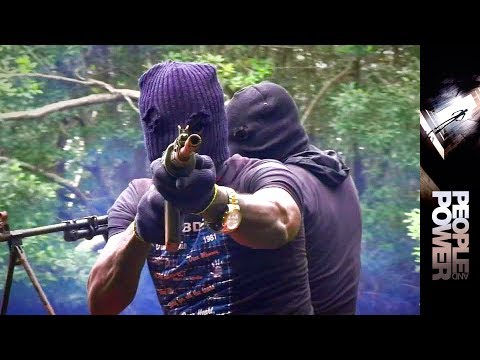
In an effort to understand the reasons why, Bertrand Monnet, a French academic and filmmaker, has been travelling to piracy hot spots around the coast of Africa. In an extraordinary and very tense series of encounters, he came to face to face with heavily armed pirate gangs operating in and around the Niger Delta, where Nigeria's huge offshore oil industry, which employs thousands of expatriates, offers rich ransom pickings. It gradually became clear that piracy in West Africa has many of the same root causes as piracy in Somalia and elsewhere, not least of which is that those who don't share in the benefits and profits of global trade have ever fewer reasons these days to respect the security of those who do.
Source: Al Jazeera
- Subscribe to our channel: http://aje.io/AJSubscribe
- Follow us on Twitter: https://twitter.com/AJEnglish
- Find us on Facebook: https://www.facebook.com/aljazeera
- Check our website: http://www.aljazeera.com/


Featured Speaker: Harriet A. Washington, Medical Ethicist, Award-Winning Medical Writer and Editor.
This video clip was recorded on March 07, 2017 during the “Women's History Month 2017: Women of Vision” Event, featuring Harriet A. Washington (Award-Winning Author of “Medical Apartheid: The Dark History of Medical Experimentation on Black Americans from Colonial Times to the Present”; “Deadly Monopolies: The Shocking Corporate Takeover of Life Itself–And the Consequences for Your Health and Our Medical Future”; and “Infectious Madness: The Surprising Science of How We “Catch” Mental Illness”), at the Charles H. Wright Museum of African American History, 315 East Warren Avenue, Detroit, MI.
For more information, please visit:
http://www.thewright.org/index.....php/component/itsoc
http://www.greatertalent.com/harrietwashington/
http://nyam.org/events/event/i....nfectious-madness-we
https://www.c-span.org/video/?....313990-11/open-phone
https://www.c-span.org/video/?....305728-1/deadly-mono
https://www.c-span.org/video/?....313990-5/panel-discu
https://www.c-span.org/video/?....328703-4/harriet-was
https://www.amazon.com/Harriet....-A.-Washington/e/B00
https://www.commentarymagazine.....com/articles/medica
https://www.democracynow.org/2....011/10/31/deadly_mon
=-=-=-=-=
All Rights Reserved.
=-=-=-=-=


This documentary, produced by Cameroon Radio Television (CRTV), introduces bamboo's potential in Cameroon, and INBAR's work in Central Africa. It is published here on INBAR's YouTube account with permission from CRTV.
The International Bamboo and Rattan Organisation, or INBAR, is an intergovernmental organisation dedicated to promoting the use of bamboo and rattan for inclusive, green development. We research and strengthen the global knowledge base for bamboo and rattan and raise awareness of their use for:
♣Climate Change Adaptation and Mitigation
♣Land Restoration
♣Poverty Alleviation
♣South-South Cooperation
♣Sustainable, Affordable Construction
♣Accessible, Green Energy.
INBAR Official:
www.inbar.int
www.twitter.com/INBARofficial/
www.twitter.com/INBARlac/
www.twitter.com/INBARWaro/
www.facebook.com/INBARofficial/
www.facebook.com/INBARlac/
www.facebook.com/INBARWARO/
Follow our Youtube channel for practical tips for growing, processing and marketing bamboo and rattan products as well as interviews, speeches and more from our work around the world.


Het ASA Restoration Project werd opgericht in 2008. Directeur van dit project is niemand minder dan Anthony Browder, spreker en historicus. Hij is de eerste persoon van Afrikaanse afkomst die opgravingen in Egypte heeft gefinancierd en uitgevoerd.
================================================================
LET'S STAY CONNECTED
– Abonneer, like en deel ons You Tube Kanaal om het bewustzijn te vergroten binnen onze community.
– Bezoek onze website http://www.houseofkhepera.com/ voor meer informatie over onze cursussen.
– Kom meer te weten over events via onze Facebook pagina https://www.facebook.com/houseofkhepera/.
– Positieve informatie over onze Afrikaanse Identiteit en Cultuur kun je vinden op onze Instagram pagina http://www.instagram.com/houseofkhepera1873.
– Daarnaast nodigen we je uit om een kijkje te nemen op de House of Khepera on demand pagina van Salto (de publieke omroep van Amsterdam) waar je de afleveringen van HoK-TV kunt zien https://www.salto.nl/programma/house-of-khepera/.