- General Videos
- Music
- Economics
- Health
- Travel & Events
- History
- Psychology
- Spirituality
- Movies
- News & Politics
- Kmtyw Combat Sciences
- Ɔbenfo Ọbádélé Kambon Videos
- Ɔbenfoɔ Kamau Kambon: Black Liberation Philosophy
- Science, Tech, Engineering and Math
- Permaculture
- Self-Sustainability
- Living Off Grid
- Yoruba Language Learning
- Education
- Mmɔfra Adesua
- Nana Kamau Kambon Playlist
- Livestream
- Komplementarity Kouples and Revolutionary Singles
- Abibitumi Film Series
- Decade of Our Repatriation
- Kwento xpr
- Live
Top videos


At 7,000 kilometres (4,350 miles), the Nile is Africa’s longest river. But a mega project, the Grand Ethiopian Renaissance Dam, has triggered a major dispute in the region.While Addis Ababa says the dam is crucial to its economic development, Cairo calls it an existential threat. And Khartoum fears the project will increase the risk of flooding and affect the safe operation of its own dams on the river.Can Ethiopia, Sudan, and Egypt find a diplomatic solution to their dispute, or will it escalate further? Sudan’s Irrigation Minister Yasser Abbas talks to Al Jazeera.-
Subscribe to our channel: http://aje.io/AJSubscribe -
Follow us on Twitter: https://twitter.com/AJEnglish -
Find us on Facebook: https://www.facebook.com/aljazeera -
Check our website: https://www.aljazeera.com/


Don't forget to subscribe: https://bit.ly/2Hb8hjx
Watch more interesting videos: https://bit.ly/34ogCaw
Follow Channels Television On:
Facebook: https://www.facebook.com/channelsforum/
Twitter: https://twitter.com/channelstv
Instagram: https://www.instagram.com/chan....nelstelevision/?hl=e
Get more news on our website: https://www.channelstv.com/
#ChannelsTv


Congo Connection (2009): The mineral Coltan has fuelled a technological revolution in the West, but in the DRC it has become a talisman of brutal violence.
For similar stories, see:
Rage Of War In Congo
https://www.youtube.com/watch?v=vhHFHSNvTjo
Thousands Displaced In The Congo
https://www.youtube.com/watch?v=Nk9ZG20ymeE
The Future of Virunga's Mountain Gorillas Is In Jeopardy
https://www.youtube.com/watch?v=sYTht_-lOuw
Subscribe to journeyman for daily uploads:
http://www.youtube.com/subscri....ption_center?add_use
For downloads and more information visit:
http://www.journeyman.tv/film/4553
Like us on Facebook:
https://www.facebook.com/journeymanpictures
Follow us on Twitter:
https://twitter.com/JourneymanVOD
https://twitter.com/JourneymanNews
Follow us on Instagram:
https://instagram.com/journeymanpictures
Modern technology relies upon a mineral found in the Congo. Is our appetite for the latest gadgets fuelling rebel fighting in the Congo - threatening the survival of central Africas great gorillas?
On the inside of many devices like mobile phones and laptops is the mineral Coltan, which has made our gadgets smaller and more complex. In the mineral-rich Congo, armed militia watch over the children digging this mineral from the ground. "The government only pretends to help us" says one miner, who pays a government official just to work. "The Congo is a shifting sands of various militia, the largest of which is the Congolese state itself," explains an expert on blood minerals.
Yet the miners depend on the little they get from mining to survive. Electronic giants like Apple now claim they will no longer use Coltan from this area but experts are convinced the militias will smuggle it onto the market regardless. For local miners, the move away from African minerals is just another way of penalising Africans. Coltan fuels a conflict, which has seen national parks become war zones, gorillas killed for meat and hundreds of houses set on fire in turf wars over mineral territory. Yet it also feeds 400,000 petty traders. Why did it take a mobile phone to make us appreciate the injustice in the Congo?
ABC Australia – Ref. 4553
Journeyman Pictures is your independent source for the world's most powerful films, exploring the burning issues of today. We represent stories from the world's top producers, with brand new content coming in all the time. On our channel you'll find outstanding and controversial journalism covering any global subject you can imagine wanting to know about.


What is quantum biology? Philip Ball explains how strange quantum effects take place in the messy world of biology, and how these are behind familiar biological phenomena such as smell, enzymes and bird's migration.
Subscribe for regular science videos: http://bit.ly/RiSubscRibe
In this guest curated event on quantum biology, Jim Al-Khalili invited Philip Ball to introduce how the mysteries of quantum theory might manifest themselves at the biological level. Here he explains how the baffling yet powerful theory of the baffling yet powerful theory of the subatomic world might play an important role in biological processes.
Philip Ball is a science writer, writing regularly for Nature and having contributed to publications ranging from New Scientist to the New York Times. He is the author of many popular books on science, including works on the nature of water, pattern formation in the natural world, colour in art, and the cognition of music, and he has also broadcast on many occasions on radio and TV.
Jim Al-Khalili is Professor of Theoretical Physics and Professor of Public Engagement in Science at University of Surrey. He is author of several popular science books and appears regularly on radio and television. In 2007, he was awarded the Royal Society Michael Faraday Prize for Science Communication.
This event took place at the Royal Institution on 28 January 2015.
Subscribe for regular science videos: http://bit.ly/RiSubscRibe
Philip Ball is a science writer, writing regularly for Nature and having contributed to publications ranging from New Scientist to the New York Times.
He is the author of many popular books on science, including works on the nature of water, pattern formation in the natural world, colour in art, and the cognition of music.
He has also broadcast on many occasions on radio and TV.
Download the transcript of this talk: https://www.philipball.co.uk/a....rticles/other/108-qu
The Ri is on Twitter: http://twitter.com/ri_science
and Facebook: http://www.facebook.com/royalinstitution
and Tumblr: http://ri-science.tumblr.com/
Subscribe for the latest science videos: http://richannel.org/newsletter / Our editorial policy: http://richannel.org/home/editorial-policy
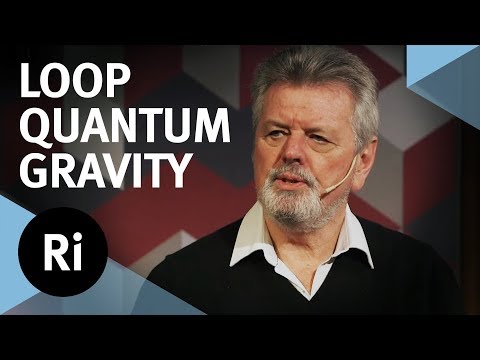
Loop quantum gravity aims to unify the theories of general relativity and quantum mechanics, as explained by Jim Baggott.
Subscribe for regular science videos: http://bit.ly/RiSubscRibe
Buy Jim's book "Quantum Space": https://geni.us/7cLy
Quantum gravity is the holy grail for modern theoretical physicists – a single structure that brings together the two great theories of the 20th century: quantum mechanics and general relativity. One widely-known solution is string theory, which emerged from particle physics. In this talk, Jim Baggott will describe the other approach known as Loop Quantum Gravity. This theory starts from general relativity, borrows many ideas and techniques from quantum mechanics, and predicts that space itself is quantum in nature.
Watch the Q&A: https://youtu.be/XE33mycJNNI
Jim Baggott is an award-winning science writer. He trained as a scientist, completing a doctorate in chemical physics at the University of Oxford in the early 80s, before embarking on post-doctoral research studies at Oxford and at Stanford University in California.
This talk was filmed at the Ri on 12 February 2019.
---
A very special thank you to our Patreon supporters who help make these videos happen, especially:
Darren Jones, Dave Ostler, David Lindo, Elizabeth Greasley, Greg Nagel, Ivan Korolev, Joe Godenzi, Lester Su, Osian Gwyn Williams, Radu Tizu, Rebecca Pan, Robert Hillier, Roger Baker, Sergei Solovev and Will Knott.
---
The Ri is on Patreon: https://www.patreon.com/TheRoyalInstitution
and Twitter: http://twitter.com/ri_science
and Facebook: http://www.facebook.com/royalinstitution
and Tumblr: http://ri-science.tumblr.com/
Our editorial policy: http://www.rigb.org/home/editorial-policy
Subscribe for the latest science videos: http://bit.ly/RiNewsletter