








- General Videos
- Music
- Economics
- Health
- Travel & Events
- History
- Psychology
- Spirituality
- Movies
- News & Politics
- Kmtyw Combat Sciences
- Ɔbenfo Ọbádélé Kambon Videos
- Ɔbenfoɔ Kamau Kambon: Black Liberation Philosophy
- Science, Tech, Engineering and Math
- Permaculture
- Self-Sustainability
- Living Off Grid
- Yoruba Language Learning
- Education
- Mmɔfra Adesua
- Nana Kamau Kambon Playlist
- Livestream
- Komplementarity Kouples and Revolutionary Singles
- Abibitumi Film Series
- Decade of Our Repatriation
- Kwento xpr
- Live
Top videos


Kwame Nkrumah was the leader of Ghana from independence until his deposition by a CIA-back coup d'etat in 1966, as well as one of the principal political and philosophical leaders of the Pan-African movement. While friendly with countries such as the Soviet Union, Nkrumah's Ghana was part of the non-aligned movement, and Nkrumah's political philosophy is typically described as a syncretic mixture of Marxism and traditional African cultural ideas.
While the defeats of socialist experiments in West African countries like Ghana and Guinea-Conakry urge reflection on the successes and failures of these ideologies and movements, Nkrumah remains a key figure in the history and competing ideologies of African liberation movements, and thus he, and Neo-Colonialism: The Last Stage of Imperialism, his most famous work, merit study in order to enrich our understanding of African history.
You can read a version of this text here:
https://archive.org/details/Ne....oColonialismTheLastS
I collect no fees or advertising money by sharing readings of important texts. If you would like to help cover the costs of equipment, hosting fees, and materials to allow me to continue sharing revolutionary, anti-imperialist, and anti-colonial writings, you can become a Patron at:
https://www.patreon.com/natu_r....eads?fan_landing=tru


Artist: Geechee Syndicate (Tymuh & D-Bezzle)
Shot by: Adam of Fox 24 News
Location: North Charleston, SC
2019 music video for the song, "Geechee Pride", from their 2016 album, "Geechee Pride".
Now Available for Purchase on All Digital Platforms!
https://music.apple.com/us/alb....um/geechee-pride/154
https://linktr.ee/Geecheesyndicate
https://linktr.ee/Tymuh843
S/O to Geechee Experience for this opportunity, by using their platform to show love to the Gullah/Geechee ppl around the world.

In this thought-provoking presentation, Robin Walker: The Black History Man, breaks down Franz Fanon's views on Colourism, and the way Colourism creates conflict amongst oppressed people.
To watch all the other presentations from this event visit our website here: https://thehiddenscienceacademy.com/watch/
Become a PLATINUM VIP MEMBER of The Hidden Science Academy and start enjoying UNLIMITED ACCESS to all our courses, lectures, webinars and VIP content.
Register here: https://thehiddenscienceacademy.com/register/
-----------------------------------------------------------------
Find “thehiddenscienceacademy” on:
► INSTAGRAM: https://instagram.com/thehiddenscienceacdemy
► WEBSITE: https://thehiddenscienceacademy.com/
► VIMEO: https://vimeo.com/thehiddenscienceacademy/
► FACEBOOK: https://www.facebook.com/thehiddenscienceacademy
WebSite: SignUp to our mailing list
http://thehiddenscienceacademy.com
-----------------------------------------------------------------



[ESPAÑOL]
Los orígenes de la antigua Kush
Tienes que conocer el mundo antiguo para comprender el mundo moderno. Durante años, la historia y las contribuciones de Kush a la civilización mundial fueron en gran parte tergiversadas. Los primeros arqueólogos europeos lo explicaron como un reflejo o colonia de Egipto cuando Egipto se ha explicado durante mucho tiempo como un producto del Cercano Oriente y el Mediterráneo (no de África).
El legendario Reino de Kush, la madre de las civilizaciones africanas, una cultura deslumbrante que floreció en la región conocida como Nubia (que se extiende desde el Alto Nilo hasta el Mar Rojo, lo que hoy es Egipto y Sudán) hace casi 5.000 años y rigió el mundo durante milenios. La región se convirtió en un importante centro comercial de productos del interior africano, el desierto árabe y la cuenca mediterránea. Kush pone de manifiesto el papel que desempeñaron los africanos en un mundo antiguo interconectado.
Durante mucho tiempo, los académicos eurocéntricos no concibieron que una civilización negra fuera tan avanzada. Las antiguas culturas nubias eran sofisticadas y cosmopolitas. Afortunadamente, la verdad sobre esta civilización africana está emergiendo gradualmente a medida que los restos arqueológicos sobrevivientes de Kush revelan un fascinante pueblo antiguo desconocido para el mundo. Ésta es la verdad de la historia africana y debería enseñarse en todas las escuelas. Los europeos ven la antigua Grecia simbólicamente como la madre de su civilización (que también fue influenciada por las civilizaciones africanas clásicas). Los africanos debemos ver a Kush como nuestro gran antepasado. Basándose en sus estudios, viajes, excavaciones y trabajo de campo, Nubia Wardford Polk, nos lo cuenta en "Los origenes de la antigua Kush"
NUBIA WARDFORD-POLK, M.A., Antropóloga / Científica Cultural (Arqueóloga) Nubia Wardford-Polk tiene una maestría en arqueología histórica especializada en arqueología del mundo africano, mundos históricos y prehistóricos. Su participación e investigación primaria en arqueología, antropología e investigación histórica dieron como resultado conclusiones sobre la importancia de la civilización antigua kushita / merolítica (antiguo Sudán) que es anterior a Egipto.
[ENGLISH]
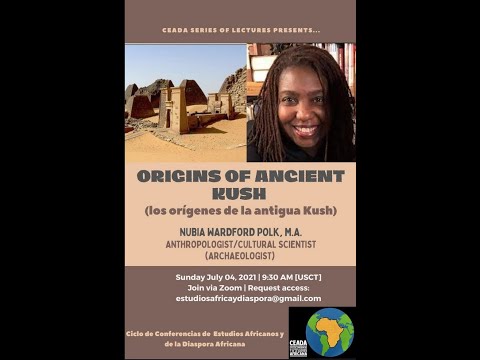
The Cycle of Conferences on African and the African Diaspora Studies [CEADA] invites to the conference “Origins of Ancient Kush” presented by Nubia Wardford-Polk, M.A.
The Cycle of Conferences on African and the African Diaspora Studies has been created to disseminate Afrocentric and Pan-Africanist thought through the experiences and contributions of Africans and their descendants worldwide. It is an open and permanent space where experts in different areas of knowledge are invited. The dialogue revolves around issues of collective interest and from the Afrocentric, Pan-Africanist, and anti-colonialist perspectives.
Origins of Ancient Kush
You have to know the ancient world to understand the modern world. For years, Kush's history and contributions to world civilization were largely misrepresented. Early European archaeologists explained it as a reflection or colony of Egypt when Egypt has long been explained as a product of the Near East and the Mediterranean (not Africa).
The legendary Kingdom of Kush, the mother of African civilizations, a dazzling culture that flourished in the region known as Nubia (stretching from the Upper Nile to the Red Sea, what is now Egypt and Sudan) nearly 5,000 years ago and ruled the world for millennia. The region became an important commercial center for products from the African interior, the Arab desert, and the Mediterranean basin. Kush makes evident the role that Africans played in an interconnected ancient world.
For a long time, Eurocentric scholars did not conceive that a black civilization was so advanced. The ancient Nubian cultures were sophisticated and cosmopolitan. Fortunately, the truth about this African civilization is gradually emerging as the surviving archaeological remains of Kush reveal a fascinating ancient people unknown to the world. This is the truth of African history, and it should be taught in all schools. Europeans see ancient Greece symbolically as the mother of their civilization (which was also influenced by classical African civilizations). We Africans must see Kush as our great ancestor. Based on his studies, travel, excavations, and fieldwork, Nubia Wardford Polk tells us about it in "Origins of ancient Kush."
NUBIA WARDFORD-POLK, M.A., Anthropologist / Cultural Scientist (Archaeologist)
Nubia Wardford-Polk holds an M.A in Historical Archaeology specializing in Archaeology of the African world, Historic, and Prehistoric worlds. Her involvement and primary research in archaeology, anthropology, and historical research resulted in conclusions regarding the importance of the Ancient Kushite/Merolitic (Ancient Sudan) civilization which predates Egypt.
Nubian Archaeological Project
http://www.ancientnubiancities.com/




![Mhenga John Henrik Clarke vs Mary Lefkowitz: The Great Debate [29 March 1996]](https://i.ytimg.com/vi/6bW-7raT3H0/mqdefault.jpg)