- General Videos
- Music
- Economics
- Health
- Travel & Events
- History
- Psychology
- Spirituality
- Movies
- News & Politics
- Kmtyw Combat Sciences
- Ɔbenfo Ọbádélé Kambon Videos
- Ɔbenfoɔ Kamau Kambon: Black Liberation Philosophy
- Science, Tech, Engineering and Math
- Permaculture
- Self-Sustainability
- Living Off Grid
- Yoruba Language Learning
- Education
- Mmɔfra Adesua
- Nana Kamau Kambon Playlist
- Livestream
- Komplementarity Kouples and Revolutionary Singles
- Abibitumi Film Series
- Decade of Our Repatriation
- Kwento xpr
- Live
Top videos


Wangari Maathai was the founder of the Green Belt Movement and the 2004 Nobel Peace Prize Laureate. She was born in Nyeri, a rural area of Kenya. Professor Maathai was internationally acknowledged for her struggle for democracy, human rights, and environmental conservation, and served on the board of many organisations. She addressed the UN on a number of occasions and spoke on behalf of women at special sessions of the General
Assembly during the five-year review of the Earth Summit. In recognition of her deep commitment to the environment, the United Nations (UN) Secretary-General named her a UN Messenger of Peace in December 2009, with a focus on the environment and climate change. For more information on these interviews as well as more interviews: http://www.treemedia.com/#!11t....h-hour-research-tape


After ten years of fighting, peace between the Tuareg guerrillas and government troops was recently signed. The war and the crisis of modernity have endangered the secular caravan carrying salt on camels from the Aïr to Agadez. This year, two Tuareg children can accompany their families in this trailer for the first time in a climate of peace, and this chapter of the series will see the generational change of the Tuareg tradition thanks to the friendship of these two children whose families were on opposite sides during the past conflict.
Don't forget to SUBSCRIBE here for more amazing docs!: http://goo.gl/vNINO4
SUSCRÍBETE al canal y descubre los mundos y las culturas más fascinantes: http://goo.gl/vNINO4
Follow us on:
Síguenos también en:
Facebook: https://www.facebook.com/NewAtlantisDocumentales
Twitter: https://twitter.com/NewAtlantisDocu

Traditional scenes of Tuareg life, including a young man's transition to manhood, wedding festivities and a camel salt caravan through the Sahara.
To purchase a clean DVD of this film for personal home use or educational use contact us at questions@archivefarms.com. To license footage from this film for commercial use visit: www.travelfilmarchive.com

Film by Sorious Samura and Clive Patterson
How political corruption is turning the country's spiralling youth unemployment into a threat to society.
You can witness the same scene at dawn every morning in Kenya's capital, Nairobi: thousands of young people in search of work are streaming out from the city's slums towards its industrial areas.
Most of them are neatly if simply dressed, many of them are full of optimism, but the vast majority are destined to be disappointed. Those that can afford it will try and cram onto a bus in an attempt to beat the crowds, the rest will weave their way on foot through the heavy morning commuter traffic. But when they arrive, the situation for all of them will invariably be the same as it was on the previous day and the day before that and on all the other preceding days.
They will spend an hour or so packed in their hundreds along the pavements and parking lots outside a factory, warehouse or office block, certificates of education and references from previous employers ready to hand, waiting patiently for something to happen.
The usual rumours pass from person to person, this company is said to need people with computer skills, that one needs fork lift truck drivers or perhaps some just some day laborers. But then a supervisor will step from the building and shout out that he can offer a day's work for four people with experience of working a lathe or two with secretarial skills.
Many step forward, a lucky few are selected at random and make their way inside, then the doors of the building close and the rest drift off to take up station at the next place or to make their long way back home - hopes dashed yet again.
A national disaster in the making?
George, a Kenyan in his early twenties, has graduated from university in December 2012 with a diploma in electrical engineering but so far he has been unable to find work.
"The chance I'm going to be chosen today is limited," he says. "I'm just gambling. You can stand here for as long as half a day, because you never know the time that you can be picked."
It is a story that is all too common. Joblessness among all people of working age is a serious problem in Kenya, but among young people, it is a catastrophe. The country has one of the largest youth populations in Africa, but roughly 70 percent of its working age youth - almost 10 million people - are unemployed, although a surprising number are very well educated and possess the kinds of skills a healthy economy really should be able to put to use.
In a country where almost 80 percent of the population is under the age of 35 some have labelled it a national disaster in the making, that may have serious social consequences and lead to civil unrest.
For a country that is still recovering from the scars of the widespread community violence that followed the 2007 election and which is still reeling from the aftermath of the al-Shabab Westgate mall terrorist attack in September 2013, it is a hint worth taking seriously.
Dr Alex Ezeh of the African Population and Health Research Centre in Nairobi put the significance of this youth population 'bulge' in context.
"It is a demographic event," he says. "It's something that many countries go through at different stages as they move from very high fertility and mortality to very low mortality, it creates this reservoir of people." But this, as he explained, can have positive and negative consequences.
"Generally, what makes it a good thing is our ability to harness the economic potential of such a large proportion of young people going into the labour market … There is a side of it, the more negative part of it, which is, if there are no jobs and no opportunities to engage, then you have a lot of young people understanding what is going on but they're disenfranchised politically, economically, and in many other ways, and this creates a lot of political instability."
The stark reality for the young people from the huge slums at Kibera and Mathare and elsewhere around Kenya's capital is that life without a job is extremely difficult. With no regular income many of them have to turn to crime to make a living. And even if they do not, they are often suspected of involvement in crime, which in turn leads to deadly entanglements with Kenya's notoriously trigger-happy police.
A generation pushed to the edge
When asked who should be doing what about Kenya's youth unemployment, the answer is clear. Successive governments in Kenya have done little to alleviate the plight of the jobless and should be doing more.
- Subscribe to our channel: http://aje.io/AJSubscribe
- Follow us on Twitter: https://twitter.com/AJEnglish
- Find us on Facebook: https://www.facebook.com/aljazeera
- Check our website: https://www.aljazeera.com/
#AlJazeeraEnglish #KenyaUnemployement


Michelle Alexander, highly acclaimed civil rights lawyer, advocate, Associate Professor of Law at Ohio State University, and author of The New Jim Crow: Mass Incarceration in the Age of Colorblindness, delivers the 30th Annual George E. Kent Lecture, in honor of the late George E. Kent, who was one of the earliest tenured African American professors at the University of Chicago.
The Annual George E. Kent Lecture is organized and sponsored by the Organization of Black Students, the Black Student Law Association, and the Students for a Free Society.
➡ Subscribe: http://bit.ly/UCHICAGOytSubscribe
About #UChicago:
Since its founding in 1890, the University of Chicago has been a destination for rigorous inquiry and field-defining research. This transformative academic experience empowers students and scholars to challenge conventional thinking in pursuit of original ideas.
#UChicago on the Web:
Home: http://bit.ly/UCHICAGO-homepage
News: http://bit.ly/UCHICAGO-news
Facebook: http://bit.ly/UCHICAGO-FB
Twitter: http://bit.ly/UCHICAGO-TW
Instagram: http://bit.ly/UCHICAGO-IG
University of Chicago on YouTube:
https://www.youtube.com/uchicago ***
ACCESSIBILITY: If you experience any technical difficulties with this video or would like to make an accessibility-related request, please email digicomm@uchicago.edu.
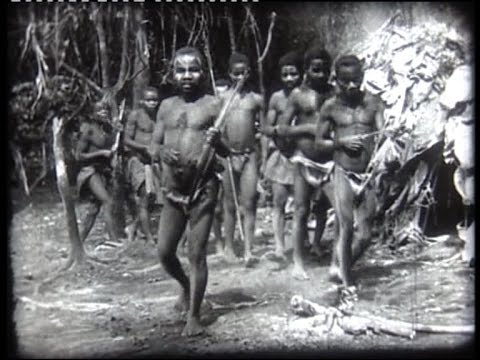

"The pygmies traditionally lived in the forest. They were mobile, semi-nomadic and relatively far from the tracks while farmers had chosen to develop their villages along the tracks. Then because of the attraction of the tracks, the pygmies finally arrived along the road too and their numbers increased. So their habitat finally became structured and developed. Moangue-Le Bosquet, which interests us because of the large population, is also interesting as regards cultural evolution. We're in a town! There's a school, a hospital, shops... So tomorrow's way of life is already starting here."
Alain Froment – Doctor of Medicine, Anthropologist - IRD Director of Research.
"It is agreed that growth is similar in all modern populations of humans. It must be remembered that growth is a change in dimensions until the adult size is attained. If the size differs between populations, this means that the processes responsible for this size are also different.
This difference in size and difference in growth reveal very rich and substantial human biological diversity.
In the case of the Pygmies, we assume that small size is an adaptation to their environment, to the forest. But what interests us is how adult size becomes established.
Six years of data gathering means that we can now sketch a growth curve for the Baka. And its immediate usefulness—seen very clearly this year—is proof that all the data that we are collecting are applicable."
Fernando Ramirez Rozzi – Anthropologist, Biologist – CNRS Director of Research.
-------------------
http://maget.maget.free.fr/A-K....ALO/Baka-cueillette.