







- General Videos
- Music
- Economics
- Health
- Travel & Events
- History
- Psychology
- Spirituality
- Movies
- News & Politics
- Kmtyw Combat Sciences
- Ɔbenfo Ọbádélé Kambon Videos
- Ɔbenfoɔ Kamau Kambon: Black Liberation Philosophy
- Science, Tech, Engineering and Math
- Permaculture
- Self-Sustainability
- Living Off Grid
- Yoruba Language Learning
- Education
- Mmɔfra Adesua
- Nana Kamau Kambon Playlist
- Livestream
- Komplementarity Kouples and Revolutionary Singles
- Abibitumi Film Series
- Decade of Our Repatriation
- Kwento xpr
- Live
Top videos



Botswana is the fastest growing economy in history, But how could that possibly be the case? Why is it so fundamentally better off than all of those that surround it? and Is the miraculous growth just too good to be true?
Miraculously there appears to be a single extraordinary exception to the narrative of poverty in Africa. Straddling the Kalahari Desert in the interior of southern Africa lies the fastest growing economy for the last 50 years. Botswana for all intents and purposes looks identical to its neighbors and this is why in 1965 it was the 7th poorest nation on earth. But over the subsequent decades Botswana has maintained a political structure that's integrity rivals those in Europe, lifted a vast majority of its population from abject poverty, maintained civil and national peace, and invested the revenues of its natural wealth into its future and its people.
--Contents of this video--------------------------------
00:00 - African Economy
01:08 - Botswana Fastest Growing Economy
02:21 - Brief History of Botswana
05:21 - Botswana's Unique Institutions
06:27 - Independence
07:03 - Fastest Growing Economy Ever
08:06 - Seretse khama
09:04 - Diamond Revenue
10:32 - Too Good to be True?
Support the Channel! https://www.patreon.com/CasualScholar
--Sources used---------------------------------------------
Books:
-Botswana – A Modern Economic History
-Why Nations Fail: The Origins of Power, Prosperity, and Poverty
Scholarly Articles:
-An African success story: Botswana
-The political state and the management of mineral rents in capital-surplus economies: Botswana and Saudi Arabia
--Audio used------------------------------------------------
-Accralate - The Dark Contenent by Kevin MacLeod is licensed under a Creative Commons Attribution 4.0 license. https://creativecommons.org/licenses/by/4.0/
Source: http://incompetech.com/music/r....oyalty-free/index.ht
Artist: http://incompetech.com/
-Artifact - The Dark Contenent by Kevin MacLeod is licensed under a Creative Commons Attribution 4.0 license. https://creativecommons.org/licenses/by/4.0/
Source: http://incompetech.com/music/royalty-free/index.html?isrc=USUAN1100324
Artist: http://incompetech.com/
#Botswana #FastestGrowingEconomy #Economics #History


In this interview, we break down the FBA mindset, anti-African rhetoric, and why this movement may not have the staying power some believe. A candid conversation about identity, the Black diaspora, and where these tensions could lead.
Javen Bernadez's Youtube: https://www.youtube.com/@javenbernardez/videos
#fba #blackdiaspora #diaspora #africa #blackamericans #diaspora #black #american #black #foundationalblackamerican

AKANFO NANASOM: Ancient Authentic Akan Ancestral ReligionWeek 1 from our 4-Week Online Course Akan people of Ghana and Ivory Coast originated in ancient Khanit (Nubia) and would later migrate to West Afuraka/Afuraitkait (Africa) over 2,000 years ago. Centuries later some Akan were forced into the western hemisphere during the Mmusuo Kese, Great Perversity/Enslavement era, with many ending up in North america. Akan Ancestral Religion, Akanfo Nanasom, is an unbroken tradition from ancient Khanit and Kamit (Nubia and Egypt), through West Afuraka/Afuraitkait (Africa) to North america wherein our tradition is popularly called Hoodoo from the Akan term ‘Ndu’ (oohn-dooh’) meaning ‘medicine’ from ‘roots, trees, plant-life’ (rootwork). Akan Ancestral Religion is also called Obeah in Jamaica which is derived from the Akan term ‘obayi’. In Guyana it is called Comfa, from the Akan term ‘okomfo’. In Suriname it is called Winti from the Akan term ‘hwinti’. We continue to be possessed by and communicate with the same Abosom (Deities) and Nananom Nsamanfo (Spiritually Cultivated Ancestresses and Ancestors) today as we have for tens of thousands of years. Spirit-possession and spirit-communication is the foundation of Ancient Authentic Akan Ancestral Religion, free from the corruptions of the pseudo-religions of christianity, islam, judaism, hinduism, buddhism and white ill-culture. In this course we examine the pantheon of the Abosom (Deities) and the nature of the Nananom Nsamanfo (Spiritually Cultivated Ancestresses and Ancestors) rooted in Akan cosmology and how they impact every aspect of our lives. Obtain this course and all of our 35 online courses on our website: AKONGUASUA - Institutionwww.odwirafo.com/akonguasuapage.htmlInstructor: Odwirafo Kwesi Ra Nehem Ptah Akhan, author of 31 books and Odumafo, traditional Hoodoo Diviner.
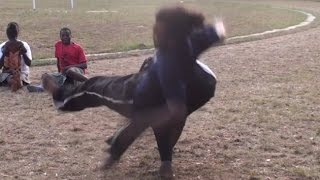

(Disclaimer: Note that this is the full-contact Afrikan version of Capoeira and not the contemporary non-contact "Afro-Brazilian Cultural Aerobics" version) https://www.abibifahodie.com
FULL VIDEO LENGTH: 35 MINUTES 52 SECONDS
FORMAT: MP4 DOWNLOAD
SIZE: 2.28GB
HD (1280 X 720)
Part 1: REAL FIGHTS! Afrikan Combat Capoeira Fight and Sparring Vines!
Abibifahodie Asako: Afrikan Combat Capoeira
Featuring Dr. Ọbádélé Kambon, Brandon "Okumapem" Rogers, Zohra Opoku, Michael, Tahir, Ama Kambon, Dean Nefer, Kwabena "Jahwi" Danso, Kwame Akoto Bamfo, Tchinga Mikolo, Carlos, Wanlov Kubolor, Adetayo Olufunmi, Johnie Dennis Ridehouth, Ernest, Izak, Adinjah, Haile Sotome, Olivier Kabre, NanaHene Koduah, Nii "Bɔkɔɔ" Armah, Thai Smith, Yaa Anima, Harry Abeeku, Razak-Zaquus, Samuel Obeng, Suzanne Ngoeyok and more!
Capoeira stick fighting, capoeira sparring, capoeira striking, capoeira wrestling/grappling, capoeira submissions and more!


While learning about the changes Burkina Faso is making in education, I was made aware of the severity of the mental colonisation that Africa is currently enduring, and I had to talk about it.
Previous video that was mentioned: https://youtu.be/KuZgNgDBxyA
--------------------------------------------------------------------------------------------------
Sign up for my weekly newsletter: https://mailchi.mp/db95199bf59....2/sign-up-landing-pa
---------------------------------------------------------------------------------------------------
Download the Mara Akuko News Aggregator App:
iOS: https://apps.apple.com/us/app/....mara-ak%E1%BB%A5k%E1
Android: https://play.google.com/store/....apps/details?id=com.
----------------------------------------------------------------------------------------------------
Looking for Black manga, comic, or novel to read? Check out my recommendation list here: https://alllinks.cc/scionofculture
-----------------------------------------------------------------------------------------------------
Follow me on all SOCIALS:
X/Twitter: https://x.com/ScionofCulture
Instagram: https://www.instagram.com/scionofculture/
Threads:https://www.threads.com/@scionofculture?hl=en
TikTok: https://www.tiktok.com/@scionofculture?lang=en
Mastadon: https://mastodon.social/@panafrocore
Facebook: https://www.facebook.com/panafrocore/
Bluesky: https://bsky.app/profile/scion....ofculture.bsky.socia
Check out my website: https://panafrocore.com/


Follow us:
Facebook: https://www.facebook.com/pg/CitiTVGH/
Twitter: https://twitter.com/CitiTVGH
Instagram: https://www.instagram.com/cititvgh/
Website: http://cititvonline.com/

Please turn on subtitles with the CC (Closed Captions) button to see the explanatory annotations designed for educators.
Transcript of closed captions:
0:05: We are approaching a redwood tree. To animate a scientifically accurate leaf, artists studied the texture of a redwood leaf specimen on a glass slide at high resolution. They even counted the stomata, and used that exact count for this film!
0:25: These leaves would be measured on a centimeter scale. Throughout the animation, we will gradually zoom in to smaller scales.
0:40: As we approach a single stoma, we are now on a millimeter scale.
0:48: As we enter the interior of the leaf, we see many individual palisade cells. These cells are where photosynthesis takes place; they are translucent to allow sunlight to enter.
1:00: As we approach a single palisade cell, we’ll zoom down to the micrometer scale. The shapes inside the cell are organelles: the bright globules at the bottom are the Golgi apparatus; the yellow spotted tubes are endoplasmic reticulum studded with ribosomes.
1:09: That large, blue membrane surrounds the nucleus; the purple blobs are mitochondria.
1:18: The faint, yellow, spider-web structure of the cytoskeleton provides structure and support to the cell.
1:24: You are about to enter a chloroplast; inside you see flat, pancake-like membranous structures called thylakoids. This is where the light-dependent reactions of photosynthesis take place to produce ATP, the cell’s energy carrier molecule. way
1:38: The time scale has changed: the molecules are shown moving 1 million times slower than in real life!
1:42: As we near an individual thylakoid, the animation scale continues to shrink down to the molecular level, where things are measured in nanometers.
1:52: The green and blue bush-like structures are photosystems: clusters of proteins that absorb light energy from the sun and help convert it into the chemical energy that’s stored in the bonds of the energy carrier molecule called ATP.
2:03: The yellow-green, rotating structure is an enzyme called ATP synthase. This molecular machine facilitates the flow of protons down their concentration gradient from one side of the thylakoid membrane to the other, using the energy released in the process to assemble ATP.
2:16: The pulses of light in the thylakoid membrane in which the photosystems are embedded represent energized electrons being passed from one photosystem to another, passing along the energy which will be stored in the bonds of ATP (the classic “bucket brigade”).
2:26: The small “wigglies” are ATP molecules. Living things store energy in the bonds of the ATP molecules and then use that energy to conduct all the processes of life.
This animation is a model, and has its strengths and limitations. In order to model something well, visual artists have to make decisions about what to represent and how best to do so. What’s present in this model, and what’s intentionally missing or altered? Find out by visiting https://www.calacademy.org/edu....cators/travel-deep-i
- - -
The California Academy of Sciences is a renowned scientific and educational institution dedicated to exploring, explaining, and sustaining life on Earth. Based in San Francisco’s Golden Gate Park, it's the only place in the world to house an aquarium, planetarium, rainforest, and natural history museum—plus cutting-edge research programs—all under one living roof.
Connect with us:
• Facebook: https://facebook.com/calacademy
• Twitter: https://twitter.com/calacademy
• Instagram: https://instagram.com/calacademy
• Snapchat: https://www.snapchat.com/add/heycalacademy
• Tumblr: https://heycalacademy.tumblr.com


![Lt. Col. Oliver North - Memo To History [1987] | Iran Contra Hearings Documentary](https://i.ytimg.com/vi/cYlNGa55M1Y/hqdefault.jpg)