








- General Videos
- Music
- Economics
- Health
- Travel & Events
- History
- Psychology
- Spirituality
- Movies
- News & Politics
- Kmtyw Combat Sciences
- Ɔbenfo Ọbádélé Kambon Videos
- Ɔbenfoɔ Kamau Kambon: Black Liberation Philosophy
- Science, Tech, Engineering and Math
- Permaculture
- Self-Sustainability
- Living Off Grid
- Yoruba Language Learning
- Education
- Mmɔfra Adesua
- Nana Kamau Kambon Playlist
- Livestream
- Komplementarity Kouples and Revolutionary Singles
- Abibitumi Film Series
- Decade of Our Repatriation
- Kwento xpr
- Live
Top videos


29 Nov 2024
Provided to YouTube by DistroKid
Gwaza mkhonto · Yatara
Gwaza mkhonto
https://www.youtube.com/watch?v=RBmlkQ_gcWU
℗ 2834253 Records DK
Released on: 2024-11-28
Auto-generated by YouTube.
Music1 songs
Gwaza mkhontoYataraGwaza mkhonto


(Disclaimer: Note that this is the full-contact Afrikan version of Capoeira and not the contemporary non-contact "Afro-Brazilian Cultural Aerobics" version) https://www.abibifahodie.com
FULL VIDEO LENGTH: 35 MINUTES 52 SECONDS
FORMAT: MP4 DOWNLOAD
SIZE: 2.28GB
HD (1280 X 720)
Part 1: REAL FIGHTS! Afrikan Combat Capoeira Fight and Sparring Vines!
Abibifahodie Asako: Afrikan Combat Capoeira
Featuring Dr. Ọbádélé Kambon, Brandon "Okumapem" Rogers, Zohra Opoku, Michael, Tahir, Ama Kambon, Dean Nefer, Kwabena "Jahwi" Danso, Kwame Akoto Bamfo, Tchinga Mikolo, Carlos, Wanlov Kubolor, Adetayo Olufunmi, Johnie Dennis Ridehouth, Ernest, Izak, Adinjah, Haile Sotome, Olivier Kabre, NanaHene Koduah, Nii "Bɔkɔɔ" Armah, Thai Smith, Yaa Anima, Harry Abeeku, Razak-Zaquus, Samuel Obeng, Suzanne Ngoeyok and more!
Capoeira stick fighting, capoeira sparring, capoeira striking, capoeira wrestling/grappling, capoeira submissions and more!


Stonebwoy Welcomes Spice (Jamaican Dancehall Artist) In Ghana
In this exclusive entertainment update, Ghana’s own Stonebwoy warmly welcomes Jamaican dancehall sensation, Spice, to Ghana! The moment is monumental as these two iconic artists from different parts of the world unite in the name of music, culture, and collaboration. If you’re a fan of Jamaican dancehall, African music, or the global entertainment scene, this video is a must-watch!
Join us as we delve into the exciting arrival of Spice in Ghana, one of the most talked-about events in the Jamaican dancehall and Ghanaian music scenes this year. Watch as Stonebwoy, a leading figure in the Afro-dancehall movement, shows his admiration for Spice’s groundbreaking career and what her visit means for the future of Caribbean-African music collaborations.
Get the latest entertainment updates, celebrity news, and insider info on Jamaican artists, dancehall music, and how Stonebwoy and Spice are making waves in the global music industry. Don’t forget to like, comment, and subscribe for more entertainment news and showbiz updates on your favorite artists and collaborations.
#stonebwoy #spice #jamaicandancehall #ghanamusic #entertainmentnews #dancehall #jamaicaartists #afrodancehall #musiccollaboration #jamaicanartistsinghana #upandrunning6


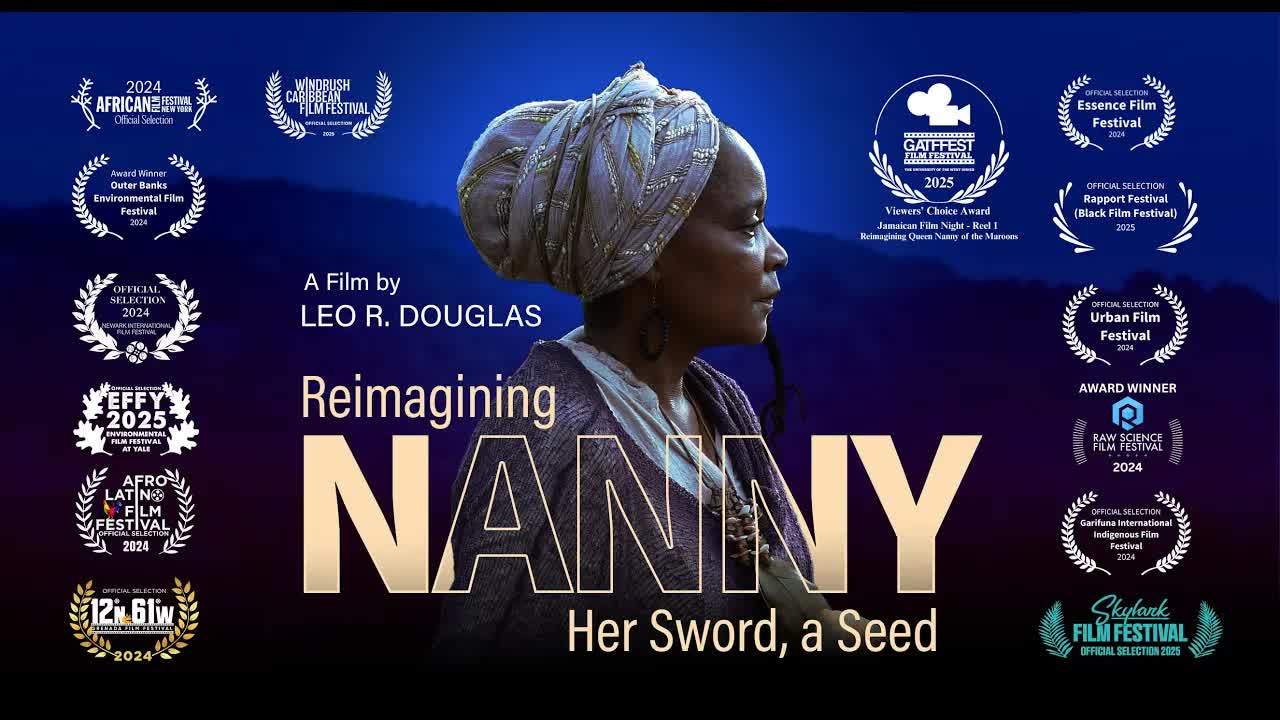
The Reimagining Queen Nanny Documentary
Official Logline: Reimagining Queen Nanny – Chieftess of Blue Mountain’s biodiversity, forests and waters.
Director: Udemba McLean
Co-Writer/Narrator: Marcia B. Douglas (Ph.D.)
This documentary, written and produced by Jamaican Professor at NYU Leo Douglas, seeks to retell the story of Queen Nanny of the Maroons, national heroine of Jamaica. Traditionally Nanny has been portrayed through a lens of mountain guerrilla warfare, but here she is represented in what some scholars of the Black Atlantic and Trans-Atlantic Slave Trade believe to be a more accurate and broader reality – an early Afro-Caribbean ecologist, a protector of the forests and watersheds, as the quintessential Black conservationist and environmental justice leader, and scholar of the sacred things and places of the mountains of eastern Jamaica.
According to Professor Douglas, “the documentary highlights the untold herstories of Queen Nanny as a fundamental means of deepening our understanding of the leadership of Afro-descendant women on whose shoulders we stand as natural history scholars and as members of the environmental movement.” The documentary is positioned as a fresh and informative retelling of community and ancestral cultural preservation on Jamaica, including a description of a rich pantheon of West African knowledge and traditional practices about wild birds, plants, herbal healing and the conservation of the natural world.
The documentary focuses on Akan/Ashanti continuations, gendered-roles, sacred plants, and Twi names that Jamaicans still use to describe things in the natural world today. Knowledge and experiences that are largely unrecognized or undiscussed in Jamaican culture as being of West African origin. By positioning Nanny as one of the island’s first naturalists, and as a central and early Afro-Caribbean eco-spiritual leader of renown, the documentary also explores questions about the intersection of racial identity, gender, sexuality, and religious racism in relation to womanhood and how Afro-Caribbean women are (and have been) perceived - if and when they choose to work on the land, be it as farmers, herbalists, eco-spiritual leaders or as environmental protectors.
Award-winning Jamaican Professor Marcia Douglas of the University of Colorado - Boulder, who portrays Queen Nanny in the documentary feature, said she felt that “Queen Nanny would have believed that nature was life, that it was spirit, and that the essence of our being remained around us, in the things that grew in the Mountains of Jamaica, even after death. That the natural world was also a spiritual world, a world of unseen and immeasurable powers, saturated with the energy and wisdom of our Afro-indigenous fore-parents, that all life was sacred, spiritual and full of teachable wisdom.”
The “Reimagining Nanny: Her Sword – A Seed Documentary” is part of a larger project which includes an original vocal composition about Nanny of the Maroons and five (5) large-scale winning visual arts representations of Queen Nanny which were exhibited at the Institute of Jamaica (IOJ) between 2022 and 2024 – commissioned for Jamaica’s 60th year of independence from Great Britain.
Core partners are the Natural History Museum of the Institute of Jamaica (IOJ), BirdLife Jamaica, and the Jamaica Conservation and Development Trust (JCDT). The Jamaica Conservation and Development Trust (JCDT) is a non-governmental organization and charity with a mandate to advance environmental conservation and sustainable development with a focus on the Blue and John Crow Mountains National Park UNESCO World Heritage Site.
Overwhelming funding for this project was from private Jamaican citizens. The artwork created as part of this documentary project - “Moonlight Meditations of Mama Nanny” by Jamaican artist, Richard Nattoo - was donated to the Institute of Jamaica (in public trust). Additional support was provided by New York University (NYU) through its College of Arts and Sciences, Liberal Studies, and the NYU Centre for Latin American and Caribbean Studies (CLACS).
The documentary, completed in October 2023, was released publicly on December 1, 2025.
***
For further information or to schedule an interview contact:
Film Maker - Leo R Douglas
Email: LRD8@NYU.EDU
https://www.instagram.com/reimagining_nanny/
OR
Documentary Director - Udemba McLean
Email: imagebyultra@gmail.com
https://www.instagram.com/fulltimejamaican/











Traffic Beast’s Deal of the Day
https://warriorplus.com/o2/a/glhsj/0
Aura Hit Send Again
https://warriorplus.com/o2/a/j46g4/0
CryptoCommissions
https://warriorplus.com/o2/a/p7f0r/0
Infinite Hosting Evergreen Offer
https://warriorplus.com/o2/a/f4x3x/0
The Story of American Slavery : Documentary on How Slavery Dominated America (Full Documentary).
This Documentary is very good and as educational as it is fun. It's part of a series of exciting and informative documentaries.
This Youtube channel is for learning and educational purposes. Learning and Education are fundamental and important in today's society and becoming increasingly more accessible and convenient online. The availability of important information which is also entertaining helps everyone grow mentally and emotionally as people both individually and as a whole. Documentaries are the resource of choice of the information and internet generations of students around the world. The documentary here along with the other documentaries on this channel relate to important times and people in history, historic places, archaeology, society, world culture, science, conspiracy theories, and education.
The topics covered in these video documentaries vary and cover about everything you could possibly want to know including ancient history, Maya, Rome, Greece, The New World, Egypt, World wars, combat, battles, military and combat technology, current affairs and events, important news, education, biographies, famous people and celerities, politicians, news and current events, Illuminati, Area 51, crime, mafia, serial killers, paranormal, supernatural, cults, government cover-ups, the law and legal matters, corruption, martial arts, sports figures, space, aliens, ufos, conspiracy theories, Annunaki, Nibiru, Nephilim, satanic rituals, religion, christianty, judaism, islam, strange phenomenon, origins of Mankind, Neanderthal, Cro Magnon, Inca, Aztec, Persia, Maya, Indus, Mesopotamia, monsters, mobsters, time travel, planet earth, the Sun, Missions to Mars, The planets, the solar system, the universe, modern physics, String Theory, the Big Bang Theory, Quantum Mechanics, television, archaeology, science, technology, nature, plants, animals, endangered species, wildlife, animal abuse, environmental concerns and issues, global warming, natural disasters, racism, sexism, gay and lesbian issues, and many other educational and controversial topics. Please enjoy and Learn Responsibly!