- General Videos
- Music
- Economics
- Health
- Travel & Events
- History
- Psychology
- Spirituality
- Movies
- News & Politics
- Kmtyw Combat Sciences
- Ɔbenfo Ọbádélé Kambon Videos
- Ɔbenfoɔ Kamau Kambon: Black Liberation Philosophy
- Science, Tech, Engineering and Math
- Permaculture
- Self-Sustainability
- Living Off Grid
- Yoruba Language Learning
- Education
- Mmɔfra Adesua
- Nana Kamau Kambon Playlist
- Livestream
- Komplementarity Kouples and Revolutionary Singles
- Abibitumi Film Series
- Decade of Our Repatriation
- Kwento xpr
- Live
Latest videos

Hi Guys!!!!
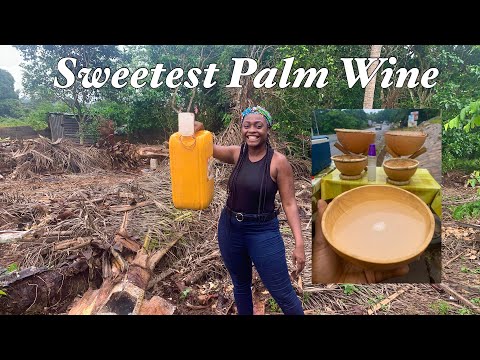
We're back again Chaley. Todays video takes us to Aburi in the Eastern region, where palm wine is tapped.
As always, thanks for watching this video and i hope you enjoy watching as much or more than i enjoyed making it. Please remember to leave a 👍 if you liked it and if you loved it, smash that Subcribe button. Until the next one, Stay safe and love you all. 😘😘😘😘
Music in this video
================
Intro @ikson
Song: Ikson - Anywhere (Vlog No Copyright Music)
Music promoted by Vlog No Copyright Music.
Video Link: https://youtu.be/UY08PUqArZI
🔴Subscribe to become part of my youtube family. lets grow by liking,sharing &commenting.it really helps a lot!
https://www.youtube.com/channe....l/UCZfiSXIArf-qnOVHP
💲If you like to donate or support my channel:
Patreon: https://www.patreon.com/user/creators
Wave or Momo +233 553 863 712
For business enquires kindly contact me on
stellakafui@gmail.com
Follow me on
Instagram: https://www.instagram.com/
Twitter: https://twitter.com/stellashanelly1?s=2



We're honoring the 100th anniversary commemoration of the Tulsa Massacre sometimes poorly referred to as the Tulsa riot. We discuss how the pre-massacre Black Wall Street, a prominent Black business district located in the segregated Greenwood neighborhood of Tulsa, Oklahoma, was not the self-sustaining Black utopia/Wakanda that popular media has depicted it as. More importantly, we discuss the nature of the racial violence that occurred on May 31st - June 1st 1921, and how it was an inevitable outcome of racial capitalism. In the end, we hope to honor the descendants of this horrible tragedy by reporting the truth of what they built and how they worked to defend it.
Show notes
https://docs.google.com/docume....nt/d/1LhLvq1yt_-QqmD
Twitter - @blackmythspod
Instagram -blackmythspod
Facebook- The Black Myths Podcast
Spotify - https://open.spotify.com/show/....70RdUs6GHCWmOlFvceGg
Apple - https://podcasts.apple.com/pod....cast/id1504205689?ls
Join the BPM channel!
https://www.youtube.com/channel/UCC6o...
Follow BPM:
WEBSITE - https://www.blackpowermedia.org/
TWITTER - https://twitter.com/BlackPowerMedi1
INSTAGRAM - https://www.instagram.com/black.power...
FACEBOOK - https://www.facebook.com/Blackpowermedia

![Dr. Molefi Asante - Dubois and Africa: The Convergence of Consciousness [2008]](https://i.ytimg.com/vi/DcwD_3Y_DxM/hqdefault.jpg)


Usisahau kutufuatilia katika mitandao yetu ;
Subscribe to our Youtube Channel : http://bit.ly/itvtanzania
Facebook : https://bit.ly/2KeQNl3
Twitter : https://bit.ly/2XG7aii
Instagram : https://bit.ly/34KItmg

Thousands of African women are trafficked to Italy and forced into sex work. How does a former sex slave who married one of her clients now rescue women from the clutches of human trafficking gangs? Subscribe for more Dateline stories: https://www.youtube.com/user/DatelineSBS
More on Princess and the Sex Slaves: http://bit.ly/2GBeNPS
https://www.sbs.com.au/news/dateline
https://www.facebook.com/DatelineSBS/
#SpecialBroadcastingService
#DatelineSBS
#Documentary

Makandal's revolution is responsible for ending worldwide slavery according to the author. See www.macandal.org. Davis traveled to Haiti, the DR, and France in 1996-7 for this research. He is the only Westerner ever allowed to see where Makandal lived and began his revolution. He interviewed many Voodoo Houngans, academics, and story keepers in Haiti for his ebook "Black Millennium" and this original documentary. U.C. Berkeley supplied grants for travel & production.