








- General Videos
- Music
- Economics
- Health
- Travel & Events
- History
- Psychology
- Spirituality
- Movies
- News & Politics
- Kmtyw Combat Sciences
- Ɔbenfo Ọbádélé Kambon Videos
- Ɔbenfoɔ Kamau Kambon: Black Liberation Philosophy
- Science, Tech, Engineering and Math
- Permaculture
- Self-Sustainability
- Living Off Grid
- Yoruba Language Learning
- Education
- Mmɔfra Adesua
- Nana Kamau Kambon Playlist
- Livestream
- Komplementarity Kouples and Revolutionary Singles
- Abibitumi Film Series
- Decade of Our Repatriation
- Kwento xpr
- Live
This long-form investigation follows Apagya across royal history, military organization, lexicography, and the unresolved institutional record of Mampɔn Akuapem. By Ɔbenfo (Ɔhyefo) Ọbádélé Kambon.
09/23/26 • 156 Views

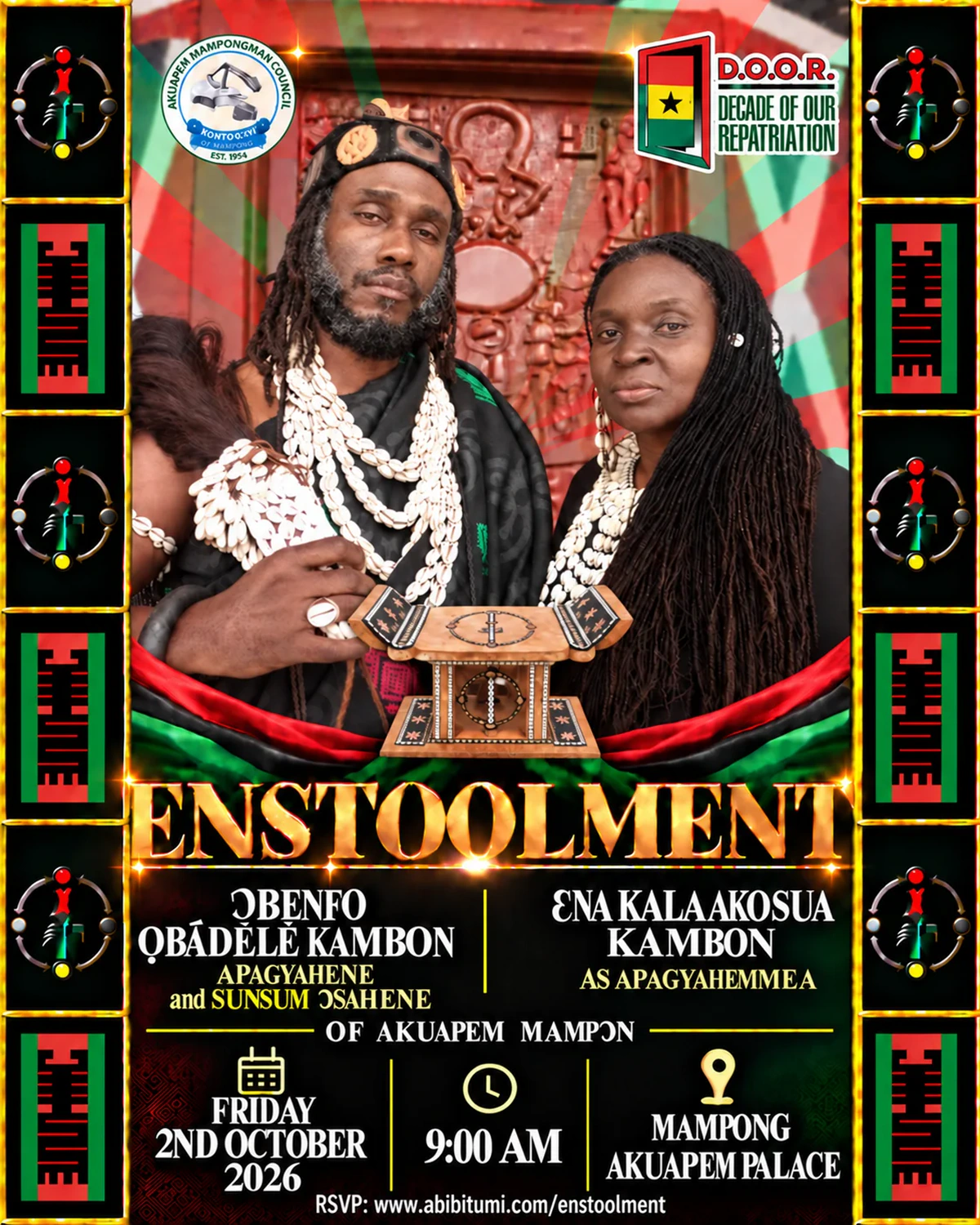
See the official enstoolment information and RSVP.
This long-form investigation follows Apagya across royal history, military organization, lexicography, and the unresolved institutional record of Mampɔn Akuapem.
The canonical edition of this research is published at obadelekambon.com.
Abstract
The title Apagyahene occurs across several Akan political traditions, yet its history cannot adequately be reduced either to the morphological gloss “ɔhene of Apagya” or to the history of Kumase Apagyafie alone. This article reconstructs the available historical, institutional, philosophical, and lexicographical evidence as a foundation for investigating the Apagyahene office at Mampɔn Akuapem. Asante traditions associate Apagya with eighteenth-century military organization, royal politics, ahenemma, land, tribute collection, and Apagyafie. One tradition places the creation of an Apagya stool under Asantehene Opoku Ware I in connection with the 1742 Asante campaign against Akyem Abuakwa. A separate Asante tradition connects the stool with Asantehene Osei Kwame “lifting his head,” raising a historical-linguistic question concerning Akan pagya, ‘to lift/raise’. Historical lexicography materially clarifies the problem: Christaller distinguishes Apagya as a proper name associated with an asafo, Apagyafo as its members, apa-gya as fire-steel used for striking fire, and pagyaw/pagya as ‘to lift up, take up, raise’. The 1909 Basel Mission English–Tshi dictionary independently gives pagya for “heave” and pagya (dibea) for “promote.” Independent nineteenth-century Akuapem evidence further identifies an Apagya asafo at Mamfe and Apagya-associated military material culture at Adukrom. These sources demonstrate that Apagya possessed political-military associations beyond the Kumase royal genealogy, although they do not establish a single historical origin for every Apagya institution. The article distinguishes Apagyahene from the explicitly development-oriented Nkɔsoɔhene institution created under Asantehene Otumfuo Opoku Ware II in 1985. It also examines the designation Sunsum Ɔsahene in relation to Ajei and Grills’s conception of sunsum as “conscious energy.” Finally, the 2019 offer of the Mampɔn Apagyahene office to Sammi Awuku provides a contemporary institutional anchor. The article concludes that the specific history and meaning of the Mampɔn office must ultimately be reconstructed through local oral, archival, linguistic, philosophical, ritual, and material-cultural evidence.
Keywords: Apagyahene, Apagya, Mampɔn Akuapem, Akuapem, Asante, asafo, ahenni, ahennie, sunsum, conscious energy, Nkɔsoɔhene, traditional rulership, historical lexicography
Introduction
The office of Apagyahene presents an instructive problem in the reconstruction of Akan political history. Contemporary use of the title can create the impression that it denotes a standardized office with essentially identical origins and functions wherever it occurs. The available evidence suggests a more complicated history. Apagyahene appears in Asante, Akuapem, Akyem-related traditions, and other Akan contexts, but the institutional histories associated with the designation cannot simply be assumed to be identical.
The immediate occasion for this study is the effort to reconstruct the history and institutional significance of the Apagyahene office at Mampɔn Akuapem. That task cannot responsibly be accomplished by transferring the history of Kumase Apagyafie wholesale to Mampɔn. Nor can the title adequately be explained by morphology alone. A wider historical survey is necessary because evidence identifies Apagya institutions both within and beyond Asante, particularly in nineteenth-century Akuapem.
The morphology appears initially straightforward. Ɔhene denotes a ruler or political head, while Apagya identifies the entity with which that authority is associated. At the most conservative level, therefore, Apagyahene may be understood as the ɔhene or head of Apagya. This observation, however, merely moves the problem backward:
What was Apagya?
At least two explanations occur in Asante historical traditions. One associates Apagya with an Akyem military company encountered during eighteenth-century Asante expansion (McCaskie, 2009). Another associates the name with the Akan verb pagya, ‘to lift’ or ‘raise’, through a tradition concerning Asantehene Osei Kwame (Asamoah-Hassan, 2011). Independent nineteenth-century evidence from Akuapem adds another dimension: Apagya appears as an asafo designation at Mamfe and in association with military material culture at Adukrom (Jectey-Nyarko, 2010; Sill, 2010).
Historical lexicography introduces a particularly important evidentiary layer. Christaller (1933) distinguishes the proper name Apagya, its members Apagyafo, the fire-striking compound apa-gya, and the verb pagyaw/pagya, ‘to lift up, take up, raise’. The Basel Missionary Society's (1909) English–Tshi dictionary independently associates pagya with physical elevation and advancement in office.
The analysis therefore distinguishes four categories that should not be collapsed:
- morphology and etymology;
- stool history and succession tradition;
- corporate and military institutional history; and
- later symbolic, philosophical, or political reinterpretation.
The article also distinguishes four levels of evidentiary confidence. Documented evidence refers to propositions explicitly supported by the cited source. Reasonable inference refers to conclusions strongly suggested by the evidence but not directly stated. Historical hypotheses are explanatory models requiring further testing. Unresolved questions are matters for which the available evidence remains insufficient.
This distinction is particularly important because the study concerns a living traditional office. The present article does not adjudicate the customary validity, succession, rank, jurisdiction, or contemporary authority of any particular Mampɔn office-holder or candidate. Its purpose is historical reconstruction.
Terminology, Colonial Classification, and Akan Political Categories
This article deliberately privileges Akan political terminology rather than routinely translating ɔhene as “chief” or ahenni/ahennie as “chieftaincy.”
For Akuapem contexts, ahenni is used in the sense of ‘traditional rulership’, with ahemfo as the plural. For Asante contexts, the corresponding forms used here are ahennie ‘traditional rulership’ and ahemfoɔ.
The English terms “chief” and “chieftaincy” are retained only where they occur in direct quotations, titles of publications, statutory or colonial nomenclature, or where the terminology itself is under examination.
This choice is methodological rather than ornamental. Kperogi (2014) calls attention to a historical asymmetry in colonial English whereby European rulers continued to be represented as kings, queens, princes, and monarchs while rulers of colonized African and Asian political formations were increasingly represented as “chiefs” or “paramount chiefs.” He interprets this terminology as part of a wider hierarchy within colonial political language.
Kperogi (2014) relates this argument to an 1821 British Foreign Office parliamentary document concerning treaty relations and suppression of the slave trade. The parliamentary collection itself is identifiable (Great Britain, Foreign Office, 1821). Because the precise page-level wording on which Kperogi bases his interpretation has not yet been independently transcribed for the present study, however, his account should remain explicitly attributed to him rather than presented as direct primary-source verification.
Adjei (2024) independently examines the classificatory problem through the status of the Asantehene and demonstrates the inadequacy of assuming that colonial English political categories transparently reproduce indigenous political hierarchies.
The methodological point needed for the present investigation is narrower:
“Chief” is not an analytically exact translation of every occurrence of ɔhene.
An Akan political office should first be reconstructed through its historical constituency, succession, political relationships, military functions, ritual responsibilities, land relations, and position within the wider polity. Translation should follow institutional analysis rather than determine it in advance.
Akuapem as a Historical Political Formation
Any history of Apagya in Akuapem must be situated within the historical formation of Akuapem itself.
Kwamena-Poh's (1973) Government and Politics in the Akuapem State, 1730–1850 remains foundational for the relevant period. Akuapem developed through interaction among Guan communities, Akyem intervention, Akan political structures, interstate conflict, and subsequent relationships with Asante and European powers.
This context matters because traditions concerning Apagya intersect Akyem, Asante, and Akuapem.
Akuapem was neither historically nor linguistically homogeneous. Guan- and Akan-speaking communities participated in a shared political order while retaining distinct histories. Consequently, the recurrence of Apagya across several Akuapem communities cannot simply be assigned a single institutional genealogy without supporting evidence.
The Asante Apagya Stool
Opoku Ware I, 1742, and the Military-Company Tradition
The most detailed published reconstruction of the Asante Apagya stool is McCaskie's (2009) “Asante, Apagyafie and President Kufuor of Ghana: A Historical Interpretation.”
According to traditions analyzed by McCaskie (2009), Asantehene Opoku Ware I had a son named Adu Asabere. During the Asante campaign against Akyem Abuakwa in 1742, Adu Asabere became associated with inhabitants of a settlement or military company called Apagya.
McCaskie (2009) preserves a tradition in which members of this company were brought to Kumase and performed their company drumming and dancing before the Asantehene. Opoku Ware subsequently established an Apagya stool for Adu Asabere, who became Apagyahene.
The important historical proposition is therefore:
Within the Asante tradition reported by McCaskie, Apagya existed as the designation of an Akyem-associated military company in connection with the 1742 campaign before or alongside its institutionalization as a royal stool.
This distinction matters because the later history of Apagyafie should not automatically be projected backward as the explanation for every occurrence of Apagya.
Ahenemma and Royal Political Strategy
The institution also belongs to the history of ahenemma, sons of Asantehenes.
McCaskie (2009) places the Apagya stool within broader efforts under Opoku Ware I to strengthen political bases for royal sons. Such offices could provide the Asantehene with institutional support relative to older hereditary offices.
Within this context, the Apagya office appears simultaneously as a royal office, a political constituency, and, according to its origin tradition, an institution with military associations.
Kuwajima (2014) likewise discusses Apagya and Apagyahene within the history of royal families and ahenemma in Asante.
The historical Asante Apagyahene therefore cannot adequately be characterized as merely an honorific or development title.
Suppression and Restoration
McCaskie (2009) reports that the stool did not enjoy uninterrupted continuity after Opoku Ware I.
Following Opoku Ware I's death, Kusi Obodum reversed aspects of his predecessor's political arrangements. Adu Asabere died, the Apagya stool became inactive, and lands associated with it were affected.
The institution was subsequently restored under Osei Kwame.
The restored stool became associated with Owusu Afriyie Gyamadua, a son of Osei Kwadwo. Owusu Afriyie received lands and appears in political, administrative, and military contexts. Of particular relevance to the present study, McCaskie (2009) associates him with tribute collection in Akuapem. He later died during the Battle of Katamanso in 1826.
The restored Asante office therefore appears within a political world involving royal incorporation, land, dependents, tribute collection, external administration, and military service.
Wilks (1975) provides the wider institutional framework for nineteenth-century Asante political organization within which such offices operated.
Osei Kwame and the “Lifting the Head” Tradition
A second Asante tradition complicates both chronology and etymology.
Asamoah-Hassan (2011) records a tradition in which the Apagya stool is associated particularly with Osei Kwame and with his emergence from a difficult political period. In this account, Apagya is connected with Osei Kwame “lifting his head.”
This differs from McCaskie's (2009) reconstruction if interpreted as an account of first creation. McCaskie places an earlier Apagya institution under Opoku Ware I and understands the Osei Kwame period as a restoration.
The discrepancy should not be artificially harmonized. Stool histories may preserve different historical episodes, political memories, legitimating narratives, or subsequent reinterpretations.
The linguistic dimension, however, is particularly significant because the Akan verb pagya belongs to the semantic field of lifting, raising, and elevation.
Historical lexicography permits this question to be approached more rigorously.
Historical Lexicography: Apagya, apa-gya, and pagya
Christaller's Evidence
The second edition of Christaller's dictionary states explicitly that the work is based principally on the Akuapem dialect, while incorporating material from other Akan varieties (Christaller, 1933).
On page 371, Christaller (1933) distinguishes several highly relevant forms.
First, Apagya is entered as a proper noun and cross-referenced to asafo. Christaller further identifies Apagyafo as members of the Apagya (Christaller, 1933, p. 371).
Second, apa-gya is separately entered and glossed as “fire-steel,” that is, steel employed for striking fire (Christaller, 1933, p. 371).
Third, pagyaw, identified with Akyem pagya, is glossed “to lift up, take up, raise” (Christaller, 1933, p. 371). Among the illustrative examples is a sentence involving a person being placed upon an ahennua, demonstrating that the verb could occur in a context of political elevation (Christaller, 1933, p. 371).
The lexical distinction is crucial. Christaller does not treat these as one undifferentiated word:
- Apagya — proper name associated with an asafo;
- apa-gya — fire-steel or an instrument for striking fire;
- pagyaw/pagya — to lift, raise, or take up.
Historical lexicography therefore does not permit an automatic equation of:
Apagya = “fire strikers.”
Neither does it prove:
Apagya = pagya ‘lift/raise’.
Rather, it demonstrates that both semantic fields existed in closely related but distinguishable lexical forms.
The 1909 Basel Mission English–Tshi Dictionary
The Basel Missionary Society's (1909) English–Tshi dictionary provides an independent reverse-direction check.
Under “heave,” the dictionary gives pagya among the Akan equivalents (Basel Missionary Society, 1909, p. 92).
More significantly, under “promote”, it gives:
pagya (dibea) (Basel Missionary Society, 1909, p. 149).
This demonstrates that pagya could denote not merely physical lifting but advancement in office or position.
By contrast, under “ignite,” the dictionary gives so gya and pa- rather than pagya (Basel Missionary Society, 1909, p. 97).
Together, these dictionaries demonstrate that the semantic fields of fire-striking and lifting/elevation were represented separately in historical Akan lexicography.
Reassessing the “Fire-Strikers” Interpretation
McCaskie's (2009) association of the company name with “fire strikers” should therefore be treated as a historical interpretation requiring explanation, rather than as a self-evident lexical derivation.
At least four possibilities remain:
- Apagya may historically derive from a fire-striking expression related to apa-gya.
- Apagya may derive from or have become associated with pagya, ‘lift/raise’.
- An already established proper name Apagya may have attracted competing historical or folk etymologies over time.
- The original derivation may differ from both later interpretations.
The dictionaries neither prove nor disprove McCaskie's oral-historical interpretation. They demonstrate that the “fire-striking” and “elevation” semantic fields were lexically distinguishable.
Why the Elevation Sense Matters
The Osei Kwame “lifting his head” tradition acquires substantially stronger linguistic plausibility in light of the lexicographical evidence.
Christaller (1933) records pagyaw/pagya as ‘to lift up, take up, raise’ and includes an example involving elevation upon an ahennua (p. 371). The Basel Missionary Society (1909) independently gives pagya (dibea) for “promote” (p. 149).
Thus, the historical semantic chain:
pagya → lift → raise → elevate → promote in office
is lexicographically documented.
This does not establish that the proper noun Apagya derives etymologically from pagya. It does establish that a historical tradition associating Apagya with political elevation is linguistically coherent and cannot simply be dismissed as a modern wordplay.
Apagya Beyond Kumase: The Akuapem Evidence
The strongest evidence against reducing Apagya to Kumase Apagyafie comes from Akuapem.
Mamfe Akuapem: Apagya as an Asafo
Sill's (2010) study of Basel Mission activity reconstructs an episode at Mamfe Akuapem in 1869 in which a local Apagya asafo was involved in collective action connected with a dispute surrounding Basel Mission converts.
According to Sill's (2010) reconstruction, members of the company could be summoned through recognized signals involving a gong and war drum.
The secure proposition is therefore:
An Apagya asafo existed at Mamfe in the nineteenth century and functioned as a corporate body capable of collective summons (Sill, 2010).
It is reasonable to infer organization and membership from this evidence. More detailed conclusions concerning its internal command structure, recruitment, military specialization, or relationship to other Mamfe asafo bodies require consultation of the underlying Basel Mission archival records.
The Need for Comparative Asafo Context
The presence of drums, collective signals, and military associations is significant, but such features must be interpreted comparatively.
Across southern Ghana, asafo institutions could possess officers, drums, flags, ritual functions, civic responsibilities, military histories, and systems of collective mobilization.
The relevant question is therefore not merely whether Apagya was an asafo. It is:
What, if anything, distinguished an Apagya asafo from other asafo formations?
This requires engagement with broader comparative literature on asafo organization and with the primary records underlying the Mamfe case.
Adukrom and Apagya Military Material Culture
Jectey-Nyarko's (2010) study of the indigenous stools of the Okere area provides independent evidence from Adukrom.
His documentation includes an object explicitly identified as an “Apagya war drum”, together with apagyakwane associated with war-drumming (Jectey-Nyarko, 2010).
This supports the narrower but important conclusion:
Apagya was explicitly associated with military material culture at Adukrom (Jectey-Nyarko, 2010).
Oral traditions surrounding the drum connect it with warfare and an opposing ɔhene, although the details of the particular conflict require independent corroboration.
The Mamfe and Adukrom evidence therefore converge at a limited but important level:
| Locality | Evidence |
|---|---|
| Mamfe | Apagya asafo, gong, war drum, collective summons |
| Adukrom | Apagya-associated war drum and military material culture |
This establishes recurrent military associations in more than one Akuapem context. It does not by itself demonstrate institutional descent from a single ancestral Apagya organization.
Reindorf's “Apagya Kofi”
Reindorf (1895) refers to “Apagya Kofi of Adukrom.”
This evidence should be used conservatively.
The expression does not by itself establish that Reindorf was identifying an Apagyahene, an asafo commander, or a formal office. It demonstrates only that Apagya occurred as a recognized naming element associated with a person from Adukrom.
Its evidentiary value is therefore contextual. The stronger institutional evidence from Adukrom derives from its military material culture as documented by Jectey-Nyarko (2010).
Apagyahene Offices Elsewhere in Akuapem
Later evidence identifies Apagyahene offices in several Akuapem communities.
Gilbert (1997) acknowledges Nana Asifu Yao Okoaman, Apagyahene of Abiriw, among the traditional authorities who contributed to her research.
At Amanokrom, Ayesu (2013) identifies Nana Adu Boafo, Apagyahene of Amanokrom, as one of two co-chairmen involved in organizing the royal funeral of Oyeeman Wereko Ampem II.
The Amanokrom evidence demonstrates that an Apagyahene could exercise substantial organizational and ceremonial responsibility in a particular local context. It does not establish identical funeral responsibilities for every Apagyahene office.
The secure conclusion is that:
Apagyahene was institutionalized in multiple Akuapem communities and was not confined to Kumase (Ayesu, 2013; Gilbert, 1997).
The Guan–Akan Dimension
The geographical distribution of Apagya evidence raises an important historical and linguistic question.
Adukrom and Abiriw belong to the Guan/Kyerepong historical environment, while Mamfe, Amanokrom, and Mampɔn occupy different positions within the history of Akan-language expansion and Akuapem state formation (Gilbert, 1997; Kwamena-Poh, 1973).
At minimum, therefore, Apagya crossed local linguistic and political boundaries.
How this happened remains unresolved.
How Did Apagya Reach Akuapem?
Four historical models remain viable.
Common Akyem Source
McCaskie's (2009) Asante tradition identifies Apagya as an Akyem military company.
Akuapem's eighteenth-century political reorganization was itself deeply connected to Akyem Abuakwa intervention (Kwamena-Poh, 1973).
One possibility is therefore that the Asante and Akuapem manifestations of Apagya derive, directly or indirectly, from an earlier Akyem institutional source.
This model is plausible but presently unproven.
Diffusion through Asante–Akuapem Relations
A second possibility is diffusion through Asante political influence.
Asante maintained substantial relationships with Akuapem during portions of the eighteenth and early nineteenth centuries, and McCaskie's (2009) restored Asante Apagyahene, Owusu Afriyie, is himself associated with tribute collection in Akuapem.
Institutional terminology may therefore have circulated through such relationships.
Again, possibility is not proof.
Shared Regional Political-Military Vocabulary
A third possibility is that Apagya belonged to a wider regional military vocabulary.
Christaller's (1933) treatment of **Apagya as a proper name associated with *asafo*** is particularly suggestive in this respect (p. 371). It raises the possibility that, by the period represented in the dictionary, Apagya was intelligible as a company designation extending beyond one Kumase royal household.
Different local institutions might therefore have employed a shared political-military vocabulary without being branches of one stool.
Parallel or Convergent Development
A fourth possibility is independent or convergent development.
Separate communities may have adopted the same or similar designation without possessing a continuous institutional relationship.
Similarity of name cannot itself establish historical descent.
From Military Formation to Enduring Ɔhene Office
Several Akan political titles preserve military histories even where their contemporary holders no longer function principally as battlefield commanders.
Examples include Adontenhene, Benkumhene, Nifahene, Kyidomhene, and Asafohene.
It is therefore historically plausible that an Apagya military or asafo formation could become associated with an enduring Apagyahene office whose later responsibilities became political, ceremonial, administrative, ritual, or developmental.
This is a comparative model, not proof of an identical developmental sequence in every locality.
Apagyahene and Nkɔsoɔhene: A Crucial Institutional Distinction
The history of Nkɔsoɔhene is much more precisely datable than that of Apagyahene.
Bob-Milliar's (2009) detailed study of the institution traces the Nkɔsoɔhene institution to 1985, when Asantehene Otumfuo Opoku Ware II created a development-oriented stool intended to mobilize resources and promote development. Bob-Milliar treats the institution as a modern adaptation of traditional political organization to contemporary development needs.
Różalska (2016) independently identifies 1985 as the year in which Opoku Ware II established the Nkɔsoɔ stool division in Kumase and discusses the office as part of the changing role of traditional institutions in local and national development. Różalska further identifies businessman E. K. Osei, subsequently known by the stool name Nana Osei Nkwantabisa, as the first holder.
The historical distinction can therefore be stated precisely:
Nkɔsoɔhene belongs to an explicitly development-oriented institution created under Otumfuo Opoku Ware II in 1985, whereas Apagyahene is attested within much older eighteenth- and nineteenth-century political-military histories (Bob-Milliar, 2009; Różalska, 2016).
This does not mean that contemporary Apagyahene ahemfo cannot undertake development work. Older offices routinely adapt to modern conditions.
The difference is one of institutional genealogy:
Apagyahene — older political-military and stool history.
Nkɔsoɔhene — explicitly development-oriented institutional innovation dating to 1985.
The two should therefore not be treated as equivalent merely because their contemporary holders may both participate in development activities.
The Mampɔn Apagyahene and Sammi Awuku
A major contemporary institutional anchor appears in 2019.
Ghanaian news reports announced in September 2019 that Samuel “Sammi” Awuku was expected to be enstooled as Apagyahene of Mampong Akuapem (BestNewsGH, 2019; Kasapa FM, 2019).
The reporting separately identified Daniel Nii Kwartei Titus-Glover as the prospective Mampong Asomkahene, indicating that Apagyahene and Asomkahene were being treated as distinct offices.
Awuku was also quoted explaining his inability to proceed through the traditional-rulership process at that stage of his political career (BestNewsGH, 2019).
The available evidence therefore indicates that Awuku did not complete the installation process.
The episode nevertheless establishes several points:
- Mampɔn recognized an Apagyahene office in 2019.
- The office involved a formal installation process.
- Apagyahene was distinguished from other Mampɔn offices.
- Installation was regarded as sufficiently consequential for a prominent active politician to consider its relationship to his political position.
What the reports do not establish is the office's age, previous occupants, succession rules, constituency, oath, regalia, rank, council position, or customary responsibilities.
The Sammi Awuku episode therefore establishes contemporary institutional recognition, not the complete historical constitution of the office.
The Mampɔn Historical Question
The historical question is therefore no longer simply:
Did Mampɔn recognize an Apagyahene office?
The 2019 evidence demonstrates that it did.
The more important question becomes:
What historical institution does the Mampɔn Apagyahene represent, and how far back can its local history be traced?
That question cannot be answered from Kumase evidence alone.
Sunsum: Beyond the English Gloss “Spirit”
The Sunsum element in Apagyahene Sunsum Ɔsahene requires a different kind of analysis.
Ajei and Grills (2000) published an article explicitly titled “Sunsum as Conscious Energy.” Their formulation is significant because it resists simply equating sunsum with a Cartesian “spirit” conceived as an immaterial substance radically separated from matter. Instead, their title and analysis conceptualize sunsum through the language of conscious energy.
Ajei later developed this approach much more extensively in The Paranormal: An Inquiry into Some Features of an African Metaphysics and Epistemology (Ajei, 2014). The later work includes a section explicitly titled “Sunsum as Conscious Energy: Some Preliminary Remarks,” placing the earlier argument within a broader examination of African metaphysics, consciousness, knowledge, and phenomena conventionally categorized as paranormal.
The significance of this approach for the present paper is substantial.
If sunsum is interpreted as conscious or vital energy, translating Sunsum Ɔsahene mechanically as “spiritual war leader” may substantially flatten the conceptual content of the Akan term.
Ajei and Grills's (2000) approach instead directs attention toward:
- consciousness;
- vital force;
- agency;
- energetic presence;
- interaction;
- and the capacity of invisible force to produce effects.
Esum, Darkness, and the Etymological Question
A separate but related issue concerns the relationship among sunsum, esum, darkness, and interiority.
The interpretation associated with the Ajei and Grills discussion draws attention to the possible relevance of (e)sum, ‘darkness’, and mu, ‘inside/interior’. This is conceptually suggestive because it situates sunsum in relation to what is hidden, interior, unseen, or not immediately perceptible.
However, philosophical interpretation and historical morphology must be kept analytically distinct.
The present article therefore does not assert as a settled linguistic formula that:
sunsum = esum + mu
until the specific morphological analysis, phonological development, and tonal evidence can be checked directly against the original article and historical Akan linguistic sources.
The distinction adopted here is therefore:
Philosophically, sunsum can be approached, following Ajei and Grills (2000) and Ajei (2014), as conscious energy.
Semantically, the term belongs to a field involving invisible or non-ordinary agency, vitality, consciousness, character, force, and presence.
Etymologically, the exact historical segmentation remains a separate linguistic question.
Apagyahene Sunsum Ɔsahene
The full contemporary designation can now be approached more precisely.
Apagyahene
Historical evidence connects Apagya with military companies, asafo organization, royal office, war drums, mobilization, political administration, and martial memory.
Ɔsahene
The element ɔsa belongs transparently to the semantic field of war or military campaigning, while ɔhene denotes leadership.
The martial dimension of Ɔsahene is therefore relatively transparent.
The combination of Apagyahene and Ɔsahene is consequently historically compatible with the wider evidence connecting Apagya to warfare and military organization.
Sunsum
Ajei and Grills's (2000) formulation of sunsum as conscious energy offers a more precise philosophical framework than the generic English adjective “spiritual.”
A possible interpretive direction is therefore that Sunsum Ɔsahene concerns some domain of conscious, vital, protective, activating, or mobilizing force.
That interpretation is philosophically plausible.
It is not yet institutionally demonstrated for Mampɔn.
The strongest defensible formulation is therefore:
The Apagyahene and Ɔsahene components are historically consistent with documented political-military associations of Apagya, while the Sunsum component may point toward a domain of conscious, vital, protective, or activating force. The precise customary meaning of that domain at Mampɔn must be established from Mampɔn's own oral history, ritual discourse, succession traditions, and institutional practice.
Avoiding Circular Fieldwork
Future fieldwork must be designed to prevent published hypotheses from generating the very oral evidence subsequently cited as confirmation.
Researchers should not initially tell Mampɔn interviewees that scholars have proposed:
- “fire strikers”;
- pagya ‘lift/raise’;
- an Akyem military origin;
- an Asante transmission model;
- or “conscious energy” as the interpretation of sunsum.
Initial questions should instead be open:
What is Apagya?
What does Apagyahene mean here?
What is the history of this stool?
Who held it previously?
What does Sunsum Ɔsahene mean in Mampɔn?
Only after independent testimony has been recorded should published traditions be introduced for comparison.
Research Questions for Mampɔn
Succession and Institutional History
- Who are the remembered previous Apagyahene ahemfo of Mampɔn?
- How far back can the succession be traced?
- Who held the office before the proposed 2019 installation of Sammi Awuku?
- Why was the office available in 2019?
- Through what procedure is an Apagyahene selected?
Political Relationships
- What is the formal relationship between Apagyahene and Mampɔnhene?
- To whom does Apagyahene swear?
- Who, if anyone, swears to Apagyahene?
- Does the office possess a defined council seat?
- What is its precedence relative to other Mampɔn offices?
Corporate and Military History
- Did Mampɔn historically possess an Apagya asafo?
- Who constituted its membership?
- Was Apagyahene the head of that body?
- What other military formations existed at Mampɔn?
- Does an Apagya corporate body survive today?
Material Culture
- Does the office possess a stool?
- A sword?
- A drum?
- A gong?
- A horn?
- An umbrella?
- A linguist staff?
- Distinctive cloth or insignia?
- What histories are attached to these objects?
Ritual Responsibilities
- What does Apagyahene do during Odwira?
- What functions arise at funerals?
- What role occurs during enstoolments?
- Are there responsibilities involving ancestral or protective force?
- Are there remembered military obligations?
Sunsum Ɔsahene
- When is Sunsum Ɔsahene first remembered at Mampɔn?
- Who previously bore the designation?
- Is it a separate office or attached to Apagyahene?
- Is it an appellation, functional title, formal office, or specialization?
- How do Mampɔn custodians themselves define sunsum in this context?
Etymology
- What do Mampɔn custodians say Apagya means?
- Do they connect it with pagya, ‘raise/lift’?
- With fire?
- With an asafo?
- With warfare?
- With Akyem?
- With Asante?
- With a person, place, migration, or historical event?
Primary-Source Priorities
IAS AS 147: “Apagya Stool History”
The Manhyia Archives catalogue reportedly identifies an “Apagya Stool History” within the Institute of African Studies Ashanti Research Project stool-history collection.
This source should be consulted directly before the Asante reconstruction is treated as complete.
It may clarify:
- Opoku Ware I;
- Adu Asabere;
- the 1742 tradition;
- Osei Kwame;
- restoration of the stool;
- Owusu Afriyie;
- and the relationship among competing Apagya traditions.
Basel Mission Archives
The primary documents underlying Sill's (2010) Mamfe reconstruction should be traced where possible.
Relevant materials may include:
- station diaries;
- missionary correspondence;
- annual reports;
- descriptions of asafo organization;
- and references to Apagya, Apagyafo, or Apagyahene.
Akyem Sources
Akyem evidence is indispensable.
If the oldest Asante tradition identifies Apagya as an Akyem military company, then reconstructing that institution solely through an Asante-centered source base creates an obvious evidentiary imbalance.
Comparative Akuapem Oral History
Fieldwork should include not only Mampɔn but also:
- Mamfe;
- Adukrom;
- Abiriw;
- Amanokrom;
- and other communities where Apagya or Apagyahene traditions survive.
Evidentiary Status of the Major Claims
| Claim | Evidentiary status |
|---|---|
| The Asante Apagya origin tradition is associated with the 1742 Akyem campaign under Opoku Ware I | Historical tradition documented by McCaskie (2009) |
| Christaller records Apagya as a proper name associated with asafo | Documented |
| Christaller records Apagyafo as members of Apagya | Documented |
| Christaller distinguishes apa-gya as fire-steel | Documented |
| Christaller records pagyaw/pagya as ‘lift up, take up, raise’ | Documented |
| Christaller provides an ahennua-related example under pagya | Documented |
| Basel Mission dictionary gives pagya under “heave” | Documented |
| Basel Mission dictionary gives pagya (dibea) for “promote” | Documented |
| Basel Mission dictionary renders “ignite” separately from pagya | Documented |
| Apagya therefore derives from pagya | Not established |
| “Fire strikers” is the original etymology | Not established |
| An Apagya asafo existed at Mamfe | Documented through Sill (2010) |
| Adukrom preserves Apagya-associated military material | Documented through Jectey-Nyarko (2010) |
| Apagyahene offices existed at Abiriw and Amanokrom | Documented |
| Nkɔsoɔhene was instituted under Opoku Ware II in 1985 | Documented in scholarly literature |
| Sammi Awuku was offered the Mampɔn Apagyahene office in 2019 | Documented in contemporary reporting |
| Sammi Awuku completed installation | Available evidence indicates that he did not |
| Ajei and Grills characterize sunsum as “conscious energy” | Documented by their 2000 publication |
| Ajei further developed the conscious-energy analysis | Documented in Ajei (2014) |
| Sunsum is historically segmented as esum + mu | Requires direct linguistic verification |
| Sunsum Ɔsahene means “spiritual war leader” | Not established |
| All Apagya institutions descend from one source | Unresolved |
| Apagya entered Akuapem from Akyem | Historical hypothesis |
| Apagya entered Akuapem through Asante | Historical hypothesis |
| Apagya formed part of a broader regional political-military vocabulary | Reasonable hypothesis |
| Some Apagya institutions developed independently | Historical hypothesis |
Discussion
The cumulative evidence substantially changes how Apagyahene should be understood.
First, Apagya cannot be reduced to Kumase Apagyafie. Independent Akuapem evidence establishes military and corporate associations outside the Kumase royal genealogy.
Second, the historical dictionaries demonstrate that **Apagya itself was recognized as an asafo-related proper name**. Christaller's (1933) entry is particularly valuable because it identifies Apagyafo as members of the Apagya while simultaneously distinguishing Apagya from both apa-gya and pagya.
Third, the dictionaries significantly complicate earlier etymological claims. Apagya, apa-gya, and pagya cannot simply be treated as interchangeable spellings of the same lexical item.
Fourth, the elevation interpretation now possesses substantial historical-linguistic support. Pagya could denote not only physical lifting but also advancement in office, as demonstrated by the Basel Missionary Society's (1909) pagya (dibea).
Fifth, the comparison with Nkɔsoɔhene can now be historically precise. Nkɔsoɔhene dates to the development-oriented institutional innovation initiated under Opoku Ware II in 1985 (Bob-Milliar, 2009; Różalska, 2016), whereas evidence relating to Apagya reaches into eighteenth-century Asante traditions and nineteenth-century Akuapem institutions.
Sixth, sunsum should not automatically be flattened into the English category “spirit.” Ajei and Grills's (2000) formulation of sunsum as conscious energy, and Ajei's (2014) later development of that framework, provide a more Akan-centered conceptual approach.
Finally, the Sammi Awuku evidence provides a direct twenty-first-century connection to the specific Mampɔn institution at issue. It establishes contemporary recognition of the office without resolving its historical genealogy.
Conclusion
The history of Apagyahene is considerably more complex than the superficial gloss “ɔhene of Apagya.”
Within Asante tradition, the institution is connected to the 1742 campaign against Akyem Abuakwa under Opoku Ware I, a military company called Apagya, the political positioning of ahenemma, and later royal administration, land, tribute, and warfare (McCaskie, 2009).
A separate tradition associates Apagya with Osei Kwame “lifting his head” (Asamoah-Hassan, 2011).
Historical lexicography substantially sharpens the debate. Christaller (1933) distinguishes:
- Apagya as a proper name connected with an asafo;
- Apagyafo as members of that body;
- apa-gya as fire-steel used for striking fire;
- and pagyaw/pagya as ‘to lift up, take up, raise’ (p. 371).
The Basel Missionary Society's (1909) English–Tshi dictionary independently gives pagya for “heave” and, even more significantly, pagya (dibea) for “promote” (pp. 92, 149).
Thus, pagya demonstrably included the semantic field of elevation in office or position.
This strengthens the linguistic plausibility of the Osei Kwame tradition without establishing that Apagya is etymologically derived from pagya.
Independent Akuapem evidence broadens the institutional history. Mamfe possessed an Apagya asafo capable of collective mobilization (Sill, 2010), while Adukrom preserves Apagya-associated military material culture (Jectey-Nyarko, 2010). Later evidence identifies Apagyahene offices at Abiriw and Amanokrom (Ayesu, 2013; Gilbert, 1997).
The modern comparison with Nkɔsoɔhene is equally revealing. The latter does not belong to the same historical stratum. The Nkɔsoɔ institution was created under Asantehene Otumfuo Opoku Ware II in 1985 as an explicitly development-oriented innovation (Bob-Milliar, 2009; Różalska, 2016). Apagyahene, by contrast, appears in evidence associated with much older political-military formations.
The contemporary Mampɔn case is anchored by the 2019 offer of Apagyahene to Sammi Awuku. Although the available reporting indicates that Awuku did not complete the installation process, the episode demonstrates that Mampɔn continued to recognize Apagyahene as a formal office (BestNewsGH, 2019; Kasapa FM, 2019).
Finally, the designation Apagyahene Sunsum Ɔsahene should be treated with similar methodological care. Ajei and Grills (2000) conceptualize sunsum as conscious energy, and Ajei (2014) subsequently develops that conception within a broader African metaphysical and epistemological framework. The martial elements of Apagyahene and Ɔsahene are compatible with the historical Apagya evidence, while the Sunsum component may indicate a domain of conscious, vital, protective, or activating force. Its precise institutional meaning at Mampɔn, however, cannot be determined from general Akan philosophy alone.
The strongest conclusion presently available is therefore:
Apagya appears in historical Asante and Akuapem evidence as a designation associated in multiple contexts with organized political-military life. Historical lexicography confirms both its association with an asafo and the independent existence of pagya as a verb meaning to lift, raise, and promote. The Sunsum element is more adequately approached through an Akan philosophical understanding of conscious energy than through the generic English category “spirit.” The exact historical constitution of Apagyahene Sunsum Ɔsahene at Mampɔn nevertheless remains a local institutional question to be established from Mampɔn's own oral, archival, linguistic, ritual, and material-cultural evidence.
AI-Assisted Research Disclosure
Artificial intelligence tools were involved in various aspects of the research and development of this article, including source discovery, comparative analysis, cross-checking, synthesis, and editorial refinement. AI-generated suggestions were evaluated against available historical, linguistic, archival, and scholarly sources rather than treated as evidence in themselves. Responsibility for the interpretations, arguments, terminology, and final form of the article remains with the author.
References
Adjei, D. (2024). The conflicting categorization of kings and chiefs in Ghana: The status of the Asantehene. Amicus Curiae, 6(1), 53–75. https://doi.org/10.14296/ac.v6i1.5727
Ajei, M., & Grills, C. (2000). Sunsum as conscious energy. Psych Discourse, 20, 12–15.
Ajei, M. O. (2014). The paranormal: An inquiry into some features of an African metaphysics and epistemology. Missionshilfe Verlag.
Asamoah-Hassan, H. R. (2011). Manhyia Palace art symbols as a medium for education and information dissemination [Doctoral dissertation, Kwame Nkrumah University of Science and Technology]. KNUST Institutional Repository. https://dspace.knust.edu.gh/bitstream/123456789/4693/1/Helena%20R.%20Asamoah-Hassan.pdf
Ayesu, E. (2013). Syncretism in Akuapem society: Death and funeral of Oyeeman Wereko Ampem II. Ghana Social Science Journal, 10(1–2), 183–213. https://ugspace.ug.edu.gh/items/add6ae24-7887-48d5-b6af-40131217adfc
Basel Missionary Society. (1909). A dictionary English-Tshi (Asante): Enyiresi-Twi nsem-asekyere-nhoma (2nd ed., rev. & enl.). Basel Evangelical Missionary Society.
BestNewsGH. (2019, September 9). Sammi Awuku to be enstooled as Apagyahene of Mampong Akuapem tomorrow. https://bestnewsgh.com/sammi-awuku-to-be-enstooled-as-apagyahene-of-mampong-akuapem-tomorrow/
Bob-Milliar, G. M. (2009). Chieftaincy, diaspora, and development: The institution of Nkosuohene in Ghana. African Affairs, 108(433), 541–558. https://doi.org/10.1093/afraf/adp045
Christaller, J. G. (1933). A dicti
Related Articles





4 days ago
good read of all the potential meanings and origins of apagyahene.