- General Videos
- Music
- Economics
- Health
- Travel & Events
- History
- Psychology
- Spirituality
- Movies
- News & Politics
- Kmtyw Combat Sciences
- Ɔbenfo Ọbádélé Kambon Videos
- Ɔbenfoɔ Kamau Kambon: Black Liberation Philosophy
- Science, Tech, Engineering and Math
- Permaculture
- Self-Sustainability
- Living Off Grid
- Yoruba Language Learning
- Education
- Mmɔfra Adesua
- Nana Kamau Kambon Playlist
- Livestream
- Komplementarity Kouples and Revolutionary Singles
- Abibitumi Film Series
- Decade of Our Repatriation
- Kwento xpr
- Live
Latest videos


Subscribe Now: http://bit.ly/Subscribe-to-BROADLY
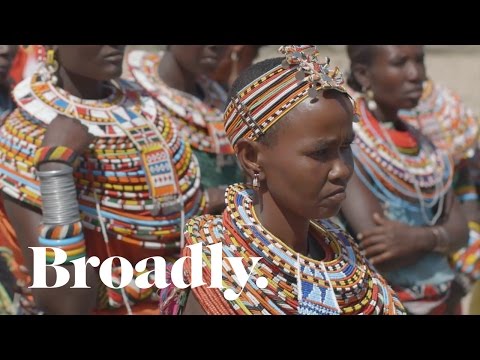
Where the foothills of Mount Kenya merge into the desert, the people of Samburu have maintained a strict patriarchy for over 500 years in northern Kenya. That is, until 25 years ago, when Rebecca Lolosoli founded Umoja village as a safe haven for the region's women. Umoja, which means "unity" in Swahili, is quite literally a no man's land, and the matriarchal refuge is now home to the Samburu women who no longer want to suffer abuses, like genital mutilation and forced marriages, at the hands of men.
Throughout the years, it has also empowered other women in the districts surrounding Samburu to start their own men-excluding villages. Broadly visited Umoja and the villages it inspired to meet with the women who were fed up with living in a violent patriarchy.
WATCH NEXT: Egg Freezing, Career Women, & the Future of Fertility - http://bit.ly/1MNUnha
The Abortion Pill - http://bit.ly/1DwQQSo
Searching for the Last Lesbian Bars in America - http://bit.ly/1J86cde
Kate Nash on Feminism & the Female Wayne's World: http://bit.ly/1JakrjV
Who's Afraid of Vagina Art? http://bit.ly/1NqxK2M
Spain's Sex Supermarket - http://bit.ly/1JcCycc
The Power Suit: http://bit.ly/1Mf8kpw
Rose McGowan on Sexism in Hollywood: http://bit.ly/1DvzkhP
Virginie Despentes on Killing Rapists: http://bit.ly/1DCDOmG
Come find us:
Broadly | https://broadly.vice.com
Facebook | https://www.facebook.com/BroadlyTV
Twitter | https://twitter.com/broadly
Tumblr | http://broadlytv.tumblr.com
Instagram | https://instagram.com/broadly
Pinterest | https://www.pinterest.com/broadlytv
Newsletter | http://bit.ly/1JKF1oA

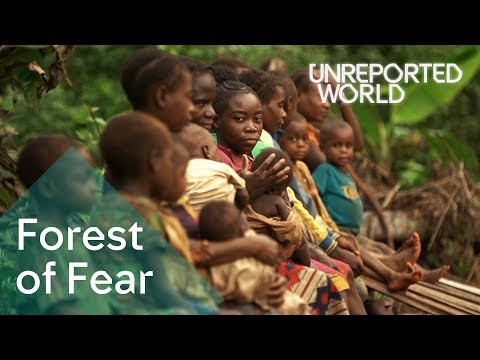
In ‘Unreported World’ we’re in the Congo with a tribe under threat, as the forest they hunt for food in is put off limits to protect the wildlife. The Baka tribe tell us of threats and intimidation by the proposed park’s guards who are part-funded by the World Wildlife Fund.
Ade Adepitan travels deep into the rainforests to see how the Baka are fighting for food. Is the survival of endangered species being put above their own?
WARNING: You may find scenes of
butchered animals upsetting.
Subscribe to our channel for more Unreported World episodes https://www.youtube.com/unreportedworld.

Congo Connection (2009): The mineral Coltan has fuelled a technological revolution in the West, but in the DRC it has become a talisman of brutal violence.
For similar stories, see:
Rage Of War In Congo
https://www.youtube.com/watch?v=vhHFHSNvTjo
Thousands Displaced In The Congo
https://www.youtube.com/watch?v=Nk9ZG20ymeE
The Future of Virunga's Mountain Gorillas Is In Jeopardy
https://www.youtube.com/watch?v=sYTht_-lOuw
Subscribe to journeyman for daily uploads:
http://www.youtube.com/subscri....ption_center?add_use
For downloads and more information visit:
http://www.journeyman.tv/film/4553
Like us on Facebook:
https://www.facebook.com/journeymanpictures
Follow us on Twitter:
https://twitter.com/JourneymanVOD
https://twitter.com/JourneymanNews
Follow us on Instagram:
https://instagram.com/journeymanpictures
Modern technology relies upon a mineral found in the Congo. Is our appetite for the latest gadgets fuelling rebel fighting in the Congo - threatening the survival of central Africas great gorillas?
On the inside of many devices like mobile phones and laptops is the mineral Coltan, which has made our gadgets smaller and more complex. In the mineral-rich Congo, armed militia watch over the children digging this mineral from the ground. "The government only pretends to help us" says one miner, who pays a government official just to work. "The Congo is a shifting sands of various militia, the largest of which is the Congolese state itself," explains an expert on blood minerals.
Yet the miners depend on the little they get from mining to survive. Electronic giants like Apple now claim they will no longer use Coltan from this area but experts are convinced the militias will smuggle it onto the market regardless. For local miners, the move away from African minerals is just another way of penalising Africans. Coltan fuels a conflict, which has seen national parks become war zones, gorillas killed for meat and hundreds of houses set on fire in turf wars over mineral territory. Yet it also feeds 400,000 petty traders. Why did it take a mobile phone to make us appreciate the injustice in the Congo?
ABC Australia – Ref. 4553
Journeyman Pictures is your independent source for the world's most powerful films, exploring the burning issues of today. We represent stories from the world's top producers, with brand new content coming in all the time. On our channel you'll find outstanding and controversial journalism covering any global subject you can imagine wanting to know about.
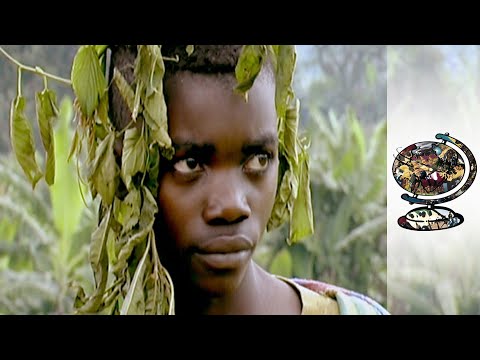
The Real Mobile Phone Wars - DRC, 10 October 2001
As the high tech age takes over more and more of our lives manufacturers will go to any lengths to get the sometimes scarce minerals that go into them. Tantalum is one such rare ingredient. Few of us know that in the middle of Africa much human suffering is created in the pursuit of it.
Subscribe to Journeyman here: http://www.youtube.com/subscri....ption_center?add_use
Coltan is a valuable metal because it can be processed and manufactured into a component called a capacitor, which sits on the circuit board of mobile phone and other portable electronic devices. The Democratic Republic of Congo is the world's second biggest supplier of coltan (after Australia), supplying an estimated 18 per cent of the world market. The trouble with coltan from Congo is that it is fuelling the war there. Various rebel groups and militias are mining, stealing, taxing and/or smuggling coltan to raise funds for their war effort. A recent UN report has declared the trade in coltan from Congo illegal because the legitimate and internationally recognised Government of the Democratic Republic of Congo does not license it. Instead the trade of coltan is helping to destabilise that government. Our reporter, JULIANA RUHFUS, travels via Uganda across the Kasindi border crossing, to Congo, her quest to find the source of coltan. Her often dangerous journey takes her via coltan traders, miners and warlords including the Mayi Mayi.
For more information, visit https://www.journeyman.tv/film/1170
Like us on Facebook: https://www.facebook.com/journeymanpictures
Follow us on Twitter:
https://twitter.com/JourneymanNews
https://twitter.com/JourneymanVOD
Follow us on Instagram: https://instagram.com/journeymanpictures
A report by Juliana Ruhfus for Unreported World. Produced by Mentorn. Ref. 1170
Distributed by Journeyman Pictures
![Dr. Molefi Asante: Toward the African Renaissance: A New Africa [2008]](https://i.ytimg.com/vi/bI_ISfsCYJ4/hqdefault.jpg)


HAPI Talks with HAPI Cast Member Dr. Leonard Jeffries about Economics, Politics and Culture.
Please visit www.hapifilm.com to get a copy of the Groundbreaking documentary film HAPI and all the latest HAPI gear.
Cash app: $hapifilm

When we walk into a supermarket, we assume that we have the widest possible choice of healthy foods. But in fact, over the course of the 20th century, our food system was co-opted by corporate forces whose interests do not lie in providing the public with fresh, healthy, sustainably-produced food.
Fortunately for America, an alternative emerged from the counter-culture of California in the late 1960s and early 1970s, where a group of political anti-corporate protesters–led by Alice Waters–voiced their dissent by creating a food chain outside of the conventional system. The unintended result was the birth of a vital local-sustainable-organic food movement which has brought back taste and variety to our tables.
FOOD FIGHT is a fascinating look at how American agricultural policy and food culture developed in the 20th century, and how the California food movement has created a counter-revolution against big agribusiness.
Want to watch more full-length Documentaries?
Click here: http://bit.ly/1GOzpIu
Follow us on Twitter for more - https://twitter.com/realstoriesdocs
Facebook - https://www.facebook.com/RealStoriesChannel
Instagram - @realstoriesdocs
Content licensed from Cargo Film & Releasing. Any queries, please contact us at: owned-enquiries@littledotstudios.com
Produced by Chris Taylor
How Corporations Ruined Food (Food Industry Documentary) - Real Stories