- General Videos
- Music
- Economics
- Health
- Travel & Events
- History
- Psychology
- Spirituality
- Movies
- News & Politics
- Kmtyw Combat Sciences
- Ɔbenfo Ọbádélé Kambon Videos
- Ɔbenfoɔ Kamau Kambon: Black Liberation Philosophy
- Science, Tech, Engineering and Math
- Permaculture
- Self-Sustainability
- Living Off Grid
- Yoruba Language Learning
- Education
- Mmɔfra Adesua
- Nana Kamau Kambon Playlist
- Livestream
- Komplementarity Kouples and Revolutionary Singles
- Abibitumi Film Series
- Decade of Our Repatriation
- Kwento xpr
- Live
Top videos


We are joined at 'Africanus Talks' by Dr Onyeka Nubia who is with us to talk about his book "Blackamoores: Africans in Tudor England, their Presence, Status and Origins" and his views on everything else from history to lifestyle!
Join us each Saturday for new content from 'Africanus World'
Website - [a]www.Africanusworld.com[/a]
Pateron - https://www.patreon.com/AfricanusWorld
Facebook - https://www.facebook.com/AfricanusWorld/
Twitter - https://twitter.com/AfricanusWorld
Instagram - https://www.instagram.com/africanuswo...
Pay Pal - https://www.paypal.com/cgi-bin/webscr...
Dr Onyeka Nubia resources
Website - http://www.narrative-eye.org.uk/
Twitter - https://twitter.com/narrativeeye?lang=en
Facebook - https://www.facebook.com/narrativeeye2017/?__tn__=%2Cd%2CP-R&eid=ARDYrwI-uitiXC5inc7dPzgwnG0T3BHtYb6VCyH_IvhhdQSjKNzNSbOTeRy5JOJ72cZro21qv4fRMoMV
Amazon - https://www.amazon.co.uk/Onyeka/e/B00... We are joined at 'Africanus Talks' by Dr Onyeka Nubia who is with us to talk about his book "Blackamoores: Africans in Tudor England, their Presence, Status and Origins" and his views on everything else from history to lifestyle! Join us each Saturday for new content from 'Africanus World'
Website - [a]www.Africanusworld.com[/a]
Pateron - https://www.patreon.com/AfricanusWorld
Facebook - https://www.facebook.com/AfricanusWorld/
Twitter - https://twitter.com/AfricanusWorld
Instagram - https://www.instagram.com/africanuswo...
Pay Pal - https://www.paypal.com/cgi-bin/webscr...
Dr Onyeka Nubia resources
Website - http://www.narrative-eye.org.uk/
Twitter - https://twitter.com/narrativeeye?lang=en
Facebook - https://www.facebook.com/narrativeeye2017/?__tn__=%2Cd%2CP-R&eid=ARDYrwI-uitiXC5inc7dPzgwnG0T3BHtYb6VCyH_IvhhdQSjKNzNSbOTeRy5JOJ72cZro21qv4fRMoMV
Amazon - https://www.amazon.co.uk/Onyeka/e/B00...


![Nelson Mandela Released [11 Feb 1990]](https://i.ytimg.com/vi/F37UPYyvl4I/hqdefault.jpg)

On February 11, 1990 Nelson Mandela was released from prison after 27 years. Watch the in-depth reporting from CBC News: The National on that historic day.
»»» Subscribe to CBC News to watch more videos: https://www.youtube.com/user/c....bcnews?sub_confirmat
Connect with CBC News Online:
For breaking news, video, audio and in-depth coverage: http://www.cbcnews.ca
Find CBC News on Facebook: https://www.facebook.com/cbcnews
Follow CBC News on Twitter: https://twitter.com/cbcnews
For breaking news on Twitter: https://twitter.com/CBCAlerts
Follow CBC News on Google+: https://plus.google.com/+CBCNews/posts
Follow CBC News on Instagram: http://instagram.com/cbcnews
Follow CBC News on Pinterest: https://www.pinterest.com/cbcnews//
Follow CBC News on Tumblr: http://cbcnews.tumblr.com
»»»»»»»»»»»»»»»»»»
For more than 75 years, CBC News has been the source Canadians turn to, to keep them informed about their communities, their country and their world. Through regional and national programming on multiple platforms, including CBC Television, CBC News Network, CBC Radio, CBCNews.ca, mobile and on-demand, CBC News and its internationally recognized team of award-winning journalists deliver the breaking stories, the issues, the analyses and the personalities that matter to Canadians.
![Nelson Mandela: Speaks at Southern University A & M College Baton Rouge [2000]](https://i.ytimg.com/vi/6YTYdnkCKJ0/hqdefault.jpg)

In one of the remotest parts of Africa, the Ethiopian tribe of Kwegu people live along the great Omo river. This documentary takes us deep into the territories of the Kwegu and Mursi tribes, introducing to the audience a rare glimpse of their daily life and special traditions.
The documentary series “Disappearing World” was originally broadcasted between 1970-1975.
As an anthropological landmark of its time, the series tells the story of traditional communities endangered by the modern world’s progressions.
The series stands as a historical document of daily life in remote and threatened societies, such as the Cuiva, Embera and Panare Indians of Colombia, the nomadic Tuareg of the Sahara, the Kurdish Dervishes and the Meo of China.
Subscribe to see more full documentaries every week:
https://bit.ly/2lneXNy
TRACKS publishes unique, unexpected and untold stories from across the world every week.
From "Disappearing World"
Facebook: https://www.facebook.com/TRACKSTravelChannel/
Content licensed from ITV Global.
Any queries, please contact us at: owned-enquiries@littledotstudios.com
owned-enquiries@littledotstudios.com


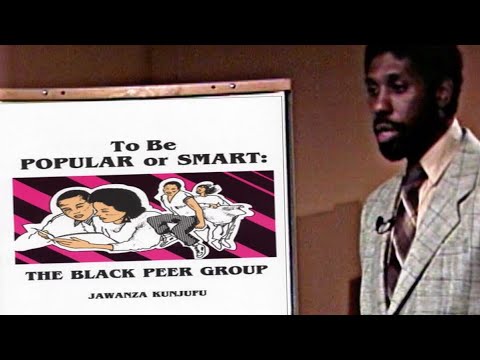
Video Lecture/ Companion to the million selling book by Dr. Jawanza Kunjufu, author of Countering The Conspiracy to destroy Black Boys. All of Dr. Kunjufu's books and videos are available for purchase at http://africanamericanimages.com Books can also be ordered through Amazon.com To book Dr. Kunjufu for a speaking engagement, email customersvc@africanamericanimages.com
Shared for historical purposes. I do not own the rights.
_____
"The phenomenon of peer pressure and its impact on
academic achievement has reached catastrophic propor-
tions. It has now reached a point that to do well academical-
ly in school is to act white and risk being called a nerd ora
brainiac. For males, the peer pressure is so great, you may be
called a sissy. Can you imagine the ancestor’s children, who
built the first civilization and taught the ancient Greek
scholars, attributing academic achievement to being
White? Please do not discern this solely to integration.
There are schools that only African-American students at-
tend, there are no White students, and they still say to be
smart is to be white.
Our students go to many kinds of schools. Some attend
all-Black schools in low-income neighborhoods, others at-
tend all-Black schools in middle-income communities,
others attend integrated, elite, magnet high schools where
admission is based on a test, some attend integrated schools
in the suburbs, and lastly some attend coed, homogeneous,
private schools. This book is written for students in all five
circumstances. In Philadelphia, the audience described ex-
periences from all five settings. They were surprised that in
the latter three environments—magnet schools, integrated
suburban schools, and private schools—negative peer
pressure still existed for their children. Many parents work-
ed very hard to live in more affluent neighborhoods and pay
tuition so their children could be ‘‘inspired”’ by a positive
peer group. Other parents like Namorahor my wife and I
were able to have our children admitted into elite magnet
schools, only to find this silent killer there too."
Jawanza Kunjufu is the author of over 25 books including national bestsellers, Countering the Conspiracy to Destroy Black Boys, State of Emergency: We Must Save African American Males, Solutions for Black America, Keeping Black Boys Out of Special Education, Raising Black Boys and his most recent, 200 Plus Educational Strategies to Teach Children of Color. His work has been featured in Ebony and Essence magazines and he has been a guest on BET and Oprah.
He has been guest speaker at most colleges and universities throughout the US, and has served as a consultant to most urban school districts. He has preached in numerous churches and taught seminary for eight years to doctoral students at Union Theological Seminary.
His other books include Black Students: Middle Class Teachers, Satan, I’m Taking Back My Health!, Developing Strong Black Male Ministries, An African Centered Response to Ruby Payne’s Poverty Theory, A Culture of Respect.
Kunjufu attended both the Morgan State University and the Towson State University exchange programs from 1972 to 1973. He went on to Illinois State University where he earned his BS in 1974. He went on to get his PhD from Union Graduate School in 1984.
#####
Reelblack's mission is to educate, elevate, entertain, enlighten, and empower through Black film. If there is content shared on this platform that you feel infringes on your intellectual property, please email me at Reelblack@mail.com and info@reelblack.com with details and it will be promptly removed.