- General Videos
- Music
- Economics
- Health
- Travel & Events
- History
- Psychology
- Spirituality
- Movies
- News & Politics
- Kmtyw Combat Sciences
- Ɔbenfo Ọbádélé Kambon Videos
- Ɔbenfoɔ Kamau Kambon: Black Liberation Philosophy
- Science, Tech, Engineering and Math
- Permaculture
- Self-Sustainability
- Living Off Grid
- Yoruba Language Learning
- Education
- Mmɔfra Adesua
- Nana Kamau Kambon Playlist
- Livestream
- Komplementarity Kouples and Revolutionary Singles
- Abibitumi Film Series
- Decade of Our Repatriation
- Kwento xpr
- Live
Latest videos
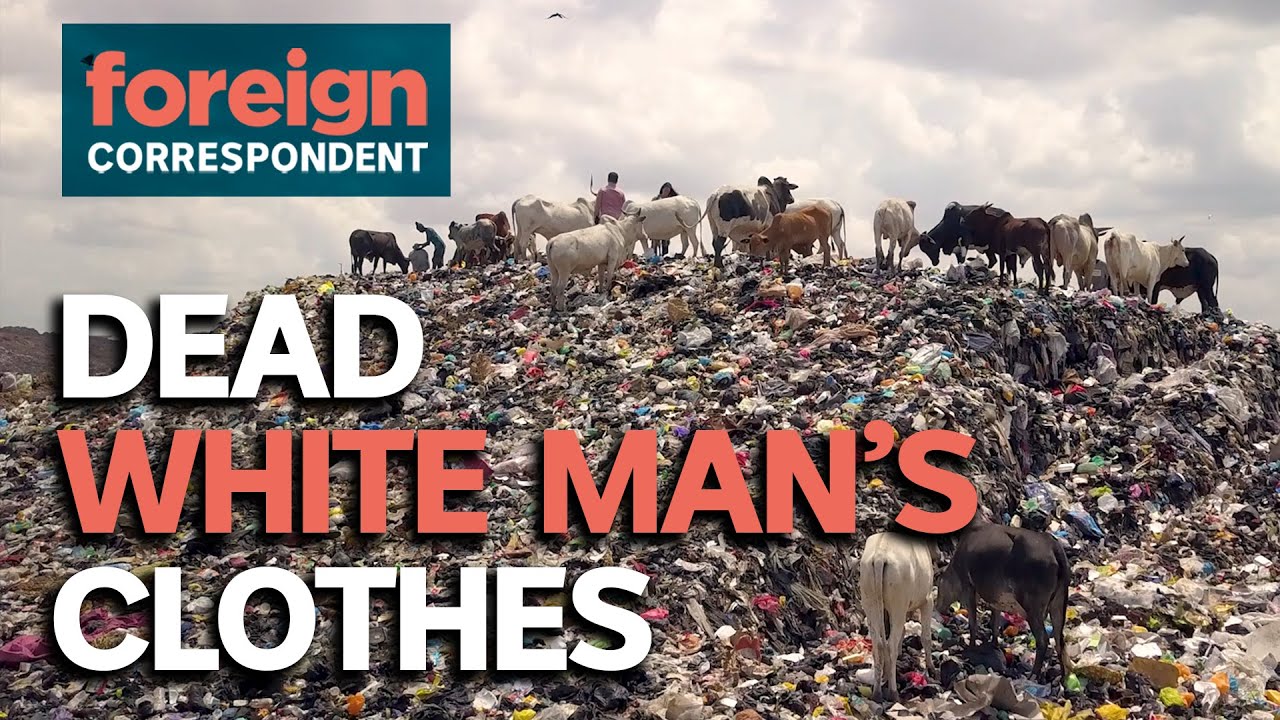

The dark side of the world’s fashion addiction. Many of our old clothes, donated
to charities, end up in rotting textile mountains in West Africa. This is a story
about how our waste is creating an environmental disaster.
Have you ever thought about what happens to your old clothes after you drop them off at the
op shop? It might be time to start, because these goodwill gestures are helping to fuel an environmental catastrophe on the other side of the world.
When charities in Australia can’t sell donated clothing, tonnes of it ends up being exported to
countries like Ghana, in West Africa. Ship after ship docks every week with bales from Europe,
the US, China and Australia.
They call them ‘Dead White Man’s Clothes’. Once they arrive in Ghana, they’re taken to the
bustling Kantamanto markets in the capital Accra and from here, they make their way to
villages and towns across the country.
The industry provides jobs for thousands of people, like Asare Asamoah, a successful importer.
He brings in clothes, mainly from the United Kingdom, and if they’re good quality, he can make
a decent living.
But it’s risky business. He has to pay upfront for a bale and never knows whether it’s trash or
treasure. With cheap, fast fashion flooding the world, the quality of the clothes arriving in
Ghana is getting worse and worse.
‘Sometimes you’ve gone and bought something, then you don’t get what you want’, says
Asamoah. ‘Then you lose your money.”
And there’s a dark side to this industry.
Correspondent Linton Besser travels to Ghana to uncover the dirty secret behind the world’s
fashion addiction.
While 60 per cent of imported fashion items are reused and resold, 40 per cent are rubbish,
creating an environmental catastrophe for this poor nation.
With the main dumpsite for textile waste now full, unregulated dumpsites ring the city. These
fetid clothes mountains are often set on fire, filling the skies with acrid smoke.
‘It is totally a disservice to us in this part of the world because we have become sort of the
dumping ground for the textile waste that is produced from Europe, from the Americas”, says
Accra’s waste manager, Solomon Noi.
Emmanuel Ajaab imports used clothes from Australia but he despairs at the poor quality of the
clothes that arrive. From a bale of about 200 garments, he finds only seven he can resell at a
good price.
“In Europe and UK and Australia, America, they think Africa here, sorry to say, we are not like a
human being”, he tells Foreign Correspondent.
The dumped textiles also get swept up in the monsoonal rains and end up choking the city’s
waterways and beaches, posing a danger to fishermen and aquatic life. Liz Ricketts, who runs
an NGO campaigning for awareness of Ghana's textile waste crisis, lays the blame at the feet
of international fashion houses.
“Waste is a part of the business model of fashion. A lot of brands overproduce by up to 40 per
cent”, says Ricketts.
Noi begs the people who donate their clothes to think twice about where they end up.
“If they come here, like you've come, and you see the practicality for yourself, then they will
know that, no, we better take care of these things within our country and not to ship that
problem to cause problems to other people.”
About Foreign Correspondent:
Foreign Correspondent is the prime-time international public affairs program on Australia's national broadcaster, ABC-TV. We produce half-hour duration in-depth reports for broadcast across the ABC's television channels and digital platforms. Since 1992, our teams have journeyed to more than 170 countries to report on war, natural calamity and social and political upheaval – through the eyes of the people at the heart of it all.
Contributions may be removed if they violate ABC’s Online Terms of Use http://www.abc.net.au/conditions.htm (Section 3). This is an official Australian Broadcasting Corporation YouTube channel

Nigeria grows 63 million metric tons of cassava (also known as yuca or manioc) every year, but most of the country's supply is eaten locally as fufu or garri. Experts say Nigeria could be missing out on billions in exports of lucrative cassava products like bubble tea pearls, starch, or ethanol. Challenges along the country's entire supply chain have caused hundreds of millions of dollars in cassava spoilage. But one entrepreneur, Yemisi Iranloye, thinks she has the solution. She's introduced higher-yielding seed varieties and moved processing plants closer to farms. Now, her farmers earn four times more for their product, and her cassava starch and sorbitol have landed her clients like Nestle and Unilever. Could Yemisi's model be the way for Nigeria to feed itself and cash in on exports?
0:00 Intro
1:48 History of cassava
2:58 Growing issues
5:42: How garri and fufu are made
6:54 Transportation issues
7:36 How cassava is processed
10:06 Global demand is so high for cassava
MORE BIG BUSINESS VIDEOS:
How Used Luxury Watches Became A $20 Billion Industry | Big Business | Insider Business
https://youtu.be/BgdxjmGN7B4
How 23 Foods Get To The Grocery Store | Big Business | Insider Business
https://youtu.be/4ArVvrhhnyI
How $2,500 Fedora Hats Are Made | Big Business | Insider Business
https://youtu.be/GRP5-WXuFHw
------------------------------------------------------
#nigeria #bigbusiness #insiderbusiness #africa #farming #yuca #bigbusiness
Insider Business tells you all you need to know about business, finance, tech, retail, and more.
Visit our homepage for the top stories of the day: https://www.businessinsider.com
Insider Business on Facebook: https://www.facebook.com/businessinsider
Insider Business on Instagram: https://www.instagram.com/insiderbusiness
Insider Business on Twitter: https://www.twitter.com/businessinsider
Insider Business on Snapchat: https://www.snapchat.com/disco....ver/Business_Insider
Insider Business on TikTok: https://www.tiktok.com/@businessinsider
Nigeria Is The World's Biggest Cassava Producer. So Why Doesn't It Make Money Off Exports?

➡️ Sign Up Today To Join The 'I Never Knew Tv' Movement:
https://ineverknewtv.com/sign-up/
➡️ Watch More Reasonings From Mutabaruka:
https://ineverknewtv.com/mutabaruka/
In this reasoning Rastafari dub poet, musician, actor, educator, and radio host Mutabaruka criticizes West Indian people who deny their African ancestry.
➡️ Please subscribe to Mutabarukas' new internet radio station Rasss Internet: https://rasssinternet.today
➡️ Listen To The 'Generation Gap Riddim':
🔥🇬🇳 https://ingrv.es/generation-gap-riddi-3qn-i 🇬🇳🔥
#mutabaruka #ineverknewtv


In this video we discuss the state of liberation for African peoples worldwide.
Enjoy! ✊🏿🌍
Register for the Investors Roundtable at https://t3andme.org/events
Reach Us At:
https://t3andme.org/consultations
Repat Travel Guide:
https://www.amazon.com/shop/t3me
If you’d like to support the channel:
CashApp: $FordsHerbal
PayPal: PayPal.me/fordsherbaldoula
Follow us on Instagram: https://Instagram.com/_timfordjr


#TheNewBlackMind
► Subscribe to Transatlantic Productions 💥Smash The LIKE Button👍🏿 Share↗️ & hit the Notifications Bell 🔔
► Donate so we can complete the upload https://www.gofundme.com/tapvideo
► Cash App: $Tapvideo $Moneymark0730 $BrotherRonn
► Share on video on all Social Media.
► Website https://tapvideo.blogspot.com
https://www.facebook.com/Tapvi....deocom-7441435789873
► Back up Channels:
https://www.youtube.com/channe....l/UCs9-wRHfFb7v7RQAi
https://www.youtube.com/user/savejamaica


Human Zoos tells the shocking story of how thousands of indigenous peoples were put on public display in America in the early decades of the twentieth century.
"A racially charged story that will mesmerize you...." —Oregon Documentary Film Festival.
👉 For more about the movie, additional information and clips be sure to visit the film's website at https://humanzoos.org/.
Often touted as "missing links" between man and apes, these native peoples were harassed and demeaned. Their public display was arranged with the enthusiastic support of the most elite members of the scientific community, and it was promoted uncritically by American's leading newspapers. This award-winning documentary explores the heartbreaking story of what happened, shows how African-American ministers and other people of faith tried to push back, and reveals how some people today are still drawing on Social Darwinism in order to dehumanize others. The film also explores the tragic story of eugenics in America, the effort to breed human beings based on Darwinian principles.
Human Zoos was an official selection of the African World Documentary Film Festival and has won awards for Best Editing (Oregon Documentary Film Festival), Best in Show (Cinema WorldFest Awards) and Awards of Excellence from the Impact Docs Awards and the Hollywood Independent Documentary Awards.
Be sure to check out these other videos about social Darwinism.
The Biology of the Second Reich: Social Darwinism and the Origins of World War 1
https://youtu.be/9n900e80R30
Darwin Day in America
https://youtu.be/cm4WuWOatjs
The War on Humans
https://youtu.be/RWcEYYj_-rg
============================
The Discovery Science News Channel is the official Youtube channel of Discovery Institute's Center for Science & Culture. The CSC is the institutional hub for scientists, educators, and inquiring minds who think that nature supplies compelling evidence of intelligent design. The CSC supports research, sponsors educational programs, defends free speech, and produce articles, books, and multimedia content. For more information visit https://www.discovery.org/id/
http://www.evolutionnews.org/
http://www.intelligentdesign.org/
Follow us on Facebook and Twitter:
Twitter: @discoverycsc
Facebook: https://www.facebook.com/discoverycsc/
Visit other Youtube channels connected to the Center for Science & Culture
Discovery Institute: https://www.youtube.com/user/DiscoveryInstitute
Dr. Stephen C. Meyer: https://www.youtube.com/user/DrStephenMeyer
The Magician's Twin - CS Lewis & Evolution: https://www.youtube.com/user/cslewisweb
Darwin's Heretic - Alfred Russel Wallce: https://www.youtube.com/user/AlfredRWallaceID