- General Videos
- Music
- Economics
- Health
- Travel & Events
- History
- Psychology
- Spirituality
- Movies
- News & Politics
- Kmtyw Combat Sciences
- Ɔbenfo Ọbádélé Kambon Videos
- Ɔbenfoɔ Kamau Kambon: Black Liberation Philosophy
- Science, Tech, Engineering and Math
- Permaculture
- Self-Sustainability
- Living Off Grid
- Yoruba Language Learning
- Education
- Mmɔfra Adesua
- Nana Kamau Kambon Playlist
- Livestream
- Komplementarity Kouples and Revolutionary Singles
- Abibitumi Film Series
- Decade of Our Repatriation
- Kwento xpr
- Live
Top videos




It's being called a game changer - and the start of a new era. Germany has promised to begin returning the artefacts known as the Benin Bronzes to Nigeria next year, making it the first country to do so.
Germany has a collection of just over 1,000 Benin Bronzes. They're on display in museums in Cologne, Dresden, Hamburg, Leipzig, and Stuttgart. The sculptures and metal plaques are from the ancient Kingdom of Benin - which is today known as Edo State in southern Nigeria. The Bronzes were looted by British soldiers in 1897 and sold to museums in North America and Europe. The largest collection of the Bronzes is held by the British Museum.
Nigeria has been trying to get the bronzes back for decades. Without success. But momentum has been building over the last few years... with calls growing ever louder for artefacts seized during the colonial era to be returned to their places of origin. Germany's culture minister explained why Berlin had decided to act now. She said:
''We are confronting our historic and moral responsibility. We want to contribute to a common understanding and reconciliation with the descendants of the people who were robbed of their cultural treasures during the times of colonialism.''
It's not just the Benin Bronzes from Nigeria that are wanted by their rightful owners. There is also a claim from Cameroon from where a special artefact known as the Tangay was stolen from a local King. More than a century later it is still in Germany. But not everyone in Cameroon is of the view that it should be brought back to the country.
In Douala, Cameroon Prince Kum'a Ndumbe III has been advocating for the return of the Tangue, a sculpture stolen from his grandfather in 1884. Prince Ndumbe has made a copy of the Tangue and put it on show in Cameroon.
The original artifact - looted by the Germans during colonial times - is on display at a museum in Munich.
But not everyone agrees that the Tangue should be immediately returned. Princess Marilyn Douala Bell is an artist and founder of an art center in Douala. Even though her great-grandfather was executed in 1914 for resisting German rule, Marilyn thinks Cameroon is not ready to receive the artefact.
Others in Douala also claim to be the rightful owners of the Tangue. At least one more descendant of a Douala King has made a claim on the artifact. For Marilyn this is a source of concern. She wants the tangue to be returned but fears the conditions are currently not right.
Subscribe: https://www.youtube.com/user/d....eutschewelleenglish?
For more news go to: http://www.dw.com/en/
Follow DW on social media:
►Facebook: https://www.facebook.com/deutschewellenews/
►Twitter: https://twitter.com/dwnews
►Instagram: https://www.instagram.com/dwnews
Für Videos in deutscher Sprache besuchen Sie: https://www.youtube.com/dwdeutsch
#BeninBronzes #Nigeria #LootedArtefacts


↓TRACKLIST↓ Vol.1
1. Kélétigui & ses Tambourinis - Soundiata : 00:00
2. Balla & ses Balladins - Diaraby : 05:52
3. Kebendo Jazz - Soumba : 12:04
4. Horoya Band National - Karan-Gbegne : 16:20
5. Bembeya Jazz National - Djanfamagni : 20:25
6. Orchestre de la Paillote - Kankan-Yarabi : 24:34
7. Orchestre de Dabola - Semba : 27:41
8. Orchestre de Beyla - O.U.A : 31:54
9. Palm Jazz - R.D.A : 36:47
10. Bembeya Jazz National - Minuit : 41:55
11. Orchestre du Jardin de Guinée - P.D.G : 45:04
12. Orchestre de Beyla - Koukou Befo : 49:39
13. Kebendo Jazz - Information : 53:47
14. Orchestre de Kindia - La Guinée Wodi : 56:54
15. Super Boiro Band - Mariama : 01:00:15
16. Bembeya Jazz National - Boiro : 01:07:02
↓TRACKLIST↓ Vol.2 ▷▷ http://bit.ly/2zUGdt8
1. 22 Novembre Band - Kouma
2. Kélétigui & ses Tambourinis - Miri Magnin
3. Pivi & ses Balladins - Samba
4. Bembeya Jazz National - Bembeya
5. Horoya Band National - Were Were
6. Soumbory Jazz - Nana
7. Palm Jazz - Zimaï
8. Syli Authentic - Fabara
9. Camayenne Sofa - Karamoko
10. Tropical Djoli Band de Faranah - Soko
11. Nimba Jazz - Ziko
12. Le Simandou de Beyla - Festival
↻ ÉCOUTEZ / TÉLÉCHARGEZ la compilation "The Syliphone Years : Authenticité Vol.1" : http://smarturl.it/5q0coz
↻ ÉCOUTEZ / TÉLÉCHARGEZ la compilation "The Syliphone Years : Authenticité, Vol 2" : http://smarturl.it/rjj4eb
Pays : Guinée
Label : Syliphone
Production : Syllart Records / Sterns Music
Année : 2007
The Syliphone Years
Au lendemain de la décolonisation de la Guinée, le nouveau président Sékou Touré s'affirme comme le promoteur d'une réhabilitation de l'authenticité africaine face au déni colonial des cultures colonisées. Dans une perspective d'unité nationale et panafricaine, les artistes obtiennent le statut de fonctionnaire d'état et sont encouragés par le gouvernement à composer et écrire de nouvelles chansons dans un style plus moderne, tout en puisant dans le répertoire des récits historiques et des musiques ancestrales de l'aire Mandingue. Le fer de lance de cette politique n'était autre qu'un label d'état, le label Syliphone, dont les enregistrements sont de formidables témoignages du dynamisme et des richesses culturelles d'un peuple à l'aube de son indépendance qui porte au monde la voix de sa révolution.
► Authenticité : les orchestres nationaux et fédéraux guinéens (1965-1980)
Ce double album compile les merveilles du catalogue authenticité ainsi qu’un grand nombre d’enregistrements jamais édités en CD. Tous les grands orchestres de cette belle époque sont présents comme le Bembeya Jazz, Keletigui et ses Tambourinis, Balla et ses Balladins. Mais on y découvre également des orchestres moins connus, comme le Syli Autentic, le Kebendo Jazz ou le Palm Jazz, qui rivalisaient tout autant de leurs qualités propres lors des célèbres Festivals des Arts qui leur permettaient d'être promu au rang d'orchestre national et de s'assurer une carrière internationale et panafricaine.
(Texte : J.Dayan / Syllart Records)
↻ ÉCOUTEZ / TÉLÉCHARGEZ la compilation "The Syliphone Years : Authenticité Vol.1" : http://smarturl.it/5q0coz
↻ ÉCOUTEZ / TÉLÉCHARGEZ la compilation "The Syliphone Years : Authenticité, Vol 2" : http://smarturl.it/rjj4eb
▷ Abonnez-vous à Syllart Records : http://bit.ly/2vGqE5i
✔ Likez #Syllart sur FACEBOOK - https://facebook.com/Syllartrecords

Learning more about the current state of Honduras. My Instagram: https://www.instagram.com/indigo.traveller/
-My Patreon (A way to support these videos): https://www.patreon.com/indigotraveller
-Where I get music for my videos (free 30 day trial): http://share.epidemicsound.com/indigotraveller
-Offset your carbon footprint here: https://www.wren.co/join/indigotraveller
-Omare's channel: https://www.youtube.com/channe....l/UC8b1032HLiunrIy7-
-Luis's music: https://www.facebook.com/Luissabaya/
-Copa Númada (football club):https://www.facebook.com/Copa-....N%C3%BAmada-HN-10320
My Facebook: https://www.facebook.com/watch/theindigotraveller/
My e-mail: nick@indigotraveller.org
Thanks for watching!

Music students download the technique of their favorite pianist or singer directly into their brains. Medical students download the skills of a seasoned surgeon or diagnostician. And each one of us routinely uploads our thoughts and memories to the digital cloud. While these scenarios still lie in the future, rudimentary versions of the necessary brain-to-brain technology exist today. But the ability to directly influence another person’s brain raises serious questions about human rights and individual freedoms. This program will present the latest technology and explore how the ethical implications of enhanced thinking go to the heart of consciousness itself.
This program is part of the Big Ideas Series, made possible with support from the John Templeton Foundation.
Our media partner for this program is Popular Science.
Footage of the brain-to-brain interface experiment provided by the University of Washington. For more information on the research:http://www.washington.edu/news..../2014/11/05/uw-study
Subscribe to our YouTube Channel for all the latest from WSF.
Visit our Website: http://www.worldsciencefestival.com/
Like us on Facebook: https://www.facebook.com/worldsciencefestival
Follow us on twitter: https://twitter.com/WorldSciFest
MODERATOR: John Donvan
PARTICIPANTS: Joseph Fins, Miguel Nicolelis, Chantel Prat, Andrea Stocco, Seung-Schik Yoo
Original Program Date: June 4, 2016
The Dawn of Brain-to-Brain Communication 00:00
John Donvan's Introduction to Brain to Brain communication. 2:22
Participant Introductions. 4:10
What to keep in mind when thinking about brain to brain communication. 6:22
How does one get into the mind business? 8:15
Aurora the monkey plays a game with just her brain.11:05
Transitioning to human brain to brain research. 18:41
Connecting the brains of two rats. 22:27
The tangled ball of neurons in our head is "us" 29:40
The puppet master describes linking two humans through their brains. 32:33
Using focused ultrasound to connect two human brains. 42:19
What are the contemplative factors in brain to brain communication? 49:50
If you can get two animals to communicate can you link 100? 54:09
The worry of people controlling your brain. 59:48
The risk of sharing thoughts from one brain to another. 1:02:54
How long until we can just download knowledge to our brains? 1:07:40
Giving credit to Arthur Clarke. 1:09:28
Is there any fear of brain damage from this technology? 1:10:20
Is it crazy to think we will all have chips in our brains? 1:13:01
What are the goals of brain to brain communication in the next 5 years? 1:17:33
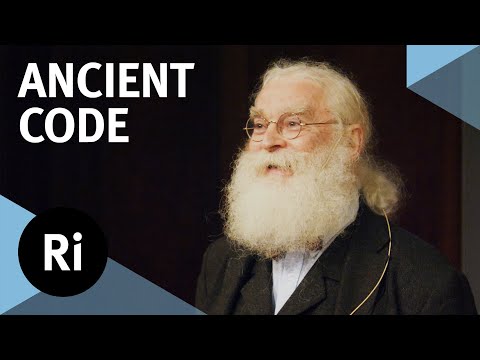
Writing is generally agreed to be among the greatest inventions in human history, perhaps the greatest invention, since it made history possible.
Subscribe for regular science videos: http://bit.ly/RiSubscRibe
You can read more about Irving's quest to explore the Noah's Ark myth in "The Ark Before Noah: Decoding the Story of the Flood": https://geni.us/zU95bVO
or learn more about cuneiform writing in "Cuneiform": https://geni.us/eMPb
Writing seems to have been invented in the late fourth millennium BC in Mesopotamia in the form of wedge-shaped marks pressed into soft clay with a reed stylus: the script known as cuneiform. Through his work on this ancient language, Irving Finkel, has uncovered amazing secrets from over five thousand years ago, including the story behind Noah’s ark.
Irving Finkel is the curator in charge of cuneiform inscriptions on tablets of clay from ancient Mesopotamia at the British Museum, of which the Middle East Department has the largest collection of any modern museum. This work involves reading and translating all sorts of inscriptions, sometimes working on ancient archives to identify manuscripts that belong together, or even join to one another. He is the author of The Ark Before Noah: Decoding the Story of the Flood.
This talk was filmed in the Ri on 18 January 2019.
---
A very special thank you to our Patreon supporters who help make these videos happen, especially:
Dave Ostler, David Lindo, David Schick, Erik Shepherd, Greg Nagel, Ivan Korolev, Joe Godenzi, Julia Stone, Kellas Lowery, Lasse T. Stendan, Lester Su, Osian Gwyn Williams, Paul Brown, Radu Tizu, Rebecca Pan, Robert Hillier, Roger Baker, and Will Knott.
---
Subscribe for regular science videos: http://bit.ly/RiSubscRibe
The Ri is on Patreon: https://www.patreon.com/TheRoyalInstitution
and Twitter: http://twitter.com/ri_science
and Facebook: http://www.facebook.com/royalinstitution
and Tumblr: http://ri-science.tumblr.com/
Our editorial policy: http://www.rigb.org/home/editorial-policy
Subscribe for the latest science videos: http://bit.ly/RiNewsletter
Product links on this page may be affiliate links which means it won't cost you any extra but we may earn a small commission if you decide to purchase through the link.