- General Videos
- Music
- Economics
- Health
- Travel & Events
- History
- Psychology
- Spirituality
- Movies
- News & Politics
- Kmtyw Combat Sciences
- Ɔbenfo Ọbádélé Kambon Videos
- Ɔbenfoɔ Kamau Kambon: Black Liberation Philosophy
- Science, Tech, Engineering and Math
- Permaculture
- Self-Sustainability
- Living Off Grid
- Yoruba Language Learning
- Education
- Mmɔfra Adesua
- Nana Kamau Kambon Playlist
- Livestream
- Komplementarity Kouples and Revolutionary Singles
- Abibitumi Film Series
- Decade of Our Repatriation
- Kwento xpr
- Live
Top videos
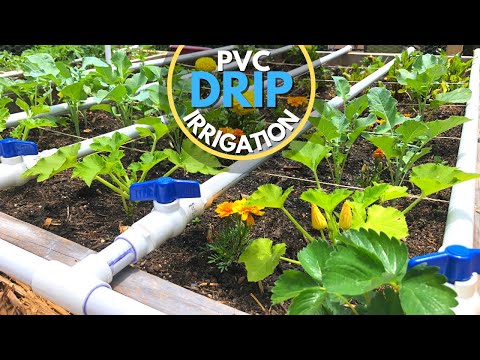

In this video, Robert explains his process for creating a PVC drip irrigation system for his raised square foot garden.
Robert also shows how he is using his rain barrel water system that can be controlled by his smart phone to turn the drip irrigation system on and off.
A comparison between class 200 and schedule 40 PVC is also performed, and Robert explains his thoughts between the two types.
Overall, Robert’s goal was to keep the overall cost low for creating a DIY PVC drip irrigation system but also making the system easy to disassemble, reassemble and flexible for different types of gardens.
Video Links:
►Smart WiFi Relay (Control Rain Barrel Water Pump Remotely): https://youtu.be/cLKAEB7Xl2k
►Rain Barrel Water Pump: https://youtu.be/opgxarh0G9Q
Below you can find the majority of the parts and cut dimensions Robert used in the video.
Parts / Items Used In Video:
► PVC Pipe - https://www.homedepot.com/p/Ch....arlotte-Pipe-3-4-in-
► PVC Ball Valve - https://amzn.to/3f7igVO
► PVC Tee - https://amzn.to/3f5u2jF
►PVC 90 Degree Elbow - https://amzn.to/2QFDeC2
►PVC Male Adapter - https://www.homedepot.com/p/Ch....arlotte-Pipe-3-4-in-
►PVC FNPT x FHT Swivel (Garden Hose Adapter) - https://www.homedepot.com/p/3-....4-in-FNPT-x-FHT-PVC-
►PVC End Cap - https://amzn.to/3oBn899
►Oatey PVC Primer & Cement - https://amzn.to/3bGAU55
►Telfon Tape - https://amzn.to/3oBStYY
►1/16” Drill Bit - https://amzn.to/3f5sN47
►3” Exterior Screws - https://amzn.to/3f72NW8
►EXPO Black Marker - https://amzn.to/3oBRNCU
►Power Drill - https://amzn.to/2SaWYOn
Optional Items:
►Quick Grip Clamps (Kit): https://amzn.to/39Iripd
PVC Cut Dimensions & Quantity
►5x - 68-3/4”
►5x - 2-3/4”
►4x - 10-1/2”
►2x - 2-1/2”

**LINK BELOW FOR IN-CLASS USE INSTRUCTIONS**
Virtual Plant Cell: Into Aquaporins highlights the important role that aquaporin proteins play in shuttling water, carbon dioxide and other molecules vital to good plant health, into and out of plant cells.
See https://plantenergy.edu.au/outreach/resources for materials to support classroom use of VPC: Into Aquaporins. This is a curriculum-aligned resource that addresses topics including diffusion across membranes, transcription and translation. This video can also be used with the lesson plan resource: Planting Science: Classifying Systems in Cells (year 7-10), developed by the ARC Centre of Excellence for Translational Photosynthesis: http://photosynthesis.org.au/years7-10/
Virtual Plant Cell (VPC) is a suite of educational virtual reality experiences created by the ARC Centre of Excellence in Plant Energy Biology. Explore and learn about the sub-microscopic inner world of a plant. www.plantenergy.edu.au/VPC
Subtitled. Full transcript below.
CREDITS:
3D Modelling and Animations: Peter Ryan, Tail Art, www.peterryanart.com.au
Graphic and Logo Design: Chris Brown, Eyecue Design, www.eyecue.com.au
Music: Jim Kennedy, Audiosimian, www.audiosimian.com
Voice Over: Glenn Hall
Science from the ARC Centre of Excellence in Plant Energy Biology with support from the ARC Centre of Excellence for Translational Photosynthesis. Project led by Karina Price and the researchers of the ARC Centre of Excellence in Plant Energy Biology.
Funded by the Australian Research Council.
TRANSCRIPT:
Plants are amazing. They create energy from sunlight and they use this energy to create what we use for our food, fuel and fibre, and this takes us on a journey deep into the inner world of a plant cell.
Plant cells collect sunlight and use it to convert water and carbon dioxide into sugar. This process is called photosynthesis. Photosynthesis happens inside the many green chloroplasts found around a plant cell.
The movement of water, carbon dioxide and other molecules like nitrogen, sugars and salts are vital for good plant health.
But how do water and other solutes get into the cell? Aquaporins are here to help. Aquaporins are tiny protein channels that are created in plant cells. They facilitate diffusion, the movement of important solutes, across cell membranes.
Aquaporins can be found in different membranes of the cell.
Water, carbon dioxide, and more is moved across these membranes, via aquaporin channels, as required.
Let’s see how plant cells create aquaporins when needed.
Proteins like aquaporins are coded for by genes. This is a sequence of information within a cell’s DNA. A message, called RNA, is first created from a gene through a process called transcription.
Messages move out of the nucleus to the ribosome. Here, the RNA message is “read” to create an aquaporin protein. This process of building a protein from an RNA message is called translation.
Aquaporins, like all proteins in a cell, have a unique structure. An aquaporin’s main function is to act as a channel that sits in a membrane. The aquaporin’s structure reflects this role.
Through research we can come to understand how aquaporins work, and how they work best. We can apply this knowledge to produce higher yielding crop plants by maximising their photosynthesis, improving their salt tolerance and enhancing their ability to survive challenging environmental conditions. And more efficient and resilient crops will ensure a secure food future.

#ValueAddition
Making Cakes and Bread from Sweet Potato Value Addition - Bungoma County Part 1
www.Farmers.co.ke is the site for authoritative multimedia agricultural and agribusiness content.
Visit us today for farming news, agribusiness tips, practical expert advice and industry updates.
SMS: 22071



Wongel Zelalem reports on Chinese migrants aided by Nigerian soldiers allegedly hurt!ng a mechanic at Ofada in Ogun state Nigeria, Olujimi Ogunbona is a 50 year old man.
Connect with Wongel👇🏽
https://www.youtube.com/wongelzelalem (YT Channel)
https://www.instagram.com/wongelzelalem/ (Instagram)