







- General Videos
- Music
- Economics
- Health
- Travel & Events
- History
- Psychology
- Spirituality
- Movies
- News & Politics
- Kmtyw Combat Sciences
- Ɔbenfo Ọbádélé Kambon Videos
- Ɔbenfoɔ Kamau Kambon: Black Liberation Philosophy
- Science, Tech, Engineering and Math
- Permaculture
- Self-Sustainability
- Living Off Grid
- Yoruba Language Learning
- Education
- Mmɔfra Adesua
- Nana Kamau Kambon Playlist
- Livestream
- Komplementarity Kouples and Revolutionary Singles
- Abibitumi Film Series
- Decade of Our Repatriation
- Kwento xpr
- Live
Top videos


To donate to our course
Buy us a coffee https://www.buymeacoffee.com/africanbuzz
Burkina Faso to publish their own textbooks
#burkinafaso #traoré #senegal #senegal #sonko #diomayefaye #diomayepresident #niger #tiani #burkinafaso #mali #niger #g5 #france #ibrahim #tchiani #mali #assimi #goita #burkinafaso #africa #african #kenya #africanclimatesummit #climatechange #climate #carbondioxide #china #africa #african #niger #france #french #france24 #ambassador #africanamerican #nigeria #gabon #ecowas #chad #congo #africaunite
Please SUBSCRIBE, LIKE, COMMENT and Share, Thank for Watching
#Love
#Peace
#theafricawewant

In the early 1900s, Germany carried out one of the first genocides of the 20th century, wiping out over 80% of the Herero and Nama people in Namibia. This brutal campaign, fueled by colonial ambitions, involved mass killings, forced labor, and starvation. This documentary uncovers the horrors of this forgotten atrocity and its lasting impact on Namibia’s history.
This video is for documentary and educational purposes. No images and footage shown are intended to shock the viewer. Everything is displayed in context and censored as much as possible without sacrificing the need to tell a compelling story with the actual footage.
If you love our work, consider supporting the channel via Patreon:
https://www.patreon.com/bisimedia
Become a Channel Member to get access to perks:
https://www.youtube.com/channe....l/UC9hKpjMxWev7U81xL
Naira Account No:
7810120458, Wema Bank
Buy Kema a Coffee:
www.buymeacoffee.com/kema
*****
Video Sources:
Germany’s Black H0l0c@ust 1890-1945 by Carr Firpo
The Kaiser’s H0l0c@ust by Casper Erichsen and David Olusoga
*****
Clips and Image credits:
Getty Images: https://www.youtube.com/c/gettyimages
AI Images: Midjourney AI
AP Archive: https://www.youtube.com/c/APArchive
Maps: https://www.freevectorflags.com
www.vemaps.com
https://davidrumsey.com
Free Piks: https://www.freepik.com
Adeyinka Makinde: https://www.youtube.com/channe....l/UCKARV7TfiudYewrT1
The Mic I Use: https://amzn.to/3EvGYKD
Music used: Music Used: https://share.epidemicsound.com/b3whp2
#bisi #namibia
****
All materials in this video are used for educational purposes and fall within the fair use guidelines. No copyright infringement is intended.
AFFILIATE DISCLOSURE: There may be a few links in this description that, at no cost to you, will earn me a commission if you click them and purchase. Don’t worry, we only ever promote things that have genuinely helped us.
Copyright © Bisi Media 2024


In the Early Modern Period (around 1500-1800), West Central Africa (modern day Angola, the Congos, and Gabon) was home to a variety of different types of cloth and clothing. In this video, we discuss some of the textiles, jewelry, and other adornment that people in this region wore to cover up or show off status, primarily focusing on the kingdoms of Kongo, Ndongo, and to a lesser extent Loango. Join us as we explore some Central African Fashion History! This video is part of Untold Black History III, a collaboration for Black History Month discussing interesting and positive Black history from around the world. No Generative AI was used in the creation of this video.
Check out the Untold Black History III playlist here: https://www.youtube.com/playlist?list=PLivC9TMdGnL8Nnt6Ra8JPQUzHCPI9tcUE&jct=5s3lCP4eK5V4eiLuTPeFSg
Thank you to the following people for lending their voices to some of the primary source quotes in this video:
@ravinelux
@CivilWarWeekByWeek
Citations:
1. Vansina, 266; Heywood, 12-13
2. Heywood; Fromont
3. Vansina; Gibson and McGurk
4. Vansina, 272; Heywood; Fromont
5. Thornton, 12-13
6. Vansina, 276
7. Vansina, 265
8. Vansina, 267-268
9. Vansina, 263
10. Thornton, 19
11. Fromont, 845
12. Heywood, 22
13. Fromont, 846
14. Heywood, 196
15. Vansina, 272-273
Sources:
Fromont, Cécile. “Common Threads: Cloth, Colour, and the Slave Trade in Early Modern Kongo and Angola.” Art History, Volume 41, Issue 5 (November 2018): 838–867, https://doi.org/10.1111/1467-8365.12400
Gordon D. Gibson and Cecilia R. McGurk, “High-Status Caps of the Kongo and Mbundu Peoples." Textile Museum Journal, Volume 16 (1977) https://archive.org/details/gi....bson-mc-gurk-high-st
Heywood, Linda M. Njinga of Angola: Africa’s Warrior Queen. Cambridge, MA. Harvard University Press, 2017.
Thornton, John. “Precolonial African Industry and the Atlantic Trade, 1500-1800.” African Economic History, no. 19 (1990): 1–19. https://doi.org/10.2307/3601886.
Vansina, Jan. “Raffia Cloth in West Central Africa, 1500-1800.” Essay. In Textiles: Production, Trade, and Demand, 263–82. Ashgate Publishing Limited, 1998.
Clips used:
https://www.youtube.com/watch?v=uhznFtHhkBo
https://www.youtube.com/watch?v=VCpT-4vctNY
https://www.youtube.com/watch?v=oStCNLZBjUM
https://www.youtube.com/watch?v=Y2ADpO6bau8
https://www.youtube.com/watch?v=ijVfGarTEfc
Other Resources:
https://mavcor.yale.edu/mavcor....-journal/nature-cult
https://mavcor.yale.edu/mavcor....-journal/depicting-k
Patreon: https://www.patreon.com/somasacademy
Twitter: https://twitter.com/somas_academy
BlueSky: https://bsky.app/profile/somasacademy.bsky.social
ArtStation: https://www.artstation.com/kalahsoma
00:00 Intro
00:45 Types of Adornment
01:37 Textiles in West Central Africa
03:44 Making Raffia Fabric
06:38 Class and Clothing
11:59 Decline of West Central African Fashion
12:35 Conclusion


![American Slave Narratives [Recorded 1941]](https://i.ytimg.com/vi/vp-wxnHc-_I/hqdefault.jpg)


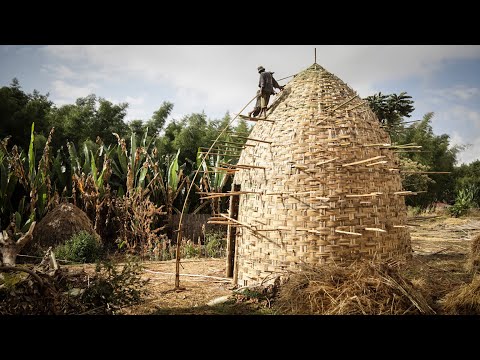

Bamboo is an important building material in many parts of the world. Nowhere are the builders more skilled than among the Dorze in the Rift Valley Mountains in Southern Ethiopia. They have learned to split it and weave it into fantastic beehive houses which will last their occupants a whole lifetime. We have recorded the complete process of harvesting, preparing and building these amazing houses.
Order our new book and help us to continue with this important research. UK and international postage options are available here https://www.nomads.org/Books.html.