




Top videos

He Left America to Live Off the Land in Ghana
He Left America to Live Off the Land in Ghana Kwabena Ofori Osei 45 Views • 2 months ago

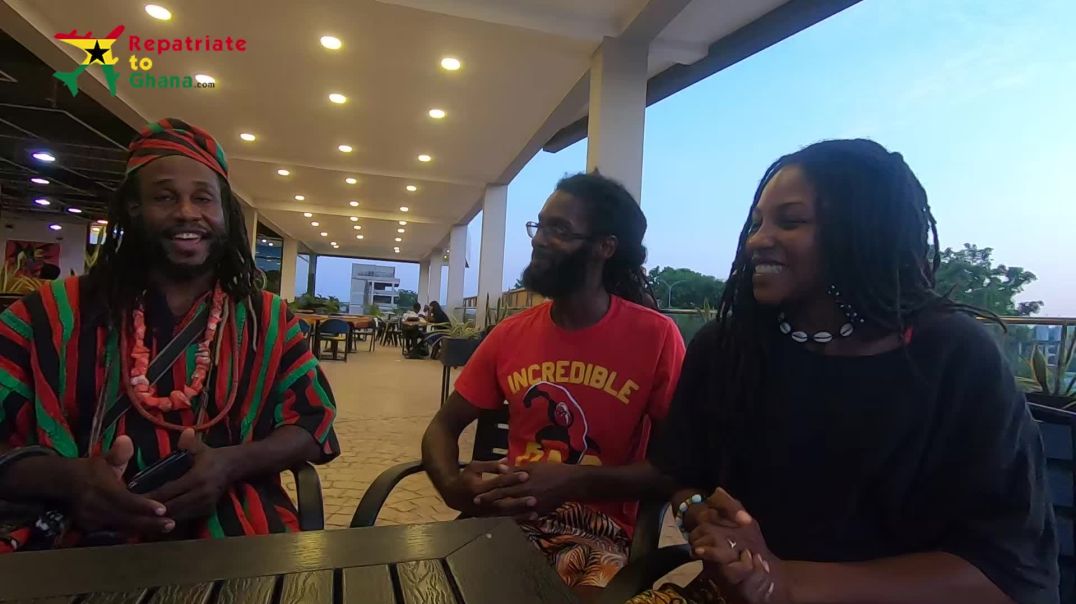
What does it really look like to walk away from the Western world and build a new life rooted in nature?

In this episode, I sit down with Cashawn Myers, Executive Director of the Kweku Andoh Sustainability Institute (KASI), located in Liati Wote in Ghana’s Volta Region.

Originally from the United States, Cashawn made a life-changing decision to move to Ghana and help build a community centered on sustainability, healing, and intentional living.

KASI is not just a place—it’s a model for a different way of life.

Here, they:

Grow most of their own food
Live in alignment with the land
Teach sustainability practices rooted in African knowledge systems
Offer programs focused on healing, wellness, and reconnecting with nature
_______________________________
Support the goal of travel to tell more compelling stories from the African continent.
Zelle: info@ivyprosper.com
_______________________________
Join this channel to get access to perks:
https://www.youtube.com/channe....l/UCgZB3nu4P9BaH0jLW
_______________________________
Are you sending money to loved ones in Ghana, Kenya, Uganda, Tanzania, Nigeria, Senegal, and Liberia? You should try Sendwave! Use my code IPROSPER to get a $10.00 credit towards your first transfer. Download at https://try.sendwave.com/kjap/02nnofcp
_____________________________
Want to support the growth of this channel to bring you more guests and more impactful stories from Africa? No donation is too small. Tap here to show your support: https://www.paypal.com/donate/....?hosted_button_id=QC
_____________________________
Whether you're considering moving to Ghana, or simply want to plan a trip. A CONSULTATION with Ivy Prosper about Ghana may be what you need -
Book 30 MINS:
https://calendly.com/ivyprosper/30min
___________________________
PURCHASE BOOK - 'Your Essential Guide on Moving to Ghana' - https://www.amazon.com/Your-Es....sential-Guide-Moving

The Confession of Nat Turner | Read by Brock Peters [1968] | John Henrik Clarke
The Confession of Nat Turner | Read by Brock Peters [1968] | John Henrik Clarke Ambakisye-Okang Dukuzumurenyi 27 Views • 5 years ago

From the liner notes--read by Brock Peters with Martin Donegan as T. R. Gray


The reading of, "The Confessions of Nat Turner" by the distinguished actor, Brock Peters, represents the first attempt to make Turner, leader of the most massive slave revolt ever to occur in America, known to a large popular audience. A widely circulated novel, recently awarded a Pulitzer prize, was the cause for a number of scholars and critics, black and white, to re-examine the life of Nat Turner and its meaning for today.


The most scholarly book on Turner is Herbert Aptheker's "Nat Turner's Slave Rebellion," (1966). Aptheker reveals that Nat Turner was a "highly intelligent man" of profound religious sentiment who in the struggle for freedom, led a slave revolt in Virginia in 1831 that accelerated — if not initiated — additional and harsher forms of pro-slavery legislation. The basic historical ddcument relating to the Nat Turner revolt is, "The Confessions of Nat Turner" by Thomas R. Gray, published in Baltimore in 1831.


This document was prepared by a white man, Gray, who was not partial to the cause Nat Turner and his fellow slaves were fighting for. But for all of its limitations, The Gray Confessions remains the primary source of information on the most famous slave revolt ever to occur in the United States. The intention of this record is to let Nat Turner speak for himself to the extent that his real views are reflected in his confessions made to Thomas Gray. Gray was the recorder at Nat Turner's interrogation and acted as an officer of the court at his trial. His pamphlet on the Southhampton, Va., slave uprising is the most authoritative document available.


It contains the only biographical record of Nat's life that we have and purports to be an "authentic account" of the revolt. The Nat Turner revolt cannot be understood out of context with the atmosphere of revolt that prevailed throughout the first half of the-nineteenth century. There were hundreds of uprisings and conspiracies preceding the Southhampton, Virginia, uprising led by Nat Turner. The largest of these was the Denmark Vesey conspiracy in Charleston, South Carolina, in 1822. The presentation of The Confessions of Nat Turner on this record is one of the efforts now being made to give the life of Nat Turner an interpretation worthy of his sacrifice. —John Henrik Clarke


PRODUCER'S STATEMENT


In deciding to undertake this recording CMS Records, Inc. endeavored to depict Nat Turner as accurately as possible in light of whatever generally accepted fact exists surrounding the rebellion led by this Afro-American leader. Since the only accurate record of Turner's thoughts, statements and history is THE CONFESSION OF NAT TURNER, as given to Thomas R. Gray, and acknowledged by Turner at his trial, the producers felt that this document should be employed. However the reading of this document, in itself, leaves much to be desired in terms of contemporary English wording and for listening ease. It also must be noted that this confession is precisely that — a legal document! In addition, history, or the thought of Nat Turner, has been handed down to us through the thought, mind and words of Thomas R. Gray, a white attorney. Consequent-ly, the scholar, or any interested person, must of necessity ask several pertinent questions regarding the accuracy of the document itself.

The final part of this recording is a completely unrehearsed discussion by three people (Brock Peters who portrays Turner on this record; Herbert Aptheker—an eminent scholar, historian and writer; and John Henrik Clarke a distinguished scholar and reviewer specializing in materials about Afro-American history and culture). It should be pointed out that this discussion is intended merely to stimulate thought regarding one of the most important and, perhaps, misunderstood rebellions in the history of the United States.


Of significant his-torical import, or perhaps we should say as a postscript, on the very night that the final re-cording was effected, April 4, 1968 at 7:05 P.M. Eastern Time in the recording studio, when the taping was finally finished the participants (as noted above) learned that less than five min-utes before The Reverend Dr. Martin Luther King was assassinated in Memphis, Tenn.

Sankɔfa Journey 2026: Come Home to Ghana | Family Reunion & Interest Meeting
Sankɔfa Journey 2026: Come Home to Ghana | Family Reunion & Interest Meeting Ọbádélé Kambon 46 Views • 1 month ago

https://www.sankofajourney.comJoin us for the Sankɔfa Journey 2026 Family Reunion and Interest Meeting, a powerful introduction to one of the most transformative Black ancestral return experiences in Ghana.For 28 years, the Sankɔfa Journey has guided Abibifoɔ back to the land, culture, language, spirit, food, history, family, and ancestral power of Ghana. This session shares the story of how the journey began, what makes it different from a regular tour, and what travelers can expect in 2026.Sankɔfa Journey 2026 will take place December 11–21, 2026, with guided cultural immersion, historical education, community connection, language orientation, spiritual grounding, and access to the Abibitumi Conference and Abibifahodie Film Festival.This is not tourism. This is return.This is restoration.This is coming back to who we be.Sign up here:https://www.sankofajourney.comABIBITUMI! ABIBIFAHODIE!

How Europe Drew Africa's Borders in a Room — The 1884 Berlin Conference Still Bleeds Today
How Europe Drew Africa's Borders in a Room — The 1884 Berlin Conference Still Bleeds Today Kwabena Ofori Osei 5 Views • 5 days ago

In 1884, fourteen nations sat around a table in Berlin to divide a continent none of them owned. No African leader was invited. No African voice was heard. The borders they drew — through kingdoms, communities, and cultures — still define the map of Africa today. And they are still bleeding.
This is the story of the Berlin Conference of 1884-1885, the room where Europe carved up Africa like a piece of property. From Otto von Bismarck's power plays to King Leopold's private horror state in the Congo, from the doctrine of "effective occupation" that launched the fastest land grab in history to the colonial identity cards that helped fuel the Rwandan genocide a century later — this video traces the full, devastating arc of how a few months of European diplomacy condemned an entire continent to generations of conflict, exploitation, and artificial nationhood.
Before Berlin, Africa was home to empires that rivaled anything in Europe. The Mali Empire, Great Zimbabwe, the Kingdom of Benin, the Ethiopian dynasty — these were not empty lands waiting to be claimed. They were civilizations with histories stretching back centuries. What happened in that room on Wilhelmstrasse was not development. It was theft on a continental scale.
The consequences are not history. They are headlines. Nigeria. Congo. Sudan. Somalia. Rwanda. The borders drawn by men who never set foot in Africa are still shaping who lives, who dies, and who profits.
If you want to understand why the modern world looks the way it does, you have to understand what happened in that room.
Sources and further reading:
— King Leopold's Ghost by Adam Hochschild
— The Scramble for Africa by Thomas Pakenham
— General Act of the Berlin Conference, 1885
— Michalopoulos & Papaioannou, "The Long-Run Effects of the Scramble for Africa" (American Economic Review)
#berlinconference #scrambleforafrica #colonialism #africanhistory #kingleopold #congofreestate #europeanimperialism #bismarck #africaborders #decolonization #panafricanism #coloniallegacy #hiddenhistory #geopolitics #rwandagenocide #africanempires #worldhistory #documentaryhistory #powerandcapital #colonialborders

Nigeria and Biafra (1968)
Nigeria and Biafra (1968) Ambakisye-Okang Dukuzumurenyi 45 Views • 5 years ago

TV special report from 1968 of the Biafran War.from WikipediaThe Nigerian Civil War, commonly known as the Biafran War (6 July 1967 – 15 January 1970), was a war fought between the government of Nigeria and the secessionist state of Biafra. Biafra represented nationalist aspirations of the Igbo people, whose leadership felt they could no longer coexist with the Northern-dominated federal government. The conflict resulted from political, economic, ethnic, cultural and religious tensions which preceded Britain's formal decolonization of Nigeria from 1960 to 1963. Immediate causes of the war in 1966 included a military coup, a counter-coup and persecution of Igbo living in Northern Nigeria. Control over the lucrative oil production in the Niger Delta played a vital strategic role.Within a year, the Federal Government troops surrounded Biafra, capturing coastal oil facilities and the city of Port Harcourt. The blockade imposed during the ensuing stalemate led to severe famine. During the two and half years of the war, there were about 100,000 overall military casualties, while between 500,000 and 2 million Biafran civilians died of starvation.[31]In mid-1968, images of malnourished and starving Biafran children saturated the mass media of Western countries. The plight of the starving Biafrans became a cause célèbre in foreign countries, enabling a significant rise in the funding and prominence of international non-governmental organisations (NGOs). Britain and the Soviet Union were the main supporters of the Nigerian government in Lagos, while France, Israel and some other countries supported Biafra. France and Israel provided weapons to both combatants.

Showing 9 out of 27