




Top videos
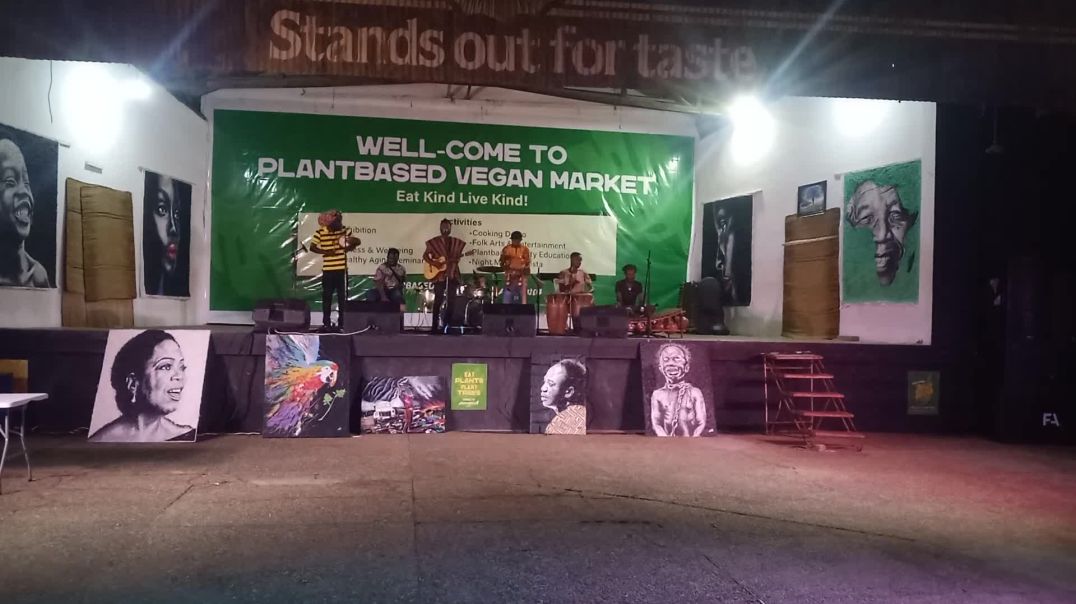
World Vegan Day is 1st November. Watch this segment and take the Healthy Living Challenge at https://NkwaDua.com/challenge for a chance to win money, prizes, and better health.
Ghanaians are shifting the way we think about food and more of us are becoming curious about vegan diets and how to eat more vegan foods.
What is the difference between vegan and vegetarianism
Do you have to give up the foods you love to eat vegan
What is the link between health and diet
The cedis is dropping. How does eating vegan help the Ghanaian economy?
What do the hosts David Kwaku and Apiorkor really think after tasting the food?
In this episode we read selections from "Religion and Other Products of Empire" by Richard A. Horsley. Join Us to learn more.
This episode continues our drive to understanding the need for a new African-centered curriculum for Black children and family units. Ask Us how can you help.
Join Our Discord here: https://discord.gg/TzT4dJN5QK
** DONATE 2 THE SHOW: $bittermedz**
Follow Us on:
Twitter: https://www.twitter.com/bittermedz
Facebook: https://www.facebook.com/BitterMedici...
Instagram: https://www.instagram.com/thebmpodcast
Tumblr: https://www.tumblr.com/blog/bittermedz
Website: linktr.ee/bmpodcast
Follow KWAZ RADIO:
Facebook: https://www.facebook.com/KWAZRADIO/
Instagram: https://www.instagram.com/kwazradio
Twitter: http://www.twitter.com/kwazradio
YouTube: https://goo.gl/a6eXJZ
Website: https://www.kwazradio.com
#TheNewBlackMind
► Subscribe to Transatlantic Productions 💥Smash The LIKE Button👍🏿 Share↗ & hit the Notifications Bell 🔔
► Donate so we can complete the upload https://www.gofundme.com/tapvideo
► Cash App: $Tapvideo $Moneymark0730 $BrotherRonn $LadySapphire5D
► Share on video on all Social Media.
► Website https://tapvideo.blogspot.com
https://www.facebook.com/Tapvi....deocom-7441435789873
► Back up Channels:
https://www.youtube.com/channe....l/UCs9-wRHfFb7v7RQAi
https://www.youtube.com/user/savejamaica
Live News Broadcast from Nigerian Television Authority.
Abuja, Nigeria
More from NTA at
Website: http://www.nta.ng/
Twitter: http://www.twitter.com/NTANewsNow
Facebook:
http://www.facebook.com/NTANetworkNews
Email: enquiries@nta.ng
To license this and other NTA content,
e-mail :licensing@nta.ng, info@nta.ng
And Remember to SUBSCRIBE to our Channel to get updates on Live Streams
In this video, Juliet visits African Queen restaurant in Gambia. She meets the owner Suleiman who has been managing the restaurant for 25 years. Suleiman shares his business expertise with Bla Xit and he explains the wide range of food which is available at African Queen.
Special thanks to Makonnen Sankofa (Bla Xit Cameraman & Video Editor). Subscribe to Makonnen's YouTube channel https://www.youtube.com/channe....l/UCiP8DHZ_eEFLJdOn7
Music in the video: Most Wanted by MPRA Beats https://www.youtube.com/watch?v=tWgaze9Fku4
Please support the Bla Xit channel so we can continue producing more content, you can send a donation via PayPal to bopcollective@yahoo.com
Thanks to our recent Bla Xit donators: Brenda Jenkins, Black Interlude and Siahkennde McCrumada
Become a Bla Xit Messenger (Subscribers only) by sending your video clip to blaxithome@gmail.com
Special thanks to our friend and YouTube Vlogger Wode Maya for helping to set-up the Bla Xit channel. You can follow him on YouTube too https://www.youtube.com/user/MrGhanaBaby
On 2 October 1958, Guinea became the first of France’s colonial territories in Sub-Saharan Africa to declare its independence in an act of defiance against its former colonial master.
Ahmed Sekou Toure, known as a charismatic and radical figure in Africa's post-colonial history, was the leader of the country at the time and he was driving this rebellion by the former French Colony.
However, Guinea and Sekou Toure, achieved this status of independence against the wishes of its former colonial master, France, and afterwards the nation faced an onslaught of administrative and diplomatic assault by the French which seemed to have been designed to drive the country to its knees.
The french colonial elite in Paris got so furious with Sekou Toure’s defiance, such that in an act of fury the french administration in Guinea destroyed everything in the country which represented what they called the benefits from french colonization.
After this whole fiasco, Toure would go on to rule the country of Guinea for 26 years, and his time in power and legacy divided opinions.
In this episode of African Biographics, we look at the life and legacy of Ahmed Sekou Toure, Guinea’s first president who stood up to the French, and his time in power as the leader of that country.
****************************************************************************
Sources:
The State of Africa Since Independence by Martin Meredith (2011)
THE CHALLENGE OF GUINEAN INDEPENDENCE, 1958-1971 by Mairi Stewart MacDonald (2009)
FIGHTING TALK: THE INDEPENDENT STATES OF AFRICA ,November 1961
The historical basis of French actions in Africa
https://www.britannica.com/biography/Sekou-Toure
https://www.encyclopedia.com/p....eople/history/french
https://www.tandfonline.com/do....i/full/10.1080/14682
https://face2faceafrica.com/ar....ticle/the-speech-by-
https://www.nytimes.com/1984/0....3/28/obituaries/ahme
https://www.google.com/amp/s/w....ww.africanexponent.c
https://www.google.com/amp/s/w....ww.theafricareport.c
^***************************************************************************
Music:
Lamentation Kevin MacLeod (incompetech.com)
Licensed under Creative Commons: By Attribution 3.0 License
http://creativecommons.org/licenses/by/3.0/
Heartbreaking Kevin MacLeod (incompetech.com)
Licensed under Creative Commons: By Attribution 3.0 License
http://creativecommons.org/licenses/by/3.0/
Kumasi Groove by Kevin MacLeod is licensed under a Creative Commons Attribution 4.0 licence. https://creativecommons.org/licenses/by/4.0/
Source: http://incompetech.com/music/r....oyalty-free/index.ht
Artist: http://incompetech.com/
Desert City by Kevin MacLeod is licensed under a Creative Commons Attribution 4.0 licence. https://creativecommons.org/licenses/by/4.0/
Source: http://incompetech.com/music/royalty-free/index.html?isrc=USUAN1100564
Artist: http://incompetech.com/
*****************************************************************************
Feel free to reach out to us at africanbiographics@gmail.com
What if your brain at 77 were as plastic as it was at 7? What if you could learn Mandarin with the ease of a toddler or play Rachmaninoff without breaking a sweat? A growing understanding of neuroplasticity suggests these fantasies could one day become reality. Neuroplasticity may also be the key to solving diseases like Alzheimer’s, depression, and autism. In this program, leading neuroscientists discuss their most recent findings and both the tantalizing possibilities and pitfalls for our future cognitive selves.
PARTICIPANTS: Alvaro Pascual-Leone, Nim Tottenham, Carla Shatz
MODERATOR: Guy McKhann
MORE INFO ABOUT THE PROGRAM AND PARTICIPANTS: https://www.worldsciencefestiv....al.com/programs/nuts
This program is part of the BIG IDEAS SERIES, made possible with support from the JOHN TEMPLETON FOUNDATION.
- SUBSCRIBE to our YouTube Channel and "ring the bell" for all the latest videos from WSF
- VISIT our Website: http://www.worldsciencefestival.com
- LIKE us on Facebook: https://www.facebook.com/worldsciencefestival
- FOLLOW us on Twitter: https://twitter.com/WorldSciFest
TOPICS:
- Opening film 00:00
- What is neuroplasticity? 03:53
- Participant introductions 04:21
- Structure of the brain 05:21
- Is the brain fundamentally unwired at the start? 07:02
- Why does the process of human brain development seem inefficient? 08:30
- Balancing stability and plasticity 10:43
- Critical periods of brain development 13:01
- Extended human childhood development compared to other animals 14:54
- Stability and. plasticity in the visual system 17:37
- Reopening the visual system 25:13
- Pros and cons of brain plasticity vs. stability 27:28
- Plasticity in the autistic brain 29:55
- What is Transcranial magnetic stimulation (TMS) 31:25
- Phases of emotional development 33:10
- Schizophrenia and plasticity 37:40
- Recovery from brain injury 40:24
- Modern rehabilitation techniques 47:21
- Holy grail of Neuroscience 50:12
- Enhancing memory performance as we age 53:37
- Regulating emotions 57:19
PROGRAM CREDITS:
- Produced by Nils Kongshaug
- Associate Produced by Christine Driscoll
- Opening film written / produced by Vin Liota
- Music provided by APM
- Additional images and footage provided by: Getty Images, Shutterstock, Videoblocks
This program was recorded live at the 2018 World Science Festival and has been edited and condensed for YouTube.
The dark side of the world’s fashion addiction. Many of our old clothes, donated
to charities, end up in rotting textile mountains in West Africa. This is a story
about how our waste is creating an environmental disaster.
Have you ever thought about what happens to your old clothes after you drop them off at the
op shop? It might be time to start, because these goodwill gestures are helping to fuel an environmental catastrophe on the other side of the world.
When charities in Australia can’t sell donated clothing, tonnes of it ends up being exported to
countries like Ghana, in West Africa. Ship after ship docks every week with bales from Europe,
the US, China and Australia.
They call them ‘Dead White Man’s Clothes’. Once they arrive in Ghana, they’re taken to the
bustling Kantamanto markets in the capital Accra and from here, they make their way to
villages and towns across the country.
The industry provides jobs for thousands of people, like Asare Asamoah, a successful importer.
He brings in clothes, mainly from the United Kingdom, and if they’re good quality, he can make
a decent living.
But it’s risky business. He has to pay upfront for a bale and never knows whether it’s trash or
treasure. With cheap, fast fashion flooding the world, the quality of the clothes arriving in
Ghana is getting worse and worse.
‘Sometimes you’ve gone and bought something, then you don’t get what you want’, says
Asamoah. ‘Then you lose your money.”
And there’s a dark side to this industry.
Correspondent Linton Besser travels to Ghana to uncover the dirty secret behind the world’s
fashion addiction.
While 60 per cent of imported fashion items are reused and resold, 40 per cent are rubbish,
creating an environmental catastrophe for this poor nation.
With the main dumpsite for textile waste now full, unregulated dumpsites ring the city. These
fetid clothes mountains are often set on fire, filling the skies with acrid smoke.
‘It is totally a disservice to us in this part of the world because we have become sort of the
dumping ground for the textile waste that is produced from Europe, from the Americas”, says
Accra’s waste manager, Solomon Noi.
Emmanuel Ajaab imports used clothes from Australia but he despairs at the poor quality of the
clothes that arrive. From a bale of about 200 garments, he finds only seven he can resell at a
good price.
“In Europe and UK and Australia, America, they think Africa here, sorry to say, we are not like a
human being”, he tells Foreign Correspondent.
The dumped textiles also get swept up in the monsoonal rains and end up choking the city’s
waterways and beaches, posing a danger to fishermen and aquatic life. Liz Ricketts, who runs
an NGO campaigning for awareness of Ghana's textile waste crisis, lays the blame at the feet
of international fashion houses.
“Waste is a part of the business model of fashion. A lot of brands overproduce by up to 40 per
cent”, says Ricketts.
Noi begs the people who donate their clothes to think twice about where they end up.
“If they come here, like you've come, and you see the practicality for yourself, then they will
know that, no, we better take care of these things within our country and not to ship that
problem to cause problems to other people.”
About Foreign Correspondent:
Foreign Correspondent is the prime-time international public affairs program on Australia's national broadcaster, ABC-TV. We produce half-hour duration in-depth reports for broadcast across the ABC's television channels and digital platforms. Since 1992, our teams have journeyed to more than 170 countries to report on war, natural calamity and social and political upheaval – through the eyes of the people at the heart of it all.
Contributions may be removed if they violate ABC’s Online Terms of Use http://www.abc.net.au/conditions.htm (Section 3). This is an official Australian Broadcasting Corporation YouTube channel