- General Videos
- Music
- Economics
- Health
- Travel & Events
- History
- Psychology
- Spirituality
- Movies
- News & Politics
- Kmtyw Combat Sciences
- Ɔbenfo Ọbádélé Kambon Videos
- Ɔbenfoɔ Kamau Kambon: Black Liberation Philosophy
- Science, Tech, Engineering and Math
- Permaculture
- Self-Sustainability
- Living Off Grid
- Yoruba Language Learning
- Education
- Mmɔfra Adesua
- Nana Kamau Kambon Playlist
- Livestream
- Komplementarity Kouples and Revolutionary Singles
- Abibitumi Film Series
- Decade of Our Repatriation
- Kwento xpr
- Live
Top videos


Buy " THE BLACKEST JOY" Album https://akuanaru.lnk.to/TheBlackestJoy
WHEN THE JOY COMES-TOUR tickets: https://kj.de/artist/4684/Akua_Naru.html
"My Mother’s Daughter" is the first single release off Akua Naru’s third and forthcoming studio album "...The Blackest Joy" (Spring 2018). The song, at times dark and mystical, at others bright and full of hope, is a rich narrative of black womanhood, agency, West African spirituality, lineage, and sisterhood. With West African influences, as evidenced by the song's introduction and its additional vocals (spoken & sung completely in Mina), Naru, once again, merges genres along the black music tradition and glides effortlessly between soul, jazz, and hip-hop.
Filmed in Lome, Togo, West Africa and directed by Hamburg based artist Joachim Zunke, the video, to be continued, highlights Akua Naru, the mystic/ the traveler, and documents the marriage of her inner and outer worlds. A visual homage to black womanhood on the African continent and in the diaspora.
---Deutsch---
"My Mother's Daughter" ist die erste Single aus Akua Narus drittem Album "…The Blackest Joy", das im Frühling 2018 erscheint. Der Song ist mystisch und zugleich hell und hoffnungsvoll. Er erzählt eine Geschichte über schwarze Weiblichkeit und westafrikanische Spiritualität. Letztere spiegelt sich auch in der Musik, im Intro und den Vocals, komplett in Mina vorgetragen. Akua Naru’s Hip Hop Musik ist zeitlos und repräsentiert den Reichtum und die Schönheit afro-amerikanischer Tradition und Kultur.
Der Hamburger Regisseur Joachim Zunke hat das Video in Lomé in Togo/Westafrika gedreht. Es stellt Akua Naru als Mystikerin und Wanderin dar und lässt ihre inneren und äußeren Welten verschmelzen: eine visuelle Hommage an afrikanische Weiblichkeit in Afrika und der Diaspora.
---Francais---
"My Mother's Daughter" est le premier single du troisième album d'Akua Naru "... The Blackest Joy" (Printemps 2018). La chanson, tantôt sombre et mystique, tantôt brillante et pleine d'espoir, est un riche récit de féminité noire, de spiritualité d'Afrique de l'Ouest, de lignage et de fraternité. A l’origine, influencé par un chant d'Afrique de l'Ouest, comme en témoigne l'introduction de la chanson et des voix supplémentaires (parlé et chanté complètement en Mina), akua naru fusionne encore les genres de la musique traditionnelle africaine au jazz et au hip-hop. Filmée à Lomé au Togo (Afrique de l'Ouest), réalisée par Joachim Zunke, et produite par Elom 20ce et Jahëna Louisin, cette vidéo est la première d’une série. Elle met en lumière Akua Naru, le mystique / le voyageur : un hommage visuel à la féminité noire sur le continent africain et dans la diaspora.
VISIT AKUA NARU:
FACEBOOK: https://www.facebook.com/akuanaru/
INSTAGRAM: https://www.instagram.com/akuanaru/?hl=en
TWITTER: https://twitter.com/akuanaru



A film by Callum Macrae & Elizabeth Jones
It's one of Africa's most bitter, if often forgotten, conflicts.
In 2011, South Sudan gained independence from Sudan following a 2005 peace deal that ended Africa's longest-running civil war.
After a referendum, in which an overwhelming majority of South Sudanese voted to secede, Africa's newest country came into being, the first since Eritrea split from Ethiopia in 1993.
But two Sudanese provinces, South Kordofan and Blue Nile, the people of which predominantly wanted to become citizens of the new nation, were excluded from the deal.
The SPLM-N, the northern affiliate of Sudan's People's Liberation Movement (SPLM) in South Sudan, consequently took up arms against the Sudanese government of President Omar al-Bashir, and fighting has continued on and off ever since.
Five years ago, as the war got under way, People and Power sent reporter Callum Macrae to investigate allegations of war crimes committed by the Bashir regime in the region. Last month he went back.
- Subscribe to our channel: http://aje.io/AJSubscribe
- Follow us on Twitter: https://twitter.com/AJEnglish
- Find us on Facebook: https://www.facebook.com/aljazeera
- Check our website: http://www.aljazeera.com/


'Repatriate To Ghana'www.R2GH.comObenfo Obadele Kambon is a world-renowned master linguist, scholar and the architect of Abibitumi the oldest and largest Black social education network on the planet.In Part 6 of this powerful discussion, Obenfo Obadele Kambon explains how translating ancient texts led him to recognize deep cultural similarities between ancient Kemet and African American culture.Please click link below to learn more about Obenfo Obadele Kambon and his work:https://www.repatriatetoghana.....comhttps://www.abibi


A documentary on the cultivation, harvest and exportation or distribution of Cashew in Ghana produced by Platinum Live and directed by Enoch Nana Akuoko for Kingdom Exim Group of Companies, Ghana's leading exporter of Cashew.
#cahsewproduction #platinumlivegh #kingdomexim #enochnanaakuoko #accra #sampa #wenchi #tenchiman #cashew #farming #agriculture



"Brooklyn to Benin: A Vodou Pilgrimage"
Director: Régine Romain
Assistant Director: Olatoundji Fagbenro
Executive Producer: Régine Romain
Producers: WaWaWa Diaspora Centre and Trinity Empire
________________________________________________________________
"Brooklyn to Benin: A Vodou Pilgrimage" begins with an aerial view of the Route des Esclaves (Slave Road) in Ouidah, which terminates at the Atlantic Ocean. Millions of captured Africans were shipped off into slavery for hundreds of years from this location in Benin (formerly Dahomey), West Africa. In tandem to the shifting gaze from the road to the ocean, a traditional prayer is spoken in Fon, an indigenous language of the region, and is performed by Adissowé, a Vodou high priestess.
As the invocation honors the four corners of the earth and offers reverence to the mysteries of nature, a woman emerges into view. She is a daughter from the other side of the water, who has now returned to the original homeland of her Haitian ancestors. The viewers follow her slow steady walk across Ouidah beach, as she becomes the narrator and offers the historical context of the film, free of the traditional Western bias and stereotypes of Vodou and its practitioners.
The narrator is Régine Romain and she shares her three-year journey documenting the survival of traditional African religion in the Americas. Still photographs of ceremonies and shrines in Brooklyn, NY; southern United States; Central America; and Haiti are displayed. The camera then trails the narrator as she enters a shrine for Aïda Wedo, an ancient Mami Wata divinity amidst the evocative sounds of a Haitian folksong for the exact same deity, affirming that the spirits of Vodou “c’est bon,” are good.
Viewers continue to follow her journey across the sands toward the historic Door of No Return. Each step is a powerful affirmation that she is a descendent of survivors. As the narrator states “honor one’s God fearlessly,” her footsteps fade into a montage of women in traditional dress, singing and dancing in praise and devotion. “Brooklyn to Benin” creates an alternative cinematic experience of Vodou grounded in honor and respect.
Support the journey: www.gofundme.com/BktoBenin.com
Follow the journey: Instagram [Regine Romain]
www.REGINEROMAIN.com
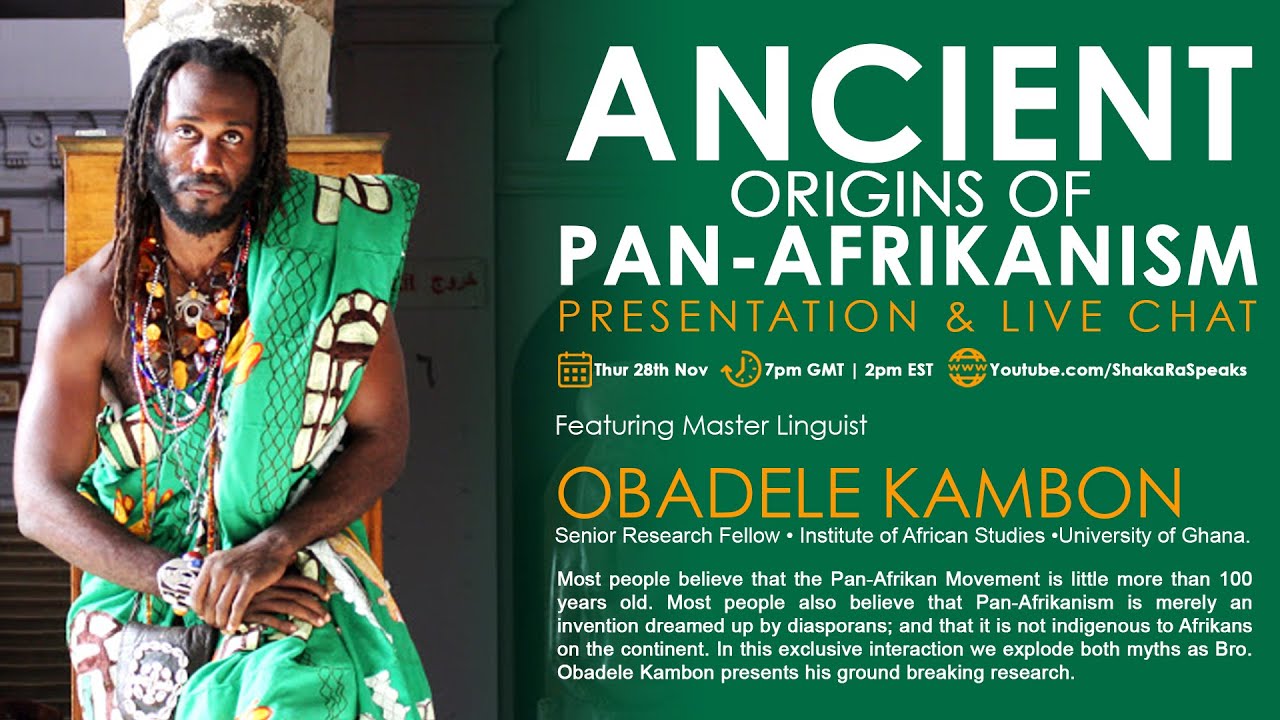

ANCIENT ORIGINS OF PAN-AFRICANISM
Full presentation: https://abibitumitv.com/v/zshjdk
Most people believe that the Pan-Afrikan Movement is little more than 100 years old. Most people also believe that Pan-Afrikanism is merely an invention dreamed up by diasporans; and that it is not indigenous to Afrikans on the continent. In this exclusive interaction we explode both myths as Bro. Obadele Kambon presents his ground breaking research.
Featuring Master Linguist
OBADELE KAMBON
Senior Research Fellow • Institute of African Studies •University of Ghana.


Follow us on the day we arrive in the beautiful Sierra Leone.
Thanks to our Sponsors Crafted Marketing Solutions, Zina Craft and Fambultik Tours, Amadu M****ally.
Thank you for your contributions to Bla Xit we are going places Bla Xit family. Thank you for your support thoroughout 2019 and I hope your ongoing support through 2020. This is our decade to go back to our roots. Please continue to support us via Paypal using BopCollective@yahoo.com or via https://www.patreon.com/join/Blaxit


Can spirituality restore Afrikan woman leadership to it’s rightful place?
full breakdown: https://alkebulan.org/2018/02/26/womenleadership/
1) Why does so little commentary about women in the movement focus on spirituality?
2) How do we develop a politicised Afrikan-Centered Spiritual world-view”?
3) Why does so little commentary about women in the movement focus on spirituality ?
4) What are the stages of Development for Afrikan women?
5) Is there an equivalent for Afrikan men?
Our very special guest:
Mama Marimba Ani: Is an Afrikan-Centered Cultural Scientist, engaged in the reconceptualization of the Afrikan Experience from the perspective of Afrikan people and also is known for introducing the term “Maafa” to describe what is known as the Afrikan Holocaust. She served as an SNCC field secretary in the Freedom Summer of 1964 and was later brought to Hunter College in the City University of New York, under the tutelage of Nana Dr. John Henrik Clarke, where she taught for 25 years. A partial list of the courses that she delivered include: Afrikan Civilization; Afrikan Spirituality in the Diaspora; Women in Afrika; Women in the Afrikan Diaspora; Men in the Afrikan Diaspora; Afrikan Spiritual Thought Systems; The Afrikan World View; The Work of Cheikh Anta Diop; The Work of Ayi Kwei Armah; Theories of White Racism.
In addition, she created the Maat/Maafa/Sankofa Paradigm as part of the development of an Afrikan Cultural Science and Social Theory. She is the founding director of the Afrikan Heritage Afterschool Program (AHAP) in Harlem New York (1983-1998) and after leaving the academy now directs this programme in Atlanta. Mama Marimba is an active member of Us Lifting Us, an Afrikan/Black economic cooperative, and the Association for the Study of Classical Afrikan Civilizations. She is author of a number of ground breaking books: Let the Circle Be Unbroken: The Implications of African Spirituality in the Diaspora (1989); Yurugu: An African-centered Critique of European Cultural Thought and Behavior: African-Centered Critique of European Thought and Behavior (1994). Ideologically, Mama Marimba considers herself “a Garveyite, An Afrikan Sovereignist, and a Race Woman” and in Mosiah 2015 Mama Marimba was appointed the UNIA-ACL Ambassador of Race First Sovereign Development.


In this reasoning Rastafari dub poet, musician, actor, educator, and radio host Mutabaruka speaks reliving the horror and pains of our ancestors while acting in the movie 'Sankofa'.
Mutabaruka goes on to explain how he gained a clear understanding of the quagmire Africans were in while enslaved in the Americas.
Please subscribe to Mutabarukas' new internet radio station Rasss Internet:
https://rasssinternet.today
Get Your 'Nyahbinghi Shirt' Today:
https://koncioust.com/products..../queen-muhumusa-empr
Tune into 'I NEVER KNEW 📻'
🇲🇱Roots, Rock, Reggae Music🇲🇱
Hosted By : Jr of 'I Never Knew Tv'
https://www.WLOY.org
Sunday 9 -11 AM EST
Wednesday 8- 10 AM EST
Thursday 10- Noon AM EST
#mutabaruka #sankofa